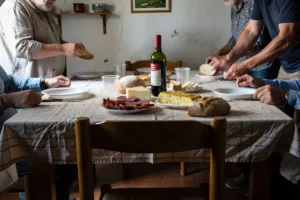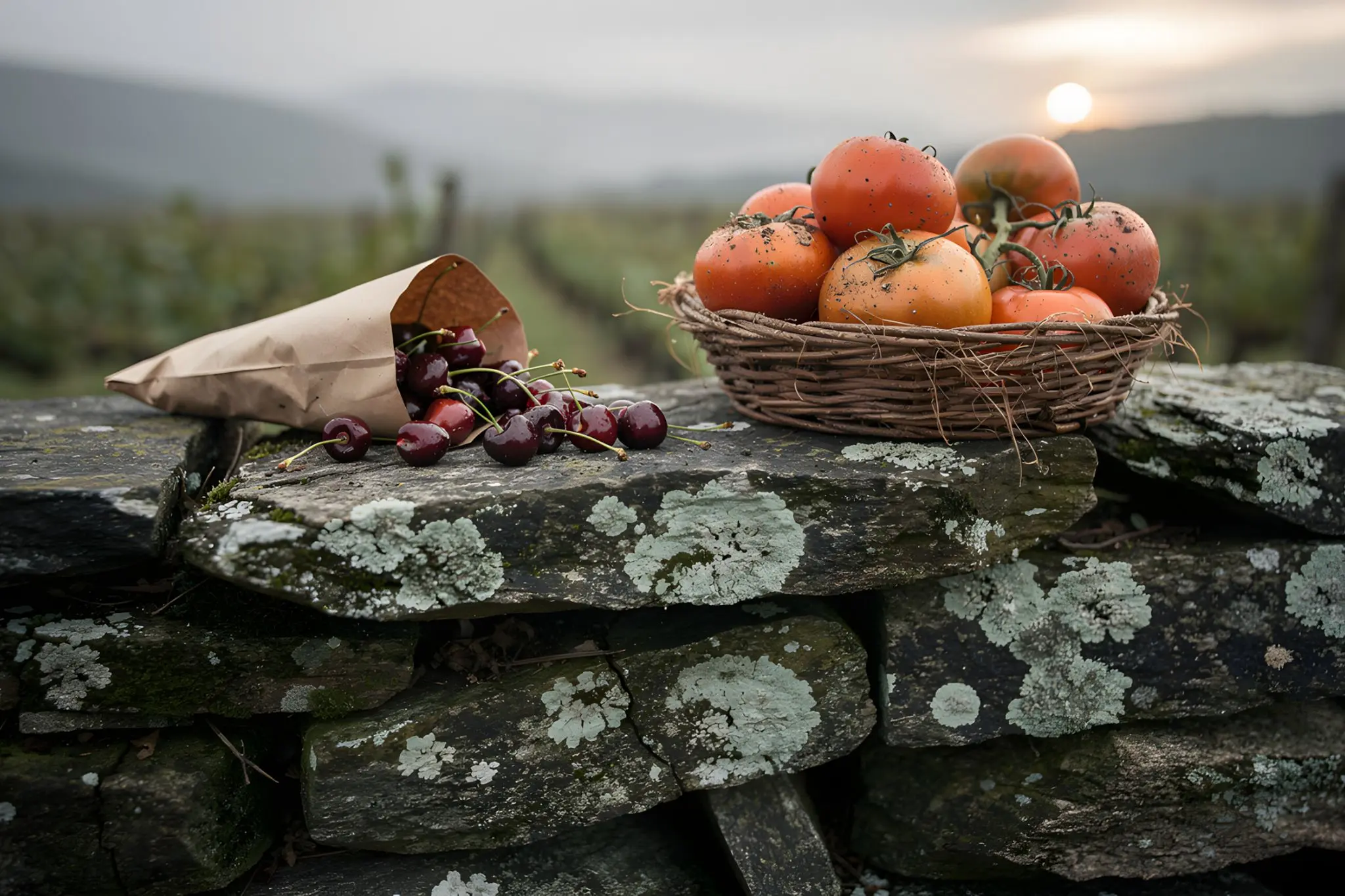
The first food you eat in Ribeira Sacra often arrives before you have ordered anything. A neighbour leaves a bag of tomatoes on a wall. Cherries appear in a paper cone, handed over a fence in early June. Chestnuts roll into the path in October and nobody picks them up because everyone already has more than they need. A glass of wine is poured before you have decided whether you wanted one. Bread is on the table before the menu is. None of this is hospitality in the commercial sense. It is what happens when a territory has not yet fully separated production from consumption.
That separation is the unspoken premise of most European food culture. The vegetable comes from a supplier, the cheese from a distributor, the wine from a list. The chain is long, the actors are specialised, and the romance of “local” is something the consumer has to actively pay for. In Ribeira Sacra the chain is shorter — less because anyone designed it that way than because depopulation, fragmented land ownership, and a stubborn domestic food economy have kept it short. The result is a gastronomy that reads more clearly as a continuity than as a scene. There are restaurants, and some of them are very good, but they sit on top of something older and more important. The table here begins outside the restaurant.
Wine as Grammar
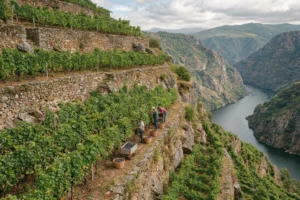
To talk about food in Ribeira Sacra without starting with wine would be a mistake of category, not just order. Wine is not a pairing here. It is the grammar of the meal — the thing that organises when people sit down, how long they stay, what gets passed around, and how the afternoon ends. Vineyards shaped where villages stood. Monastic terraces structured agricultural labour for a thousand years. Family wine production continued well outside the Ribeira Sacra DO economy, and in many houses still does. Furanchos — those licensed seasonal outlets selling off domestic surplus — are not a survival in the folkloric sense, but a legal frame around a habit that simply never went away.
What is unusual is how non-performative the wine culture remains. There is comparatively little tasting ritual at the everyday level. Glasses are filled without ceremony. The mencía is not introduced; it is poured. This is not the absence of sophistication — the wines themselves are increasingly precise, parcel-driven, and serious — but the absence of the theatre that usually accompanies wine regions of comparable quality. The drinking happens close to the producing, and the producing happens close to the eating, and the chain is short enough that nobody feels obliged to narrate it.
Galicia Pays for Galicia
One of the more counterintuitive things about food shopping in Galicia is that origin can outrank price in the order of questions asked. In a supermarket in Monforte de Lemos or Chantada you will see Galician provenance flagged on the label — ternera gallega, porco celta, Galician cheese, Galician honey — and you will see it move at a real premium. This is not the same as the “local” label in Berlin or Copenhagen, which is largely ideological and middle-class. Here it works differently. People pay more for Galician because they understand the supply chain it implies: a smaller producer, a known butcher, a cousin or a neighbour or a village they have heard of. The premium reflects trust in proximity, not a value system about it.
This carries down to the level of the village butcher, the producer’s market, the box of vegetables from a relative outside Ferreira de Pantón, the cheese brought back from a feira in Lugo province. Origin is the first filter; price is the second. In much of Europe, local food became an ideology dressed up as a consumer choice. Here it never fully stopped being logistics. The distinction matters because it explains why a region with comparatively few high-end gastronomic destinations nevertheless has a remarkably consistent food culture at the everyday level. The competence is in the supply chain itself.
Pork as Infrastructure
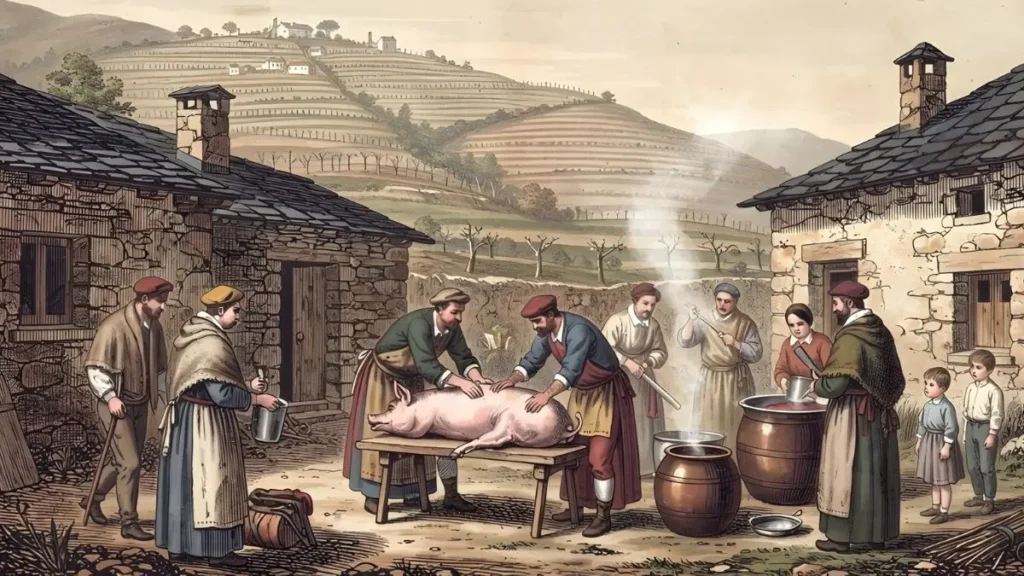
The pig used to organise the year. The matanza, the winter slaughter, was the central productive event of the rural household — a day or two of communal labour that turned a single animal into the family’s caloric reserve until spring. Sausages, lacón, cured shoulder, rendered fat for cooking, blood preparations, smokehouse cycles. None of it was decorative. The pig was infrastructure, in the same way a well or a bread oven was infrastructure.
That economy is in clear retreat. Home slaughter has been increasingly regulated, the older generation that ran it is ageing out, and many of the smokehouses have gone cold. The recovery of the porco celta, the autochthonous Galician breed, has reintroduced the animal at the level of restaurants and a handful of producers — genuinely good news for the breed and arguably less good news for the cultural form. The animal is back. The communal labour that surrounded it mostly isn’t. Treating matanza as folkloric heritage, the way coastal Galicia sometimes treats queimada, risks aestheticising what was a caloric strategy under economic pressure. The visitor who eats a plate of well-cured chorizo in a casa rural in 2026 is eating the surviving register of a system that used to be much broader and much closer to the ground.
Broths, Bones, Climate
The climate writes the menu more than any chef does. Ribeira Sacra, despite its canyon-warmed pockets and its terraced Mediterranean light, is fundamentally Atlantic. The winters are wet, the houses are made of stone, and the agricultural labour was historically calorically expensive. The result is a foundational respect for broth that has nothing to do with the recent global rehabilitation of bone stocks as a wellness product.
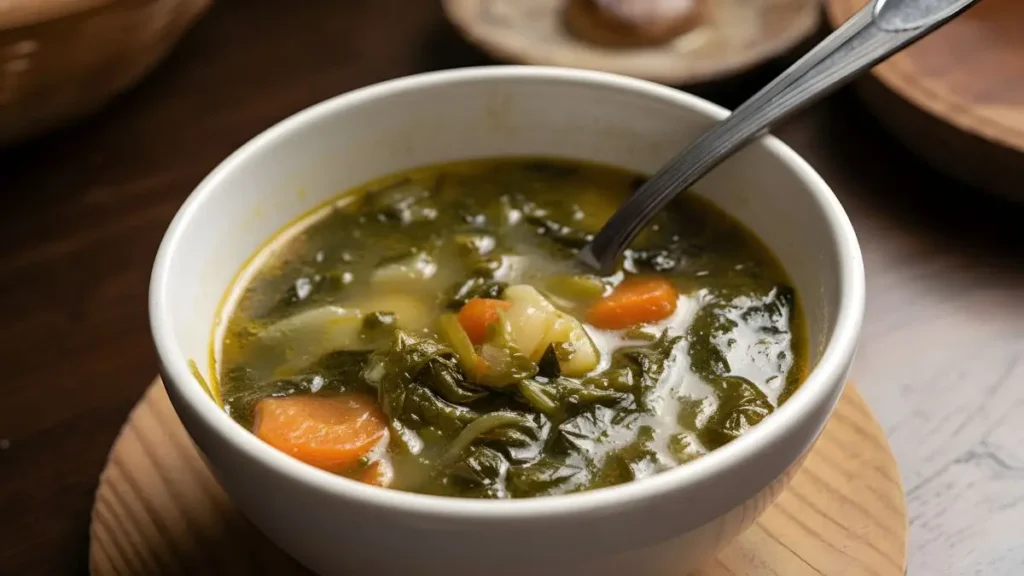
Caldo galego, with its grelos, white beans, and pork fat, is the most legible example, but it is one of many. Broths of verzas, of bones boiled for hours, of bean liquid stretched across two meals — these dishes survive because they still solve a problem. They warm a cold stone kitchen. They use what would otherwise be wasted. They feed someone who has spent the morning outside. The clearest evidence of how alive this register remains is the Festa do Caldo de Ósos in Taboada — a Carnival-weekend festival, now in its thirty-fourth edition, built around a thick broth of pork spine bones, chickpeas, and potatoes that was traditionally cooked on the second day of the matanza to use up what was left. The prestige of broth in Galicia comes from continuity, not from nostalgia, and the difference shows: it is served unceremoniously, often as a starter at lunch, and nobody calls it slow food because nobody had ever stopped doing it.
Empanada and the Invisibility of Competence
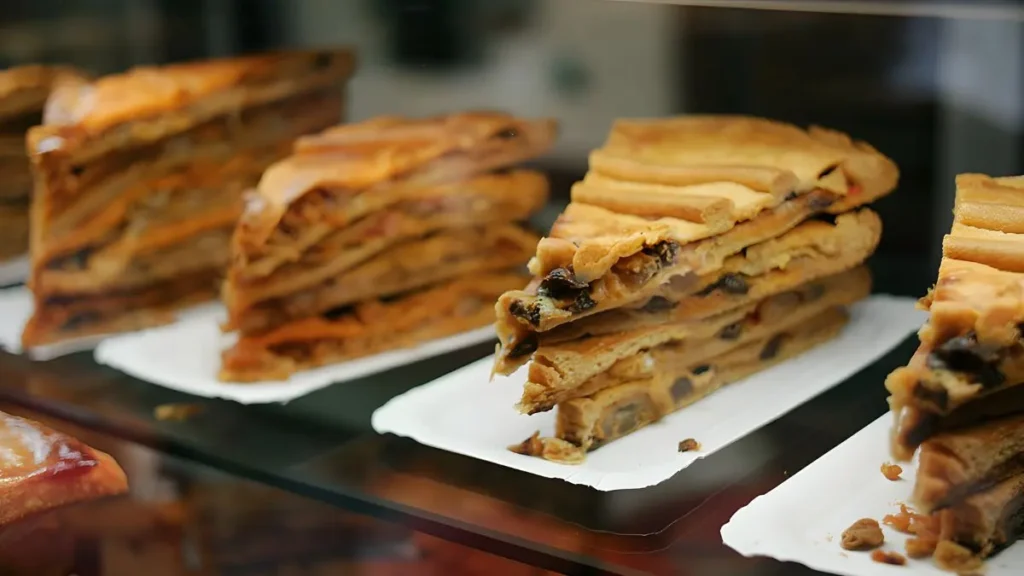
If there is one dish that captures the territory’s everyday excellence, it is the empanada. It is portable, scalable, inexpensive, and remarkably consistent across the region. A good empanada from a village bakery in Sober or A Pobra do Brollón will cost less than a glass of wine in central Madrid, and will be better than most things you eat that week. Tuna, meat, zorza, xoubas, vegetables, cod — the fillings rotate, the form holds, the dough is taken seriously without anyone making a fuss about it.
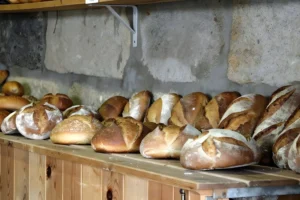
The interesting thing about empanada, and about bread more generally here, is that the quality is invisible. Nobody discusses it because competence has become baseline. Visitors used to assuming that good bread requires either a craft narrative or a high price often miss what is in front of them. The empanada is not a revival form. It is workers’ food, road food, feira food, and Sunday lunch food, sustained by a network of village bakeries that never closed. It is also, quietly, one of the things you should make sure to eat here.
The Feira: Pulpo, Cheese, the Counter
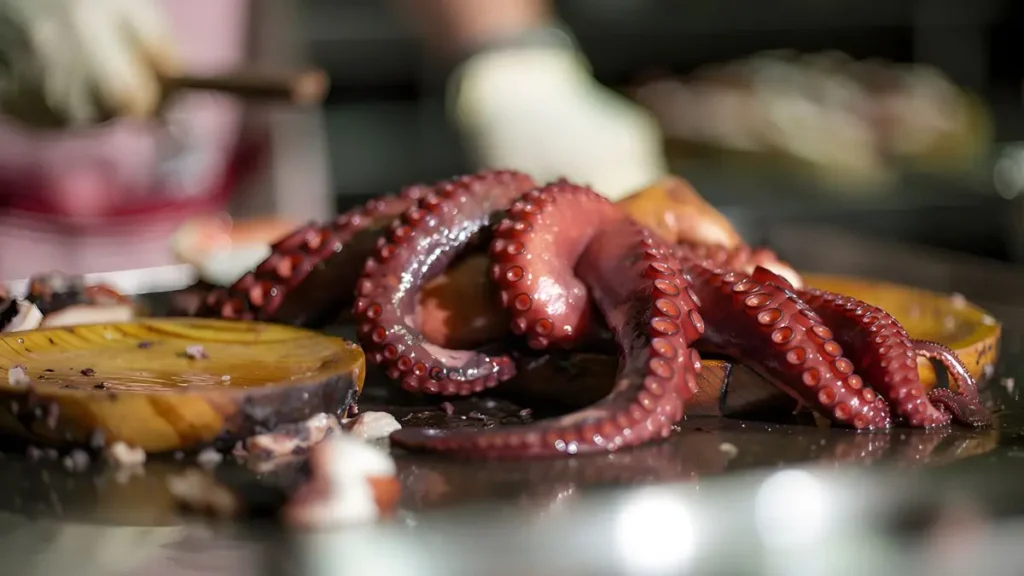
The other place to read the territory’s food culture is the feira — the rotating regional markets that move between Monforte de Lemos, Chantada, Castro Caldelas, and a dozen smaller towns on fixed days each month. The pulpeiras set up their copper cauldrons in the morning, and by lunchtime you eat octopus from a wooden plate, dressed with coarse salt, pimentón, and Galician olive oil, with bread and a glass of mencía. That pulpo is not coastal nostalgia: the inland feira is in fact where pulpo á feira got its name. The trade route from the Atlantic ports inland made dried and rehydrated octopus a feira staple long before it became a national reference dish.
The cheese stalls are the other steady fixture. Queixo do Cebreiro, the mushroom-shaped DOP from the Lugo mountains just east of the territory, sits next to the softer Galician Tetilla and a rotation of fresh and cured varieties from smaller producers who work farmhouse scale and turn up irregularly. None of it is positioned. It sits on the counter at a price that reflects what it costs to make. The honey is local, the bread is local, the empanada is local, the cured pork is local. The feira works because origin is the assumption, not the marketing.
What the Land Still Hands Over
The pillar of this whole argument — what makes Ribeira Sacra’s food culture different from a “destination” one — is that the territory still produces edible abundance outside the market. Cherries in late spring. Apples and figs through summer. Walnuts and grapes and chestnuts in autumn. Mushrooms when the rains arrive. Wild greens, herbs, garden vegetables at the scale where a single household produces more than it can use, and the surplus moves sideways through families and neighbours rather than upward into commerce.
This is not a return-to-the-land fantasy. It exists for unromantic reasons. Land ownership in the canyons is heavily fragmented, much of the productive landscape is low-intensity by necessity rather than choice, the rural population is older than it should be, and the formal agricultural economy has been retreating for half a century. The abundance is a side effect of incomplete monetisation. Plots that would have been consolidated into industrial production elsewhere remained too small, too steep, or too inherited to bother with. So the cherry tree at the edge of a property line keeps producing, and someone hands you a bag because there is no other use for them.
The system is fragile. Abandonment is visible — terraced vineyards going back to scrub, chestnut groves unmanaged, gardens not replaced when the person tending them stops. The territory feeds itself, for now, partially, and the conditions that make it possible are not stable. But the present-tense version is real. Much of Ribeira Sacra still behaves like a lived agricultural system rather than a fully monetised landscape, and that fact is the most important thing on the plate.
The Restaurants, Honestly
There are excellent restaurants in Ribeira Sacra. There are also not very many of them relative to the territory’s size, and in summer the better ones book out weeks in advance. Some are open only Thursday to Sunday. Some close for two weeks in November and reopen on no announced schedule. Some are an hour’s drive from where you are staying, on roads that take longer than the map says. This is not a hidden gastronomic capital waiting to be discovered. It is a working rural territory with a thinly distributed restaurant sector, and the visitor who arrives expecting a San Sebastián density of options will find them missing.
The scarcity has reasons — low population, labour shortages, seasonality, the simple fact that the food culture here evolved to feed residents first and visitors second. It is also, accidentally, why the territory still feels intact. The lack of a hyper-developed hospitality infrastructure has kept the place from being reorganised around tourism, and the consequence is that what you eat here is closer to what people eat here. The table evolved to feed the household. It is willing to feed you too, if you can find a seat.
A Territory That Still Eats Like a Territory
What unites all of this — the wine, the pork, the broth, the empanada, the pulpo at the feira, the queue at the village bakery, the closed sign on Tuesday afternoon — is that gastronomy in Ribeira Sacra has not yet fully detached from the territory that produces it. That is its defining feature, and increasingly in Europe, a rare one. The interest of the place is not innovation. It is proximity. The interest is not that the food here is better than elsewhere, though some of it is, but that the distance between source and plate remains unusually short, and visible, and legible to anyone willing to slow down enough to see it.
Whether this holds for another generation is not certain. But the present-tense version is here, and it is worth eating, and worth understanding for what it is rather than for what a hospitality industry might eventually turn it into.
The table starts outside. It is worth arriving early.