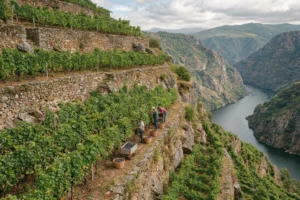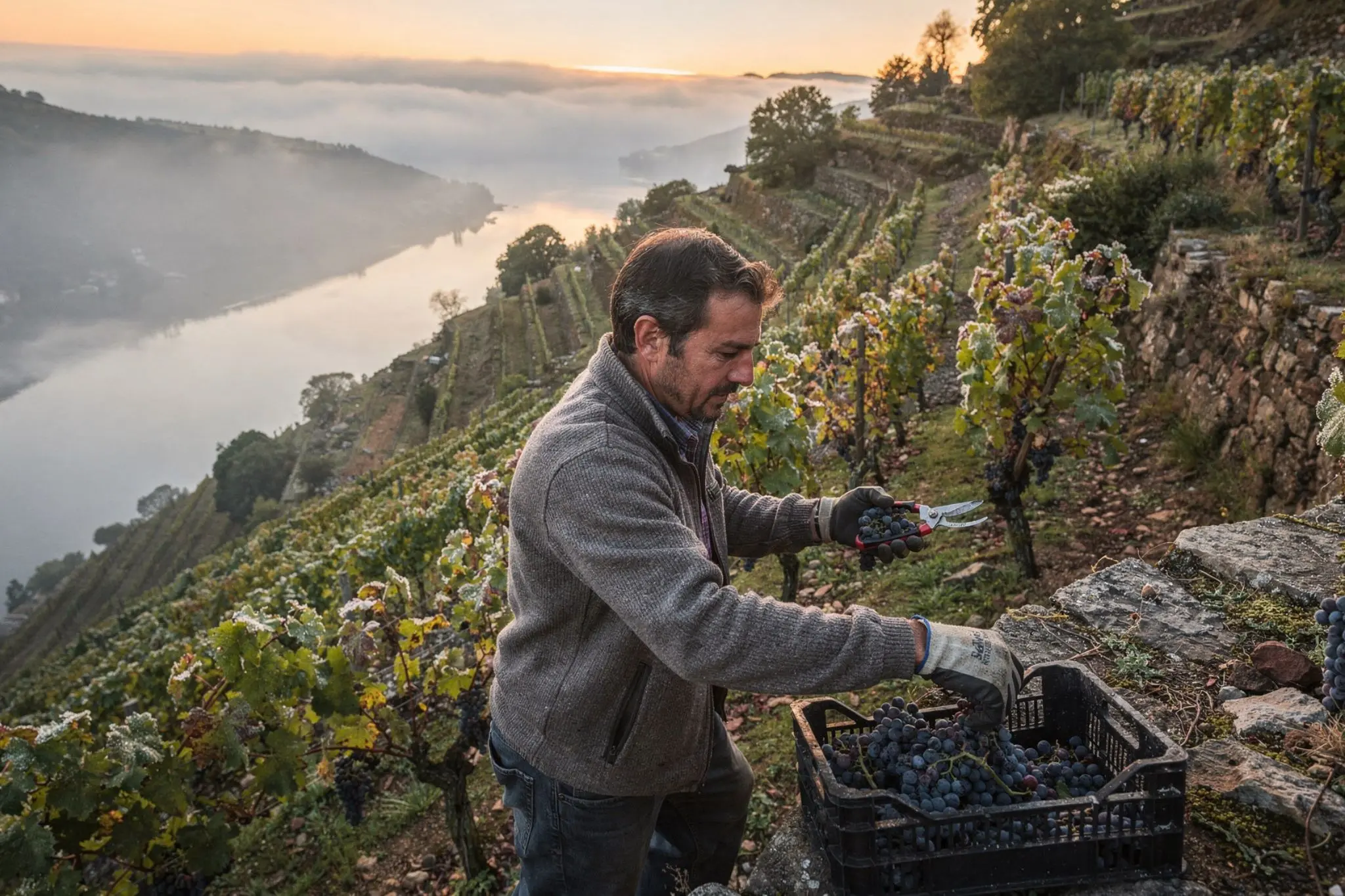
Before the harvest begins, before any decision is made in the cellar, the bancal speaks. The narrow stone terrace above the Sil — barely wide enough for two people to pass — catches the first light at an angle that defines everything: the colour the skin achieves, the tension the fruit carries down into the glass. Nothing here happens on flat ground. If you understand that, you understand mencía.
The grape has been in these canyons long enough that separating it from the landscape is almost meaningless. Roman expansion likely spread viticulture through the northwest of the Iberian Peninsula — the documentation is fragmentary, the continuity more geological than archival — but what survives is a vine shaped by slope, by schist and granite, by the Atlantic cold arriving through river corridors, by centuries of monastic stewardship in places like Santo Estevo de Ribas de Sil and Santa Cristina de Ribas de Sil, where vineyard land was organised not for pleasure but for economic and liturgical necessity.
The Wine That Resists Description
Mencía resists the adjectives wine writing reaches for. It is not a powerful red. It is not particularly tannic. What it carries instead is a kind of lateral precision — wild herbs, sour cherry, sometimes a faint ferrous edge that the slope seems to press directly into the skin of the grape. The difference between a north-facing terrace and a south-facing one here is not subtle: it is the difference between a wine that leans cool and tight and one that opens with more weight and warmth.
The distinction between growing zones deepens this further. Amandi, the most celebrated of the five subzones, produces mencía on some of the steepest, most sun-exposed slopes of the Miño corridor — concentrated, mineral, uncompromising. Ribeiras do Miño, quieter and less discussed, offers a different register entirely. These are not stylistic choices made in the winery. They are the landscape, bottled.
The New Generation
Something has shifted in the last decade. Younger producers — many of them inheriting abandoned terraces or purchasing parcels the previous generation had written off — are moving decisively away from the cooperative bulk model that dominated production for much of the twentieth century. Parcel wines are becoming more common: single-vineyard bottlings that trace a specific exposure, a specific altitude, a specific soil. It is a direction that suits mencía well. The grape resists standardisation. Its value is precisely in its refusal to be averaged out.
The DO Ribeira Sacra was officially recognised in 1996, relatively recently in the long arc of Galician viticulture. What is being built now — carefully, with full awareness of the economics involved — is a language of place, one terrace at a time.