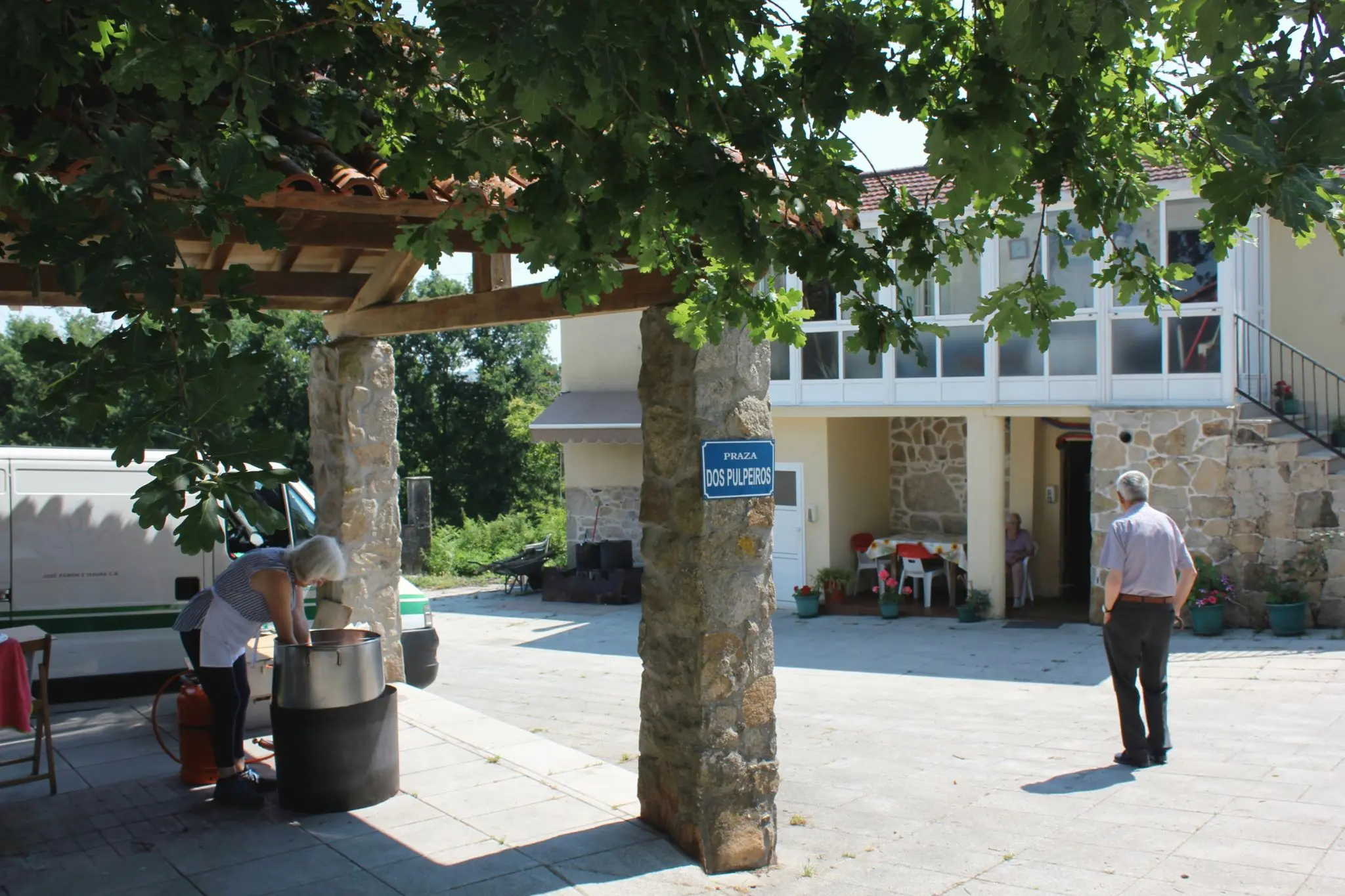
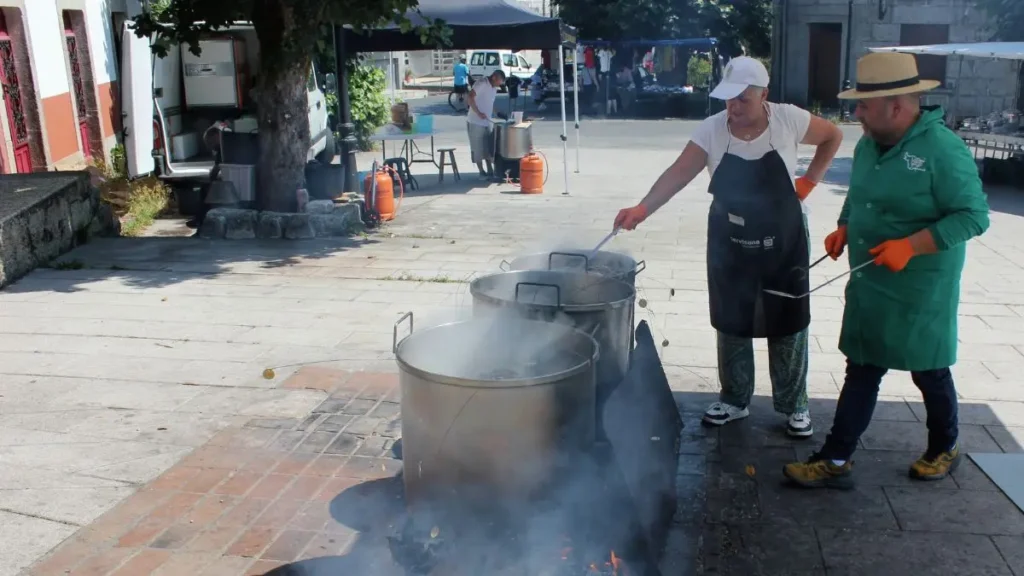
In Castro de Carballedo the square where the cauldrons stand is called Praza dos Pulpeiros — and the name is a promotion. This was once where the pigs changed hands, the ganado end of the feira, all hooves and haggling; “square of the pigs” simply read badly on a sign, and the octopus cooked along its edge lent the place a better one. The swap is the Galician feira in miniature. The animals leave, the cooking stays, and the cooking becomes the thing people remember — which is no accident of taste. In the old order the octopus stall was the ritual that closed the day, where the morning’s business was settled over a plate once the deals were done.
Arrive before ten and you’ll find Mari Carmen already feeding wood into the fire under her cauldron. She makes carne ó caldeiro — beef simmered an hour and a half over a live flame, served with potatoes, bread and wine, with home-made desserts she does herself in the kitchen out back. She has been here since 2006, which by the standards of this square makes her the newcomer; the others, she says with a shrug, are the veterans. The fire is lit by nine and not allowed to die until well past one, when the village arrives to eat and the orders — each numbered, each spoken for days in advance — come out of the pot. Now it’s almost always high season, she says, and means it: the 17th and the 29th pull people in summer and winter alike, the only difference a slightly busier date here and there.
Across the square stands Isaura, and Isaura is not a newcomer to anything. She cooks octopus because her parents did, and their parents, and theirs — the grandparents of my grandparents, she says, which is as far back as the sentence will reach. Ask her where the tradition itself comes from and she answers without hesitating, because in Castro everyone knows.
The Monks, the Coast and the Octopus
The story she carries is older than her family, and it begins, as so much in this territory does, with a monastery. The Cistercians of Santa María de Oseira, near San Cristovo de Cea, held more than a thousand properties that reached from O Carballiño all the way down to the Atlantic. In the twelfth century a knight, Diego Arias, ceded them the fishing rights of the port of Marín, and from that coastal corner octopus began arriving inland as payment of tithe. The choice of octopus was practical rather than gastronomic: barely prized as food then, it dried and cured well, which made it portable, durable, and good for settling a debt to a monastery two days’ walk from the sea.
What the monks couldn’t eat passed to the farmers who worked their land; what the farmers couldn’t eat, they sold at the fairs, where everyone already gathered. A trade grew up around it — buying the octopus, carrying it inland, cooking it on the spot in copper cauldrons — and it spread the way work always spreads in Galicia, one family following another. The pulpeiros of Monforte, of Lugo, of Verín nearly all trace back to people who set out from O Carballiño. It is how a region two hours from the sea built its signature dish around an animal it never caught. And when Galicia was repopulated by the Church rather than by warrior nobility, as happened in the south, the farmers who came to own these small inland parcels were the descendants of the same households once paid in octopus.
The dates blur the further back you go, and the account has rivals — the maragato muleteers who hauled octopus from the Atlantic ports have their own claim on how the taste spread inland. But the shape of it is sound, and it explains the thing that puzzles every visitor: why the most landlocked corner of Galicia is the one that turned octopus into a ritual.
Everywhere the animals have left and the cooking has stayed — exactly as it did in the square named for the pigs.
Why a Day Has a Number
The thing a visitor notices first is the calendar — that every village owns its days, the 4th and the 20th, the 17th and the 29th, fixed and unmoving. This was never accident. Across medieval Galicia feiras were set on fixed days, some so tied to their date that they simply took its name — a feira do Vinte e Seis, the fair of the Twenty-Sixth. Within any one comarca the rule was that no two clashed, so that no day of the month was left without a market somewhere within reach. Many fairs began as a royal concession a town could boast of; others simply grew. By the late eighteenth century the Crown had begun to suspect them — fairs were accused of pulling people away from farm work and into drink — and there was an attempt to limit them, answered by the counter-argument, preserved in the record, that Galicia by its very nature could not subsist without them. The trade in carne ó caldeiro and polbo á feira, then, deserves its own telling another day; here it is enough to know that both are old, and that both outlived the reason they were invented.
The View from Taboada
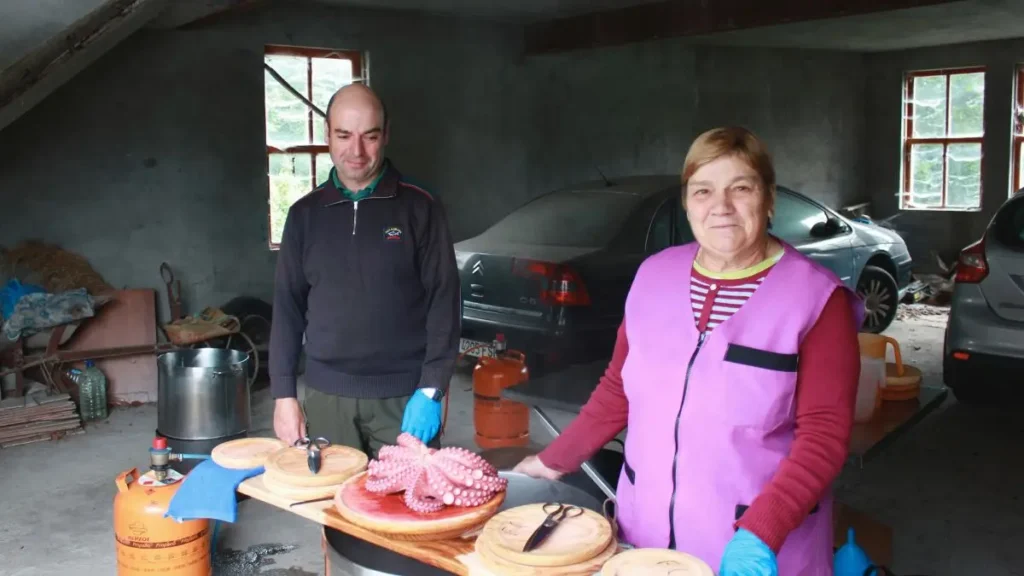
A short drive away, in a garage in Taboada, the same tradition tells a quieter story. Miguel cooks octopus where his father did, and his grandparents before that — once at the edge of the old feira ground, where stone pendellos sheltered the diners and the pulpeiros worked outside. His father died thirty years ago; the family has done this almost forever. Ask Miguel why the Taboada feira falls on the 4th and the 20th and he laughs: no idea — nobody knows, it comes from our ancestors. Ask where the octopus comes from now and the answer is blunter still: Morocco, ninety per cent of it, fished off that coast and trucked across a continent to be boiled in a Lugo garage.
That is the honest present tense. In Taboada the feira has thinned to a few stalls of clothes, hardware and garden plants; the high season barely registers, the tourists fewer each year. The cattle that once defined the day — the cows and calves brought in to be sold before the families sat down to their octopus and went home — are gone from here entirely. In the whole of the Ribeira Sacra the livestock feira survives, as far as anyone will tell you, only in Chantada and Monforte.
It is tempting to read this as decline, and in plain economic terms it is. But stand in either place on the right morning and something else is visible. The feira is the barometer of a rural economy, and the needle has fallen — yet the cauldrons still come out, the orders are still placed days ahead, the village still arrives at one o’clock. Keeping the tradition alive has become, almost without anyone deciding it, a way of keeping a shrinking community in the same place at the same time, twice a month, around a fire. The octopus may travel further than it used to. The reason people gather around it has not moved at all.
The dates that still hold across the twenty-six concellos of the Ribeira Sacra are gathered in our downloadable feiras calendar — the days each village keeps, for anyone who wants to arrive on the right one.
Praza dos Pulpeiros; Smoking Cauldrons, Castro de Carballedo; Mili & Miguel, Taboada — photos by P. Vanossi.