The term shows up in wine fair catalogues and tourism brochures with a regularity that has slowly drained it of meaning: viticultura heroica. In Ribeira Sacra, no one uses it in conversation. The growers talk about the weather, the yield, the price of labour, the slope. The word “heroic” belongs to whoever is selling the wine, not whoever is making it.
That gap — between the label and the land — is worth paying attention to.
The official definition, established by CERVIM, the international centre for mountain viticulture, is precise: slopes of at least 30%, altitudes above 500 metres, or working conditions that make mechanisation structurally impossible. Ribeira Sacra meets all three criteria in most of its five sub-zones. The definition is useful. The reality is less tidy.
The Landscape as Constraint
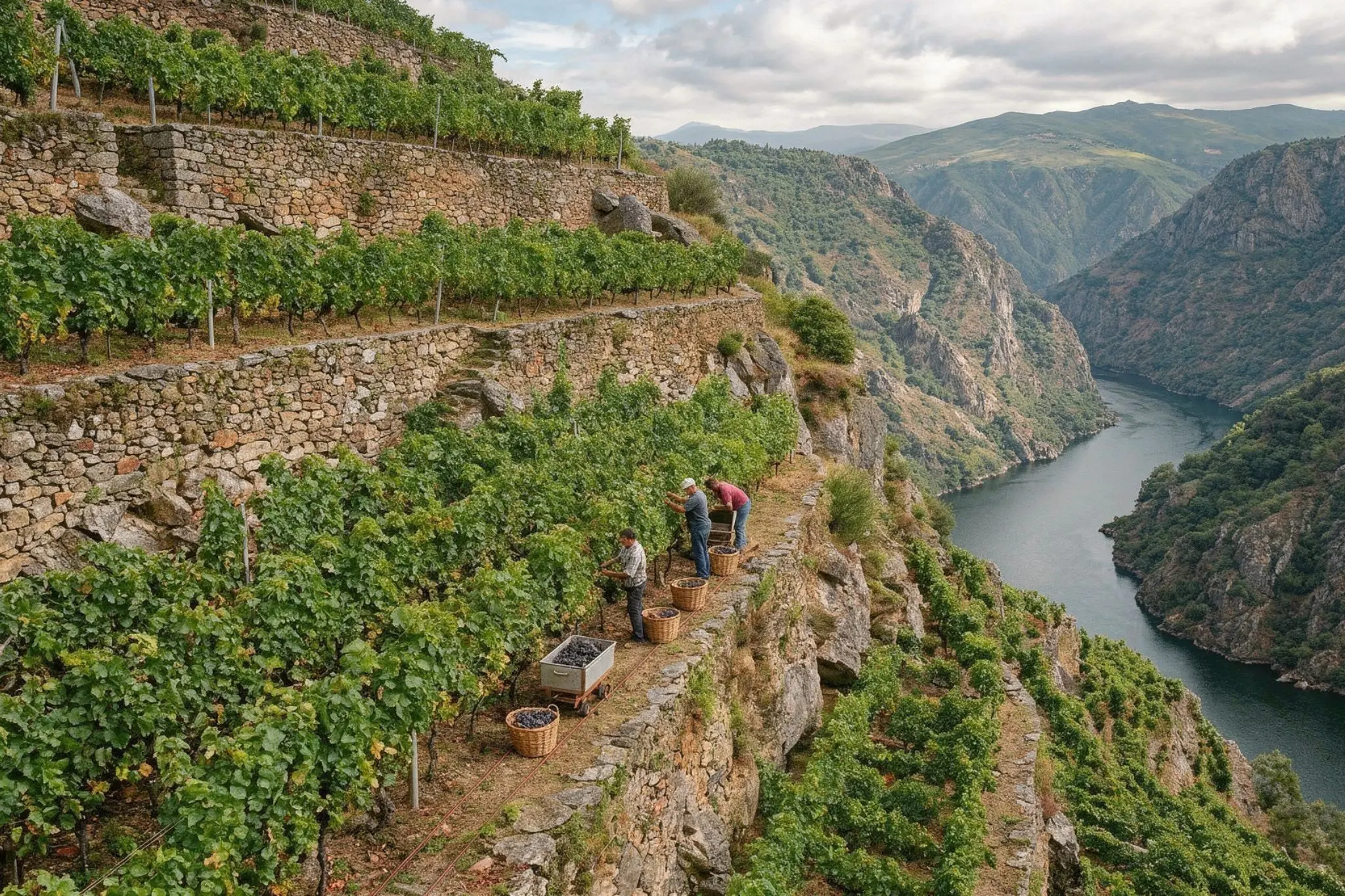
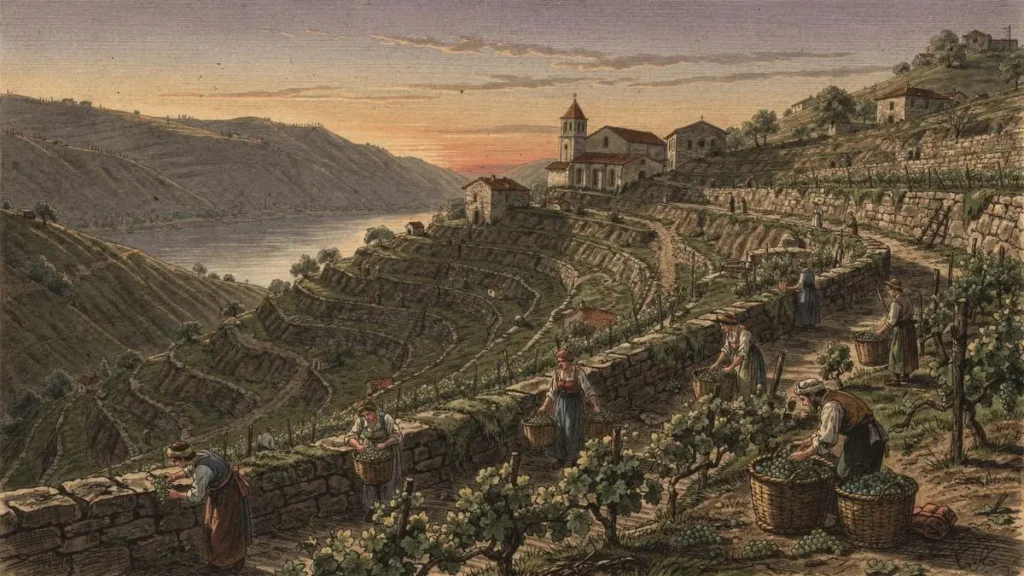
The Sil and Miño rivers have spent millennia cutting into the Galician plateau, leaving canyon walls that drop in places to near-vertical faces of schist and slate. Vines have been planted on these terraces for over a thousand years — not because it is beautiful, and not because it is efficient, but because the slopes above the river offered microclimate conditions the flatter land could not: warmth reflected from the slate, protection from Atlantic rain, drainage that prevented rot. The geography did not invite cultivation so much as it demanded a specific kind of ingenuity to be cultivated at all.
There are no tractors on a 70% gradient. Harvesting means carrying crates up steps cut into schist by hand, sometimes by boat across the reservoir formed by the Belesar dam. Plots are fragmented — rarely more than half a hectare, often a few rows separated from the next by a dry-stone wall built three generations back. The inefficiency is total, and it is not going to change.
Heroism is not a choice here — it’s a geometry.
Terraces and Abandonment
The terraces themselves are not a scenic accident. They are infrastructure built over centuries by Benedictine monasteries that needed to make the canyon walls productive. The monks were solving a problem of subsistence, not composing a landscape. What they left behind — walls, channels, micro-plots — is still the physical architecture that carries viticulture here today.
That architecture is under pressure. The population working these vineyards is ageing, yields are low, labour costs are high, and the prices Ribeira Sacra wines command are not always proportional to the effort invested. Some plots have already been left to revert — terraces still visible from the river, vines untended, walls beginning to slip. This is not picturesque decline. It is a decision made by someone who could no longer make the numbers work.
What It Produces
Mencía grown on slate soils produces small quantities of intensely concentrated fruit. Godello — the white variety drawing international attention — is mineral and precise, its acidity a direct reflection of altitude and slow canyon ripening. Low yields, old vines, manual selection: the cause-and-effect chain between landscape constraint and what ends up in the glass is unusually legible here.
“Heroic” suggests exception — a special effort under extraordinary circumstances. In Ribeira Sacra, it describes the minimum required to remain. The growers still working these terraces are not doing something remarkable. They are doing something necessary, knowing it may not be possible for the generation after them. That is not heroism. That is a much quieter kind of problem.