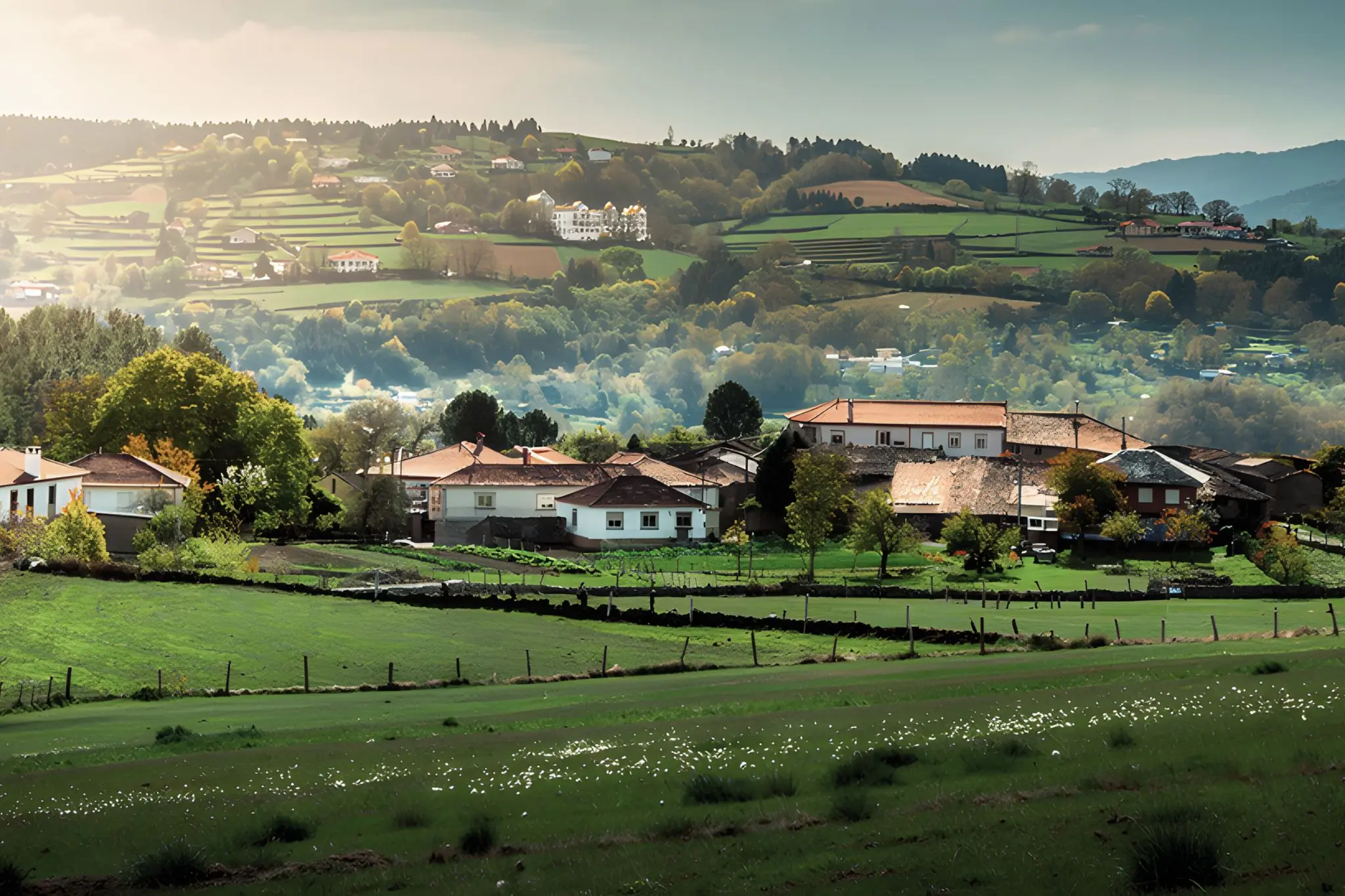
You will not find Sober on many shortlists. It does not hang above the Sil canyon, it does not have a monastery on a cliff, and the road in from Monforte de Lemos is the kind of provincial route that GPS systems seem to treat as a personal affront. What Sober has is something rarer in this part of Galicia: administrative solidity. It is the municipal capital of a concello that covers twenty-two parishes, sits at roughly 600 metres above sea level on the Lugo side of the territory, and holds together the viticultural infrastructure of Amandi — one of the five subzones of the Denominación de Origen Ribeira Sacra — without particularly advertising the fact.
The town itself is functional without being bleak. The Praza do Concello, the municipal offices, a handful of bars and commerce that serve a working population spread across a fragmented landscape. Nothing is staged. The local band — one of the oldest in Galicia — plays at the Feira do Viño de Amandi each Palm Sunday weekend in the same square, as it has for well over a century. Artisan pottery from the neighbouring parish of Gundivós, long integral to viticulture work, sits alongside wine bottles at the market stalls. It is not a heritage performance. It is still in use.
Amandi, the Myth and the Territory
The name carries weight it has never entirely earned. Amandi — officially the parish of Santa María de Amandi — sits below Sober, closer to the river, south-facing on slate-and-schist terraces that drop toward the Sil. In 785, Bishop Odoario of Lugo is recorded as having founded the villa of Amandi here, a datum that gets repeated in wine marketing with a frequency that should prompt some scepticism. What the name actually supplies is territorial identity — a subzone designation within the DO that certifies, on the back label of a bottle, that 100% of the grapes come from its registered parishes. That is the operational meaning of Amandi in 2025. The ecclesiastical founding is background.
What the territory does deliver — with no need for historical overlay — is exposure. South-facing, with the Sil running below as a thermal mass, the Amandi microclimate is measurably warmer and drier than much of the surrounding Ribeira Sacra. The terraces here are less dramatic than those of the deep Sil canyon further east, but they are dense, well-maintained, and productive. Around 300 growers and 29 registered bodegas operate within the concello, making Sober the most concentrated single municipality for wine production in the DO. Rectoral de Amandi, founded in 1990 and established in a 17th-century former rectory in the Amandi parish, was the first bodega to be registered under the DO when it was formally created in 1996. The building’s name became the wine’s name. That continuity between place and label is not common here, or anywhere.
The Descent to Doade
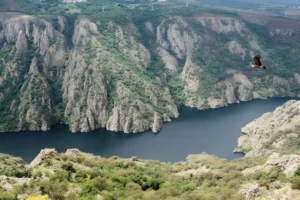
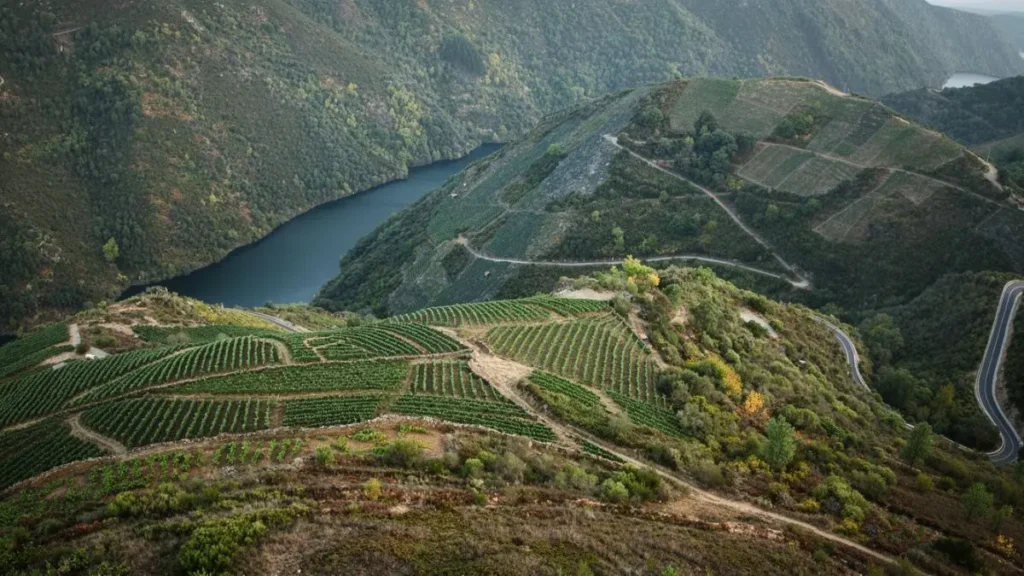
The road from Sober down to Doade is where the territory reveals itself. The village of Doade sits lower, closer to the water, and from its viewpoints — particularly the Mirador de Pena do Castelo and the Mirador de Soutochao, which rises above 600 metres and looks out over the Sil toward the Ourense bank — the logic of the landscape becomes legible in a way that no amount of topographic description substitutes. Terraces of mencía fill the slopes between where you stand and the river below. On the far bank, the forested walls of Castro Caldelas. Below, the embarcadero where catamarans depart upriver. It is a vertical world, and understanding Sober from it is understanding where the wine comes from and what it costs to make it.
The PR-G 86 trail — the Sendeiro dos Viñedos da Ribeira Sacra — passes through this zone, linking Doade with the broader landscape on foot. The walk is not a wellness amenity. It is a working agricultural route through terrain that still functions as someone’s livelihood.
Using Sober Well
The nearest service hub is Monforte de Lemos, roughly fifteen kilometres north, which supplies accommodation range, rail connection, and the kind of urban infrastructure a small concello capital cannot. The relationship is structural: Sober produces, Monforte services. Coming from Monforte, the LU-P-3201 brings you directly in. Coming from the Ourense side and the Sil canyon, the LU-903 via Doade is the more interesting approach — you arrive from below, which is the correct order.
The Oficina de Turismo de Sober operates from the Praza do Concello (Tuesday to Saturday, 9:30–14:30; extended to Sunday in July and August). It is useful, low-key, and staffed by people who know the roads.
A Note on Gundivós
Sober’s secondary footnote is its ceramics tradition. The parish of Gundivós, within the concello, produces hand-built earthenware using methods and clay bodies with deep roots in the territory. The pieces are not decorative — they were made for use in the vineyard and kitchen, and the better workshops still make them that way. In a territory where everything tends to become vineyard scenery, Gundivós is a reminder that the culture here had more than one material register — and, these days, more than one register full stop, as the parish reorganises itself, on its own terms, around art, teaching and hospitality.
Mencía terraces descending to the Sil at Doade, Sober — photo by M. Piñeiro, edited with AI.