There are places in Ribeira Sacra where history is something you look at through glass — preserved, documented, sealed. Ferreira de Pantón is not one of them. Here, the monastery bell still rings on schedule. The nuns still keep the hours. The garden still produces. If you arrive expecting ruins, you’ll need to recalibrate.
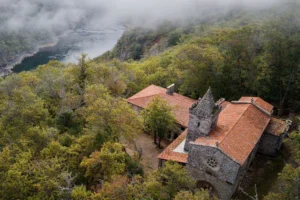
The Monastery of Santa María de Ferreira de Pantón sits at the edge of the village that bears its name, about 12 kilometres south of Monforte de Lemos — close enough to access, far enough to feel genuinely removed. Its first documented reference dates to 924, when it functioned as a private Benedictine double monastery. In 1175, the Countess Fronilde Fernández refounded the community under the Cistercian rule, placing it under the tutelage of the Abbey of Santa María de Meira. The Cistercians remained. The 1835 disentailment forced the community out; they returned in 1858 and have not left since. That resumption — quiet, determined, without fanfare — is worth pausing on. In a territory full of exquisite architectural corpses, the Monasterio de las Bernardas is the sole surviving Cistercian nunnery in Galicia still in active religious life.
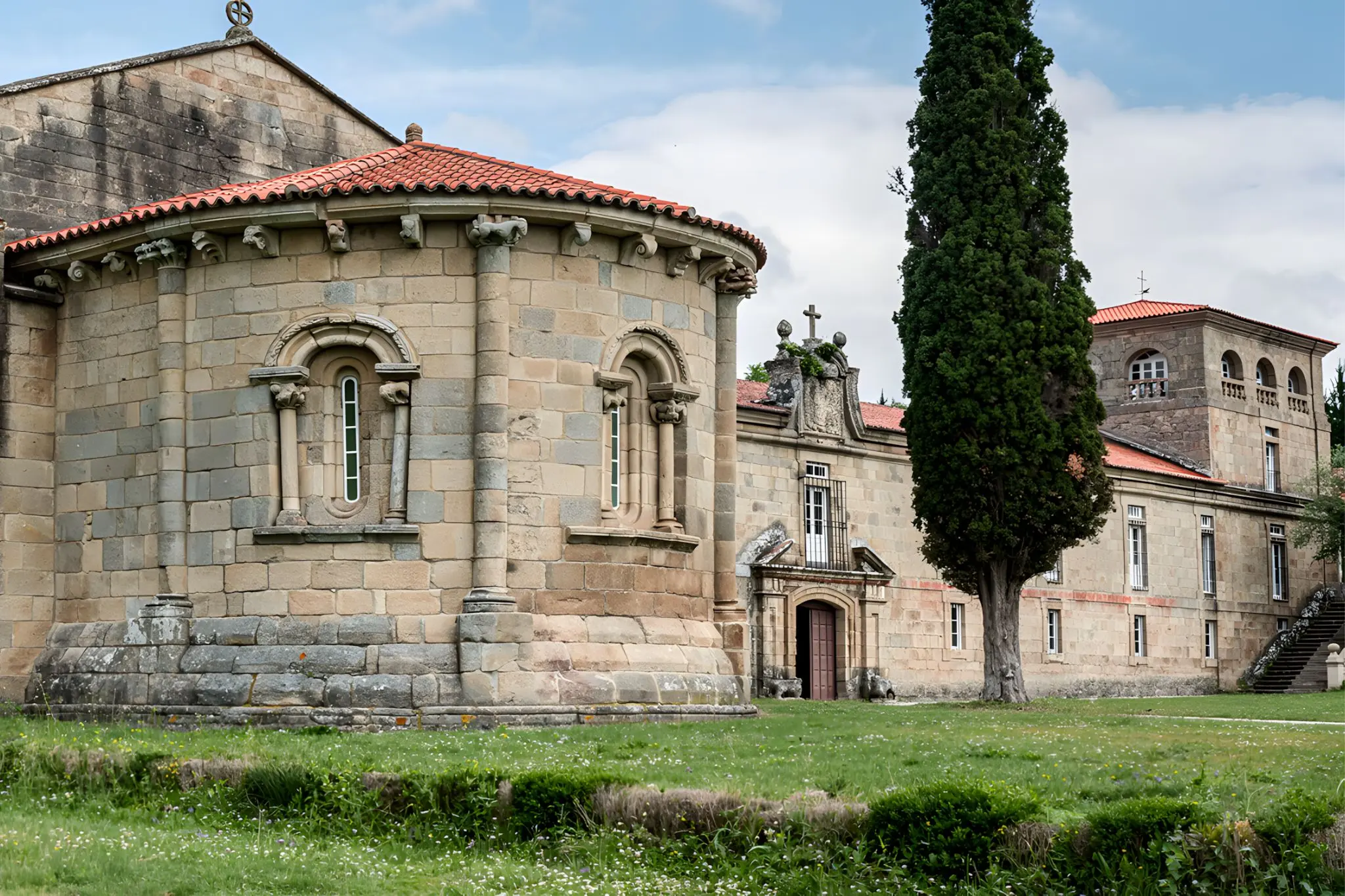
What you see from the road is the church façade, Romanesque in its bones — a single nave, semicircular apse, carved capitals both inside and out. The cloister dates from the fifteenth century; the rest of the complex was rebuilt from the sixteenth through the eighteenth in styles that don’t argue too much with each other. A declared national monument since 1975, but one that functions rather than performs. The sisters sell honey and homemade pastries — a minor but meaningful detail. Commerce as proof of continuity.
The Density of Pantón
What the municipality of Pantón offers around the monastery is less dramatic and therefore more interesting. The concello holds one of the highest concentrations of Romanesque rural architecture in the Ribeira Sacra — not a curated route, but a scattered network of small churches embedded in farmland and forest, most of them requiring a key from a neighbour or a return visit.
San Fiz de Cangas stands out. Dating from the eleventh to thirteenth centuries, it was built as the church of a Benedictine convent with Visigothic antecedents on the site — you can read the layering in the stone if you look slowly enough. The carved corbels are worth the detour alone: grapes, animals, a phallic figure, symbols whose explanations have mostly been lost. It sits off a narrow road near Ferreira; the turn-off is easy to miss. San Paio de Diomondi, further north along the Miño, is more compact but compositionally striking — a twelfth-century church that can be visited during its Sunday mass, which may be the only time it opens.
Neither site is on a tourist map of any consequence. That is precisely the point.
The Quieter River
The Miño here runs wider and less theatrical than the Sil canyon. There are no boat tours, no canyon viewpoints designed for photography. The river does something subtler: it organises the landscape. Villages along its southern bank are oriented toward the water — not for spectacle, but for the practical reasons that rivers have always mattered. Agriculture, access, proximity to trade routes now long obsolete.
This part of the Miño valley — the stretch between Monforte and Os Peares — has a quieter logic than the dramatic stretches further south. The light is different here: softer in the mornings, slower to leave in the evenings. The terraces don’t plunge as steeply. The pace of the road, the spacing of the villages, the absence of anything designed to be seen from a distance — it all contributes to a particular kind of illegibility that rewards patience.
Staying Here
Pantón is best approached as a base rather than a day trip from somewhere larger. A handful of rural houses operate in the municipality, some within easy walking distance of the monastery. The village of Ferreira itself is small and quiet — a bar, a pharmacy, the monastery, and not much else, which is either a problem or the whole appeal depending on your disposition.
The Miño side of Ribeira Sacra gets less traffic than the Sil canyon. In practical terms, that means fewer bookings required, more space on the roads, and the particular pleasure of arriving somewhere that hasn’t adjusted itself to accommodate you.
Monastery of San Salvador de Ferreira — photo by GFreihalter, edited with AI.