Galicia is not shrinking. Last year the region added population and reached its highest count in a decade; all four provinces grew. The figures come from the Instituto Galego de Estatística, working from the national padrón, and the register is not in the habit of flattering rural Spain.
Take the twenty-six concellos that form the territorial heart of Ribeira Sacra — the working definition, give or take, since its edges are negotiable and the Xunta redraws them by application. Together they held about sixty-eight thousand people in 2025, down from roughly sixty-nine thousand six years earlier. A loss of one and a half per cent over six years: by the standards of interior Galicia, almost flat. Read the headline and you would conclude Ribeira Sacra is stable.
The headline is the problem. That near-flat average is not one trend gently holding; it is at least three trends pulling against each other, and the arithmetic of cancelling them out hides the only thing worth knowing.
What the Six Years Sit On
Some perspective on the slope. The same twenty-six concellos held nearly a hundred and twenty thousand people in 1981; today they hold about sixty-eight thousand — more than two in every five residents gone in a working lifetime, lost at a startlingly even pace of roughly a tenth of the remainder each decade, through the eighties, nineties and two-thousands, without slowing. Against that, the modest six-year figure is not stability. It is the first time in two generations the bleeding has nearly stopped, and it has nearly stopped not because the interior recovered but because the growth at the edges has finally outweighed it. It is worth saying plainly, because these are the pandemic years and a return to the countryside was widely forecast: strip out the commuter and service concellos, look only at the agricultural and mountain interior, and the line fell every year from 2019 to 2025, through the lockdowns and after, without a single year’s pause. Whatever revival was imagined elsewhere did not reach these parishes.
Where the Numbers Hold
Some places are steady or even growing, and they have one thing in common: a real service economy, or proximity to someone else’s. Monforte de Lemos, the only town of any size in the comarca, added population. So did Chantada, the working capital of the Miño side, give or take a handful. Luíntra holds the administrative weight of Nogueira de Ramuín, which grew. These are not picturesque. They are the places with a hospital wing, a secondary school, a notary, a supermarket — the unglamorous machinery that lets a person stay.
The sharpest gain belongs to the place with the weakest claim to the name. O Pereiro de Aguiar grew eight per cent, the fastest of any of the twenty-six — because it is not really Ribeira Sacra at all. It is a commuter ring on the edge of the city of Ourense, where families priced out of the centre buy a house with a garden and drive in to work. Its growth is the city of Ourense spilling across a municipal line, then counted as if it were canyon country. Nothing measures more plainly how little the territory’s boundary really means.
Where the Numbers Fall
Then the interior. O Saviñao, Pantón, Carballedo, Quiroga, Taboada, A Pobra de Trives, Manzaneda, Montederramo — the agricultural and mountain concellos lose population the slow, unspectacular way: the old die, the young leave for the cities or abroad, and almost no one is born to replace either. The routes get marked and the monasteries get restored, but neither keeps a young family from leaving. No drama, no single cause, just attrition running a few per cent a year, every year.
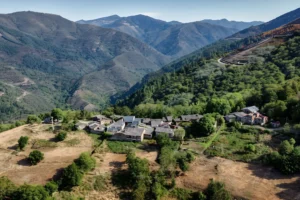
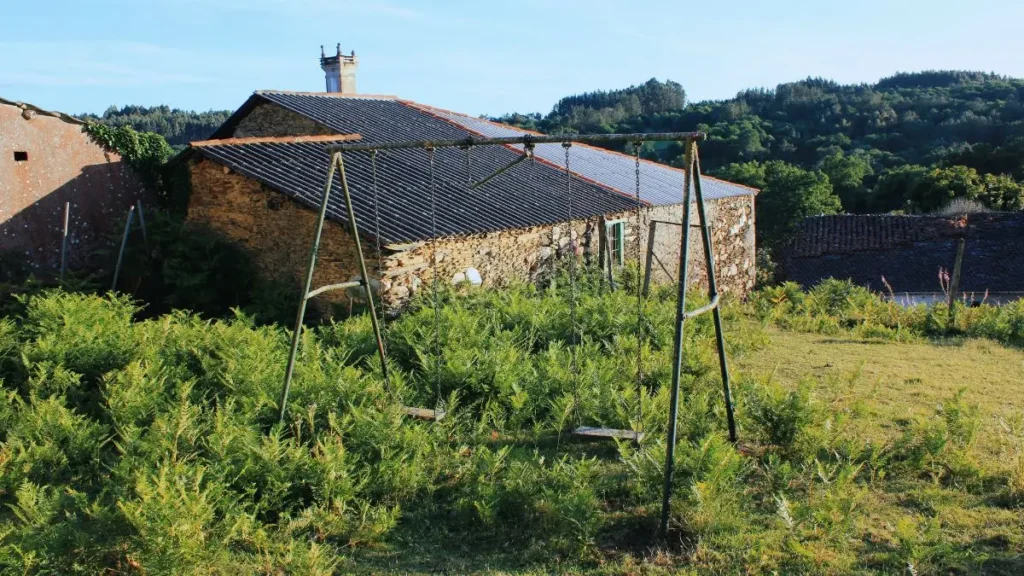
This is where the register stops being an abstraction. The concello is the unit of policy; the parish is where the count does its plainest work. In Taboada, the parish of Vilar de Cabalos (Santa Eulalia) held thirty-six people in 2025: twenty men, sixteen women. Not a dying parish, in the demographers’ grim grading; not even a critical one.
Víctor López Garcia was born the year the school closed, in 1971 — “it shut, and I was born,” he says, as if the two events agreed to swap places. He still farms; he was, by his own account, the last person in the parish to sow cereal, three years ago. He counts the old population the way the place once counted itself: by houses. “Multiply thirty-five houses by five — and houses here rarely held fewer than five.” That arithmetic lands him “just under two hundred,” which is almost exactly where the register put Santa Eulalia in the years he is describing. His grandfather was one of four siblings and had four children; that was ordinary. The wealthier houses were measured in chestnut trees — one family, he says, kept a finca with three hundred and sixty-five of them, “one for every day of the year,” and his aunts spent whole October days gathering the harvest, climbing into the branches out of fear until their father came with the donkey.
He can date the emptying precisely. There were two great departures — first to the Americas, to Argentina and Venezuela, where some of the family still have businesses; then, after the war, to the industrial cities: Avilés, Barcelona, Asturias, A Coruña. “There’s someone from Santa Eulalia in every region,” he says, not entirely joking — one emigrant’s daughter became mayor of Avilés. But the blow he felt in his own body came later. The summers he spent away as a boy sharpened his eye — each return a small shock, the kind that daily proximity protects you from. The year it struck him was 1982. “I already noticed an emptiness.” After that the children who used to fill the village at Easter and Christmas simply stopped coming, and never started again.
A parish like this one is neither extreme nor exceptional: an ordinary case in the middle of the slope, thinning. Below it in the register’s grading are the places it calls agonizante — dying, ten residents or fewer — and there are several scattered across the comarca. Frades, in Quiroga, holds six. O Camiño, also Quiroga, has eight, as does Xestoselo. Vimieiro, up at Castro Caldelas, has four, down from six in 2019. These are not statistical curiosities; they are addresses, with a roof and a name and one or two people inside.
Where the Numbers Diverge
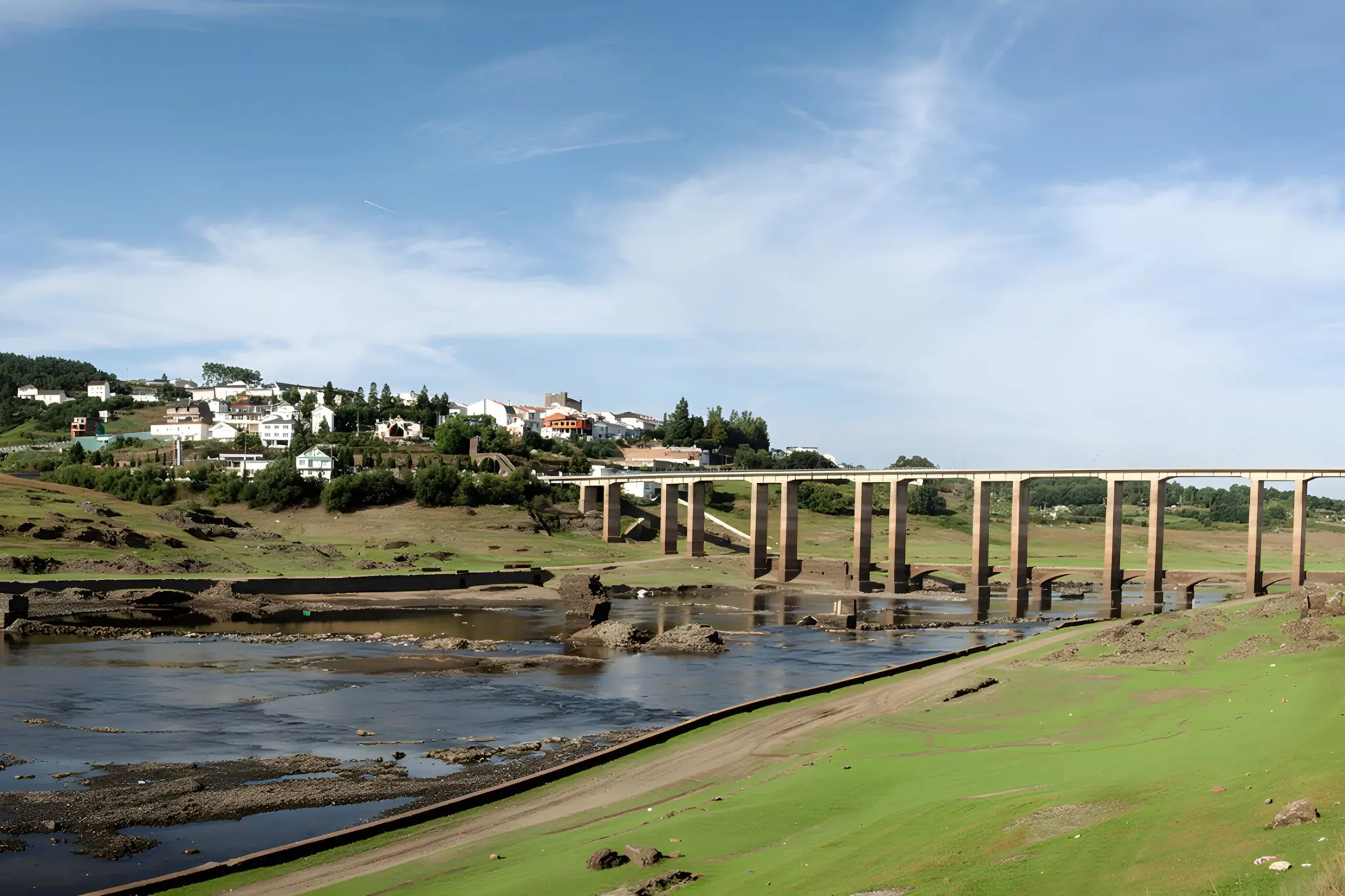
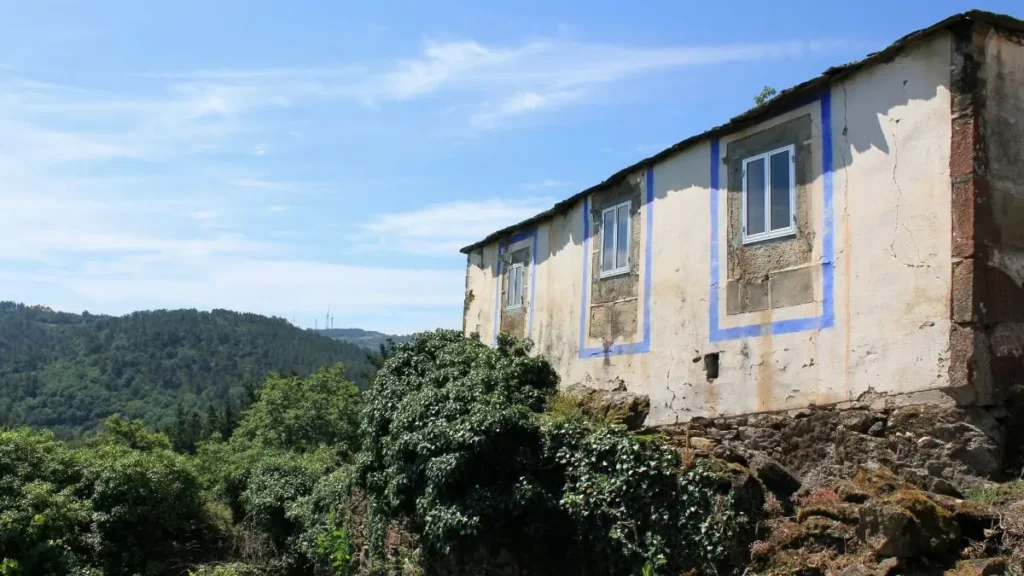
And then there is Portomarín, which refuses every category. It lost almost twelve per cent of its residents in six years — among the steepest in Ribeira Sacra. Yet anyone who arrives on a Sunday in season finds a place that looks not merely alive but overflowing: bars full, square loud, beds at a premium. The town carries more than two thousand five hundred tourist beds against a registered population of fewer than thirteen hundred — roughly two visitor beds for every resident. It sits on the Camino Francés, on the most-walked stretch of the entire route, and it has reorganised itself almost completely around the people passing through.
So Portomarín is emptying and booming at once, and both are true, because they measure different things. The economy thrives; the residency drains. A town can be busier than it has ever been and emptier than it has ever been in the same year, if what fills it does not stay the night twice. It is the one place here where the future the others are warned about — the village preserved as a service for visitors rather than inhabited by neighbours — has already largely arrived.
The Sum That Hides Its Parts
So the territory is moving in three directions at once. A commuter fringe on the Ourense edge that is growing. A handful of service towns — Monforte, Chantada, Luíntra — holding their ground. And the agricultural interior, most of the map, still emptying at the same ten per cent a decade it has lost since the year Víctor first noticed the silence. Average those together and you get a number that barely moves; read them apart and they describe entirely different futures under a single name. None of this is a verdict. The terrace walls being rebuilt are real; so is the wine; so is the work, where there is still someone to do it. The point is narrower: the figure that looks reassuring is the one that hides the most. The register makes no such mistake. It counts each parish on its own every January, without comment and without rounding up.
Portomarín, Miño reservoir at low water — photo by D. Giljohann, edited with AI.
Vilar de Cabalos, Santa Eulalia (Taboada). Population: 36. — photo by P. Vanossi.
Sabadelle, Portomarín. A house on the edge of the village — photo by P. Vanossi.