The first thing you see on arriving in Vilachá is a stage: a whitewashed concrete stand with a metal roof and a flight of steps, set on a patch of grass under the trees. On the first weekend of May it is the centre of the Feira do Viño, when growers fill the village with wine, bands play and the cellars open their doors. The rest of the year it stands empty, and so, most days, do the lanes behind it.
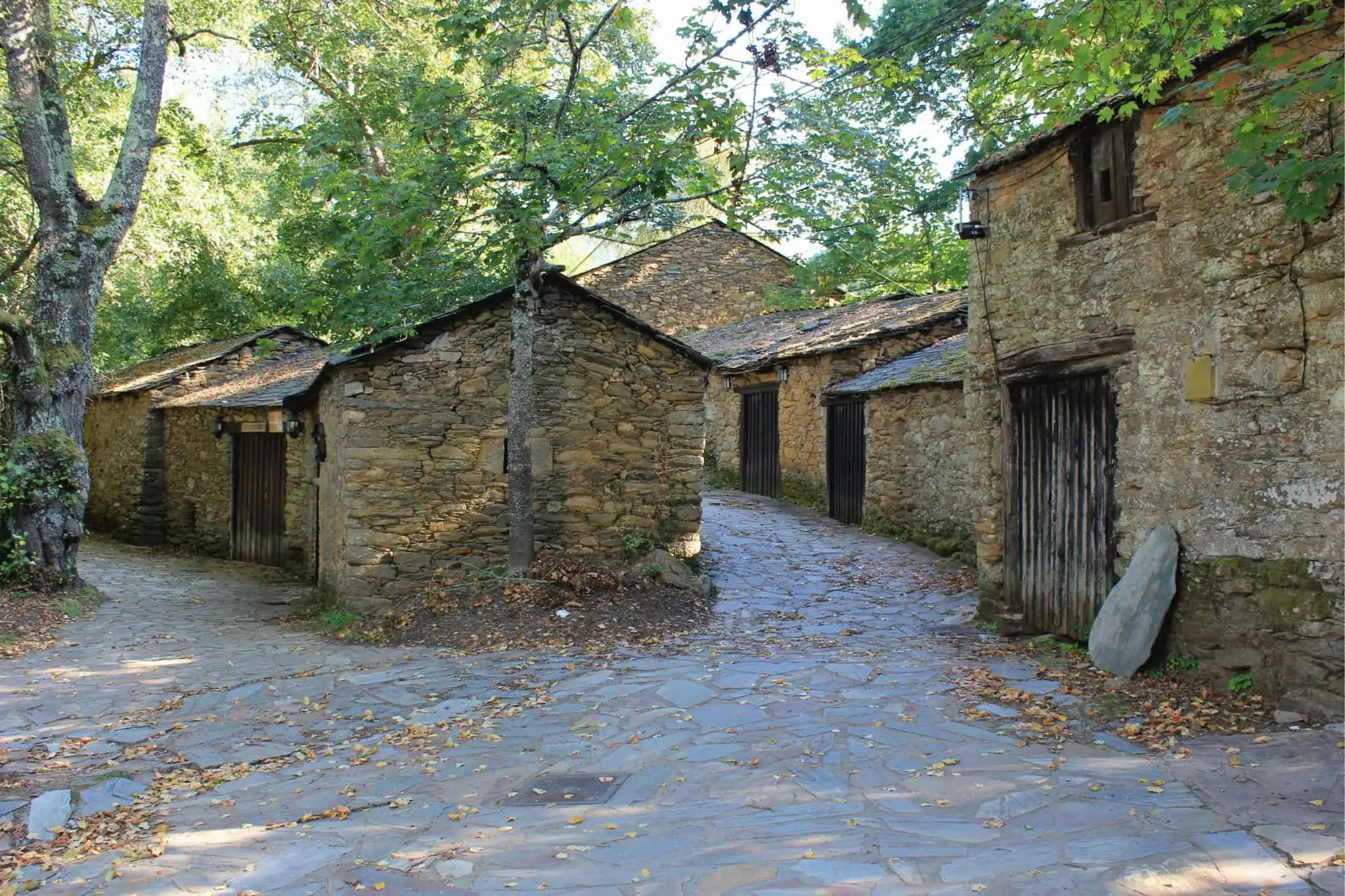
They run through A Abelaira, paved with slabs of slate and covered in fallen leaves, between low stone buildings with mossy slate roofs and doors of vertical wooden planks. There are about forty of them, 42 by the official count, because some have two doors. There are no houses. This corner of Vilachá, the only parish of A Pobra do Brollón that reaches down to the Sil, was built for wine, and Galipedia calls its cellars millennial, among the oldest in the Iberian Peninsula. Walking the lanes with every door shut, you feel the absence of the crowd the stage was built for.
Weekends and Memories
Cristina Rodríguez, the concello‘s guide, fills in what the closed doors leave out. A few cellars open as furanchos, where growers pour their own wine, but only for about three months a year, closing at the start of August. The rest belong to families who live nearby and come up at weekends, to eat with friends and open a bottle. Once a year the A Pobra football team holds its lunch in one of them.
Those weekends are what remains of the community that built the place. Families worked their vines on the slopes below and spent long days up here at harvest and pressing, helping one another. One lane was known as the lovers’ alley, because the children who grew up between these doors got to know each other here. The cellars also kept secrets. Cristina carries an album with a photograph of Juan Tizón Herreros, the socialist mayor of Monforte de Lemos in 1936, who after the July uprising, she tells us, hid in one of them before escaping to Portugal. He died in exile in Porto in 1945.
Republican hideouts are one of the threads followed by Adegas da Memória, the archaeology and oral-history project that has worked in Vilachá since 2018. The same project traced the terraces below to the 10th century, and found that the great expansion came in the 13th, when the Cistercians planted the ribeiras of Val do Frade and O Eivedo. The cellars are a Bien de Interés Cultural, like the cave-cellars of Seadur in Valdeorras, and each owner pays to keep their own: the light and water, the brambles by the door and, when a roof gives way, the slate and wood to rebuild it.
A Cellar for Saturdays
Cristina’s father-in-law shares a cellar with a friend, and it shows how these rooms are used now. On one wall stand a cast-iron wood stove, a crate of logs and a three-burner gas ring over an orange butane bottle. Above the counter, a wooden rack holds gin, vermouth, rum, whisky and soft drinks, with a top hat on the top shelf. Someone has written “Godello” at one end of the rack and “Mencía” at the other, and the medals from the Feira hang from its side. Both men have children and grandchildren, and Cristina cannot imagine anyone in the family selling.

Puri’s Cellar
Continuing the tour, we met Puri, María Purificación Díaz Ferreiro, who showed us her own cellar. She took it over from her parents, and she is one of two producers in Vilachá bottling under the DO Ribeira Sacra, in its Quiroga-Bibei subzone; the other is Adegas Salvadur. Part of it is set up for guests, with tables laid under red paper, old barrels and demijohns on the shelf beneath the beams, and chairs hanging from pegs on the wall. The rest is where the work happens, and we had arrived during the harvest: stainless-steel tanks against the stone, a destemmer, stacks of crates and fresh grape skins on the tiled floor. From one hectare of mencía and garnacha she makes about 6,000 litres of Val do Frade and sells nearly all of it to the people who come to visit. We paid nine euros for a young red that comes in at 15%. In August she brings seven wineries to the cellars for a day of her own.
A few doors along, another cellar keeps the older tools where they were. A great barrel with red hoops lies on its cradle with a wooden hopper on top, and a funnel, a pitchfork and a carved wooden scoop hang on the wall beside it.
The View From A Capela
From the cellars we all moved to the Miradoiro da Capela. The Sil bends far below, and on the near bank the growers’ terraces sit in green patches among the scrub, with a track looping down past a few tool sheds. In this mountainous corner of Lugo it comes as a complete surprise: the canyon view people usually drive to Doade, in Sober, to see, at the end of a village lane.
The concello of A Pobra do Brollón runs guided summer visits to the cellars and the viewpoint, roughly from July to September; the dates change each year, so call before planning around them (982 430 001). The visit goes inside a cellar and ends with a glass poured by whoever has opened the door that day.
Vilachá wine cellars, on an ordinary weekday; Puri in her cellar during the harvest — photos by P. Vanossi.