If the Miño organises, the Sil interrupts.
Along the north-facing cliffs between Monasterio de Santa Cristina de Ribas de Sil and Monasterio de Santo Estevo de Ribas de Sil, the monastic system changes character. What was structured along the valley becomes fragmented against the canyon.
Here, silence is no longer regulated.
It disperses.
The Vertical Condition
This stretch of the Sil — around Parada de Sil and Nogueira de Ramuín — is defined by compression. The river cuts deep, the slopes rise sharply, and access becomes conditional.
Movement is slower, less predictable. Paths descend rather than connect. The landscape resists continuity.
And that resistance shapes everything that was built here.
Unlike the Miño, this is not a territory that can be organised from within. It can only be occupied in fragments.
Santa Cristina: Withdrawal Into Terrain
At Santa Cristina de Ribas de Sil, the monastery does not dominate the canyon. It withdraws into it.
Reaching it already implies a shift. The road narrows, then gives way to forest. The final approach is on foot, through chestnut groves that filter both sound and scale.
By the time the building appears, partially obscured, it feels less constructed than discovered.
Historically linked to early Benedictine organisation, Santa Cristina retains something more primitive in its placement — a residual memory of eremitic occupation. It does not structure territory; it seeks distance from it.
The architecture reflects that logic: compact, restrained, aligned with the slope rather than imposed upon it.
Silence here is not enforced.
It emerges.
Santo Estevo: Power on the Edge
Further downstream, Santo Estevo de Ribas de Sil occupies a very different position.
Where Santa Cristina withdraws, Santo Estevo consolidates.
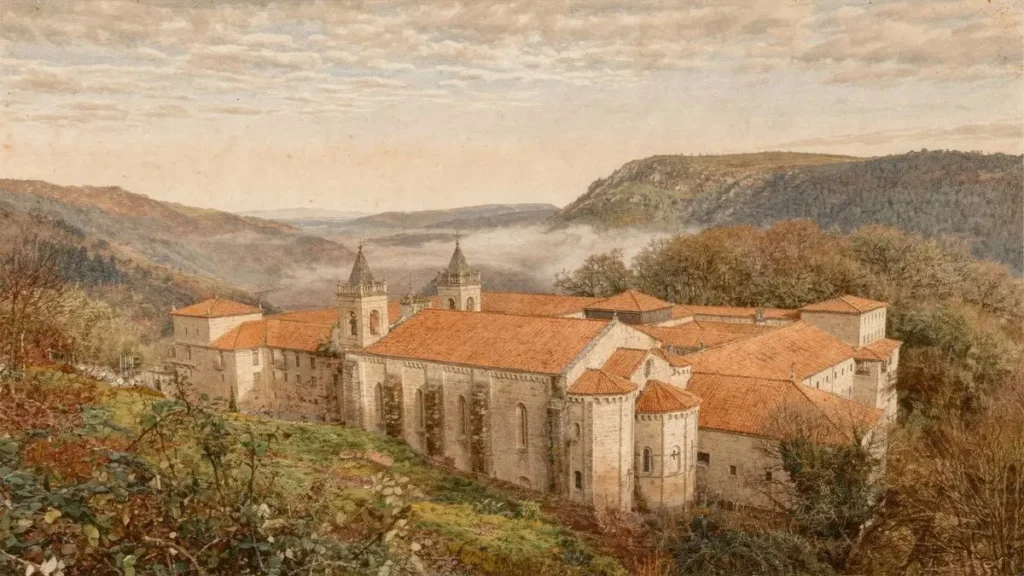
Built on a plateau above the canyon, it became one of the most powerful Benedictine monasteries in Galicia, controlling extensive land across the surrounding territory. Its scale reflects that authority: multiple cloisters, expanded structures, a presence that is both architectural and administrative.
Today, converted into a parador, its function has shifted entirely.
The silence remains — but it has been reframed.
It is now curated, managed, partially aestheticised. Accessible without resistance, legible without effort.
And yet, the site still carries a trace of its original condition: a position at the edge, overlooking a terrain that cannot be fully controlled.
Fragmentation Instead of System
Read together, Santa Cristina and Santo Estevo do not form a stable pair in the way Ferreira and Ribas did along the Miño.
Here, the system breaks.
One withdraws into the forest. The other expands into institutional power. One resists visibility; the other accumulates it.
Between them, the canyon interrupts continuity.
The monastic network no longer reads as infrastructure, but as a series of isolated responses to a difficult terrain.
Silence follows that fragmentation.
It is no longer uniform, nor clearly defined. It shifts with position — dense in the forest, exposed on the cliffs, mediated within built space.
Staying With the Exposure
What defines this part of Ribeira Sacra is not tranquillity, but exposure.
The scale is larger. The distances feel deeper. Even stillness carries tension — the sense that the landscape exceeds any structure placed within it.
And that changes how silence is perceived.
It is no longer something produced by rule, as in the Miño. Nor something that simply remains.
It is something that moves — between forest and stone, between withdrawal and control, between what can be held and what cannot.
To stay here is not to settle into calm, but to adjust to that instability.
Because along the Sil, silence does not close.
It opens.
Also in Stone and Silence
– Silence That Still Has Rules
– Before the Rule
– At the Edges of the System