Stone and Silence reads Ribeira Sacra not as a landscape dotted with monasteries, but as a territory shaped by them.
Along this stretch of the Miño, between Monasterio Cisterciense del Divino Salvador de Ferreira de Pantón and Iglesia de San Estevo de Ribas de Miño, that structure becomes visible. Silence divides into two conditions: one still lived, the other remaining.
They sit less than half an hour apart, but they do not belong to the same time.
A Softer Geography
Here, the Miño opens. The valley widens, the slopes ease, and the landscape shifts from vertical tension to something more negotiated — vineyards blending into fields, terraces into agricultural continuity.
This matters. The monasteries here were not built against the land, but with it. Less about retreat as rupture, more about organisation — of production, of time, of territory itself.
What survives reflects that quieter logic.
Ferreira de Pantón: Silence as Discipline
At Ferreira de Pantón, silence is not an atmosphere. It is a system.
Founded in the 12th century, it remains the only monastic site in Ribeira Sacra where a community has endured continuously. A small group of Cistercian nuns still inhabits the complex, maintaining a rhythm largely invisible from the outside.
You don’t fully enter Ferreira. You approach it.
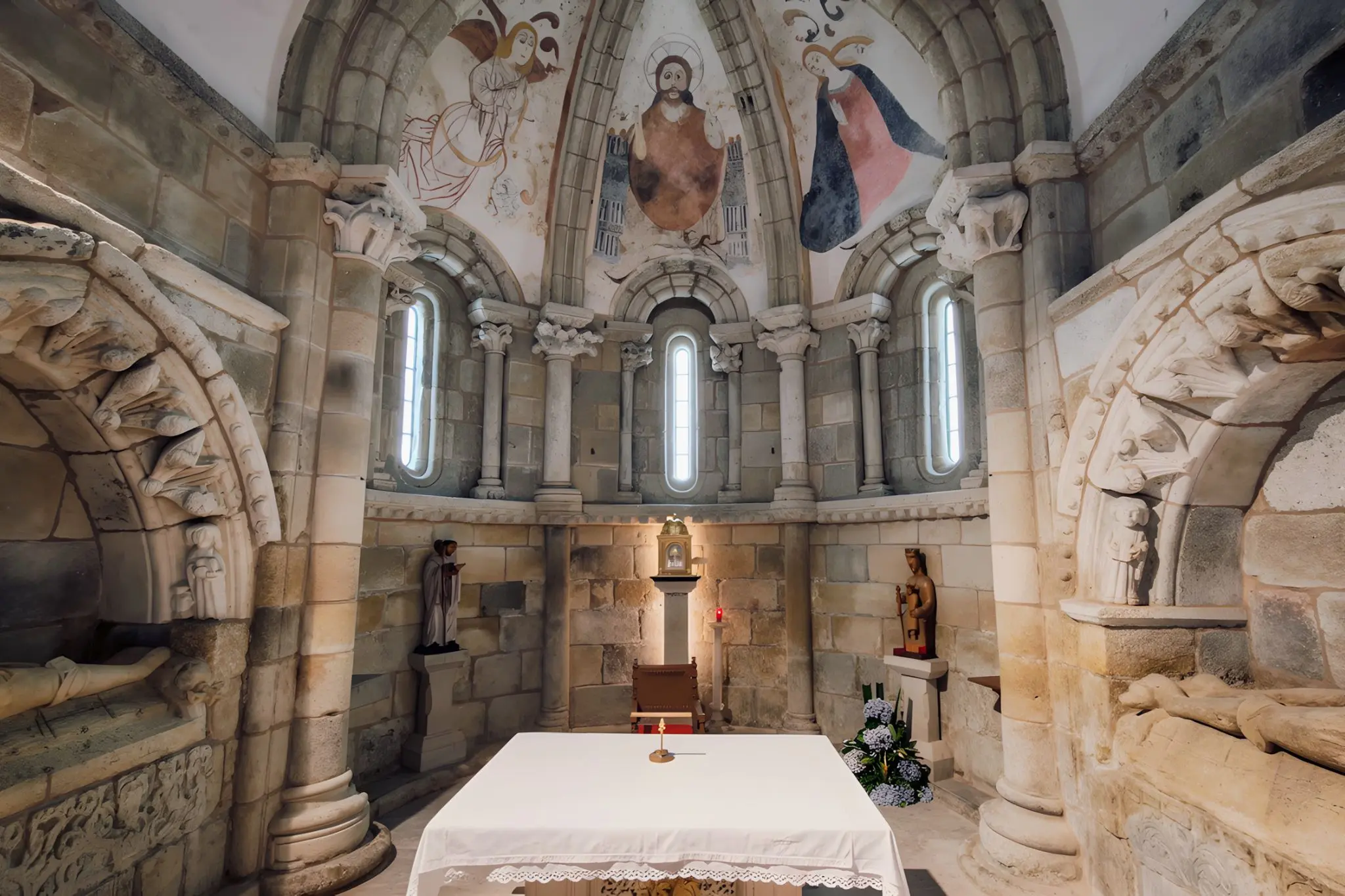
The Romanesque church is open — austere, balanced — but the life that defines the place happens elsewhere. There are no interpretive cues, no effort to translate monastic routine into visitor language.
Because the silence here is functional. It is structured by rule, repetition, and enclosure. Even the possibility of staying — occasional, discreet retreats — follows that same logic: limited, conditional, unadvertised.
Nothing performs itself.
Ribas de Miño: Silence After Use
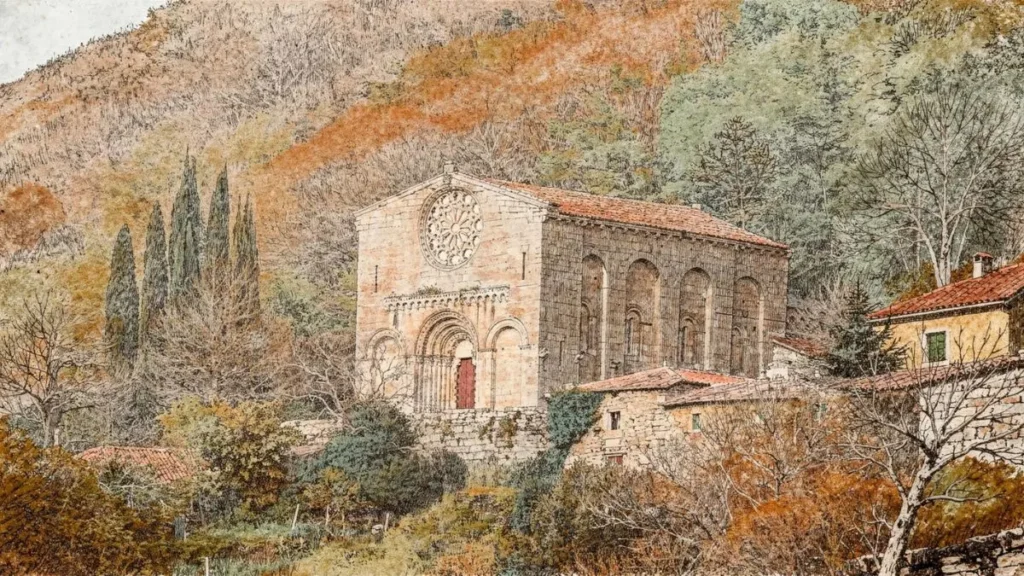
A short drive away, San Estevo de Ribas de Miño occupies a different condition.
Set above a bend in the river, it is one of the most refined Romanesque churches in Galicia — precise in proportion, deliberate in placement.
But what defines it today is not its design, but its absence of use.
There is no community. No internal rhythm. The structure remains intact, legible, even complete — but no longer active.
The silence shifts accordingly.
It is no longer produced, but accumulated. No longer regulated, but ambient. A silence that settles once function recedes, when a place becomes something observed rather than lived.
You are free to move through it. But that freedom comes with distance.
Two Temporalities, One Territory
Read together, Ferreira and Ribas make time visible.
At Ferreira, monastic time continues — cyclical, disciplined, still in operation. At Ribas, that same system has stopped, leaving only its architectural trace.
This is not preservation versus ruin. Both remain intact.
The difference is activation.
One produces silence. The other contains it.
Staying in the Tension
It would be easy to frame this as a simple contrast — living monastery versus inactive church. But the territory resists that clarity.
Because here, monastic life has not disappeared. It persists — selectively, quietly — within a landscape that has otherwise moved on.
And that persistence changes how everything else reads.
The vineyards, the villages, even the slower, wider river — all take on a different density once you recognise that silence here can still be lived, not only inherited.
At that point, Ribeira Sacra becomes harder to reduce to scenery.
It begins to read as a system still partially in operation.
Also in Stone and Silence
– Where Silence Breaks Into Space
– Before the Rule
– At the Edges of the System