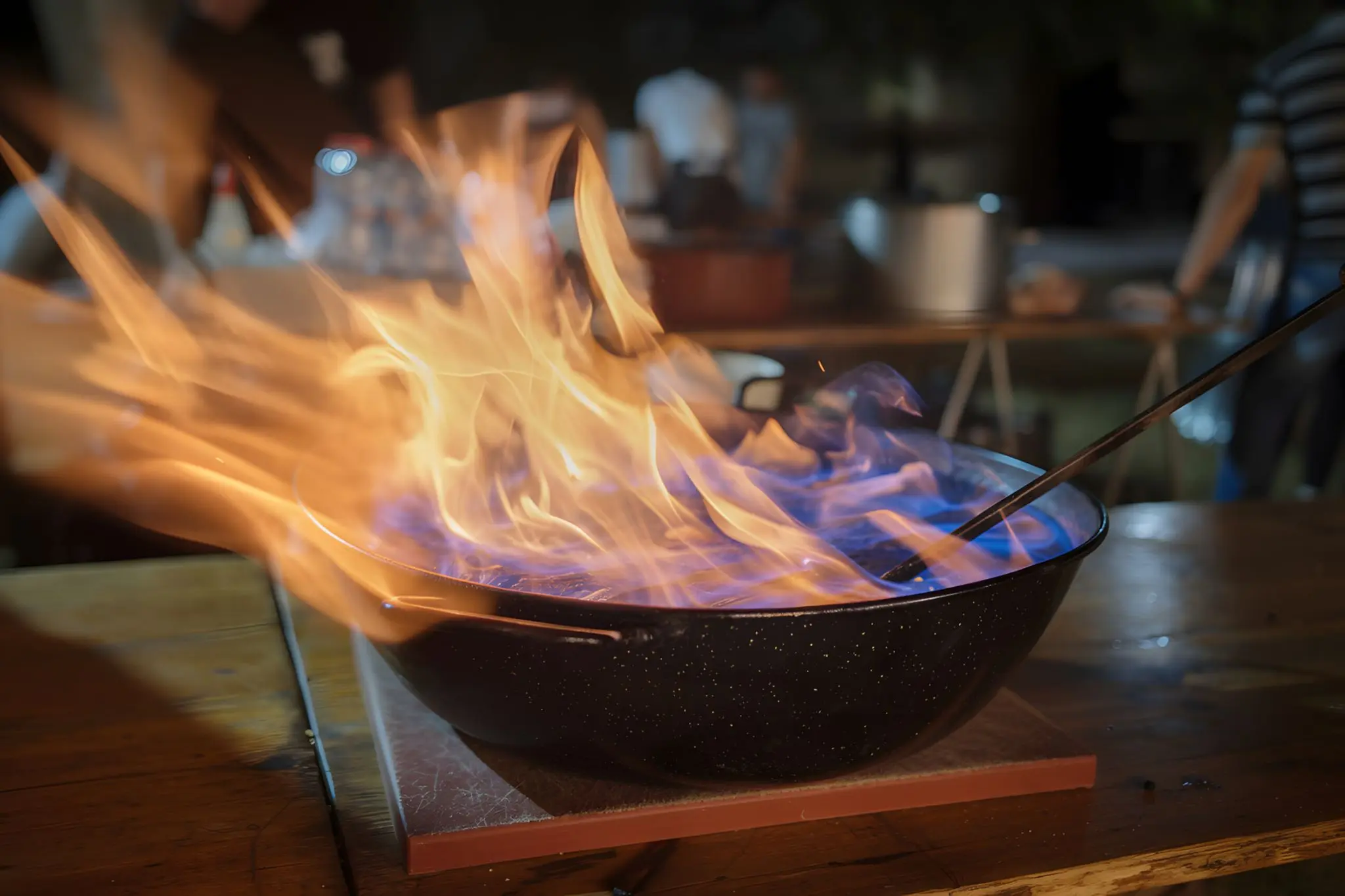
The augardente goes in first. Then sugar, lemon peel, coffee beans. Someone with calm hands tilts a ladle into the vessel — clay, usually, blackened by previous evenings — and lights the surface. A low blue flame begins its slow drift across the liquid. It will burn for a while before anyone speaks.
In a stone courtyard somewhere above the Sil, with the vineyards already dissolved into darkness and the sound of water somewhere below the walls, the queimada asks very little of you. Just that you stay.
What It Carries
Queimada is, technically, a flamed punch: spirits, sugar, citrus, fire. But reducing it to its recipe is like describing a conversation by listing the words. What holds the thing together is the conxuro — the incantation recited as the flame burns, traditionally in Galician, rhythmic and slightly hypnotic, addressed to the meigas and the night and whatever else might be listening.
The most widely known version of the conxuro is attributed to the Galician poet Mariano Marcos Abalo, written in the mid-twentieth century. This is worth holding onto: queimada as it is commonly practiced today is not an ancient ritual preserved unchanged. It is something more interesting — a twentieth-century codification of older instincts around fire, purification, and the power of spoken words. The “Celtic Galicia” framing that sometimes accompanies it is largely a romantic construction. What survives underneath is real enough without the mythology.
Where It Actually Lives
In Ribeira Sacra, queimada does not announce itself. It is not a nightly event at the local bodega or a bullet point on the village festival programme. It appears at the end of long dinners in rural houses, in the kitchens of casas rurales when the guests have stayed long enough to become temporary friends, occasionally in a stone barn near Parada de Sil when the occasion has earned it. It is situational. It cannot be scheduled.
This is what separates the inland version from what you might encounter on the tourist coast, where the props are larger, the fire more theatrical, and the conxuro sometimes translated into Spanish or English for accessibility. Those adaptations are not necessarily dishonest — they are just performing a different function. In the interior, queimada still tends toward the private, the restrained, the almost accidental.
The villages around Amandi are good territory for understanding this tone. Wine culture here operates at close range — between neighbours, between a grower and the family table. Queimada, when it appears, fits the same register.
The Conxuro
The incantation is not background music. It is the mechanism.
Recited as the flame burns and the ladle keeps moving, the conxuro addresses spirits and witches, asks for protection of the group, frames the act of drinking as a shared passage of some kind. Heard in Galician without understanding the words, it operates on cadence alone — the rhythm closes the room, makes the air feel slightly different, gives the silence between lines somewhere to go.
The power is not in belief but in participation. You do not need to subscribe to anything. You need only to be present, which in Ribeira Sacra — a territory where the quiet demands a certain quality of attention — is already something.
How to Find It
Not with a search. The best queimada in Ribeira Sacra will come to you when you have stayed somewhere long enough, eaten well enough, and shown yourself to be the kind of person who doesn’t rush the evening.
Be cautious of any version with a fixed price and a showtime. Look instead for small groups, unhurried hands, a host who knows the conxuro from memory and recites it without theatrics. The translation that flattens it into entertainment has already lost the thread.
The fire will burn itself out. Someone will pour. The night will continue in the ordinary way. But the room will have briefly been a different kind of room — one that understands something about time, and fire, and what it means to gather in a place that has been gathering people for a very long time.