9.6 km circular · ~3 hours · easy–moderate · Start: Belesar bridge, Chantada/O Saviñao
Belesar is one village with two municipalities and a single bridge holding them together, and the walk that starts there ends up crossing the Miño twice for the same reason the wine does. The families with cellars on one bank hold vines on the other. The river is the boundary; the bridges are the working arrangement.
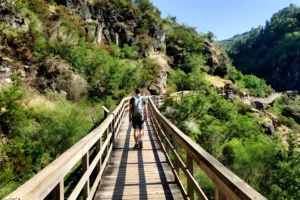
The signposted PR-G 183 is a 4.6 km traverse from the Belesar bridge up through the terraces and back down to the hamlet of A Veiga. It is homologated, well marked and one-way, which leaves the return as the only thing a walker has to decide. The version here turns back the short distance from A Veiga to the Portotide bridge, crosses to the O Saviñao side and takes 3.4 km of quiet road home — about 9.6 km in all, most of it soft underfoot.
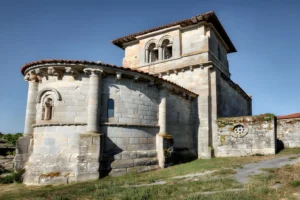
Park at the embarcadero on the O Saviñao side and walk over the yellow-railed bridge. On the Chantada bank the trail goes left, downstream, on a short stretch of cobbles below the church of San Bartolomeu. The Camiño de Inverno shares the bridge and nothing else: its arrows turn right and climb the Codos towards Chantada. Anyone who follows the yellow up the hill has committed to a very different afternoon.
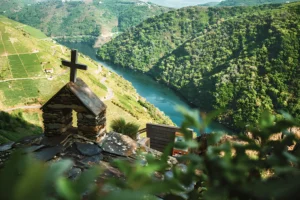
Then the vineyards, for the best part of two kilometres. These are the terraces that get photographed from across the valley, seen from inside instead: steel monorails running down between the rows to bring the crates off the slope, walls holding two or three vine-widths apart. Growers here call this band the Milla de Oro, the stretch of mencía and godello the Chantada subzone is priced on.
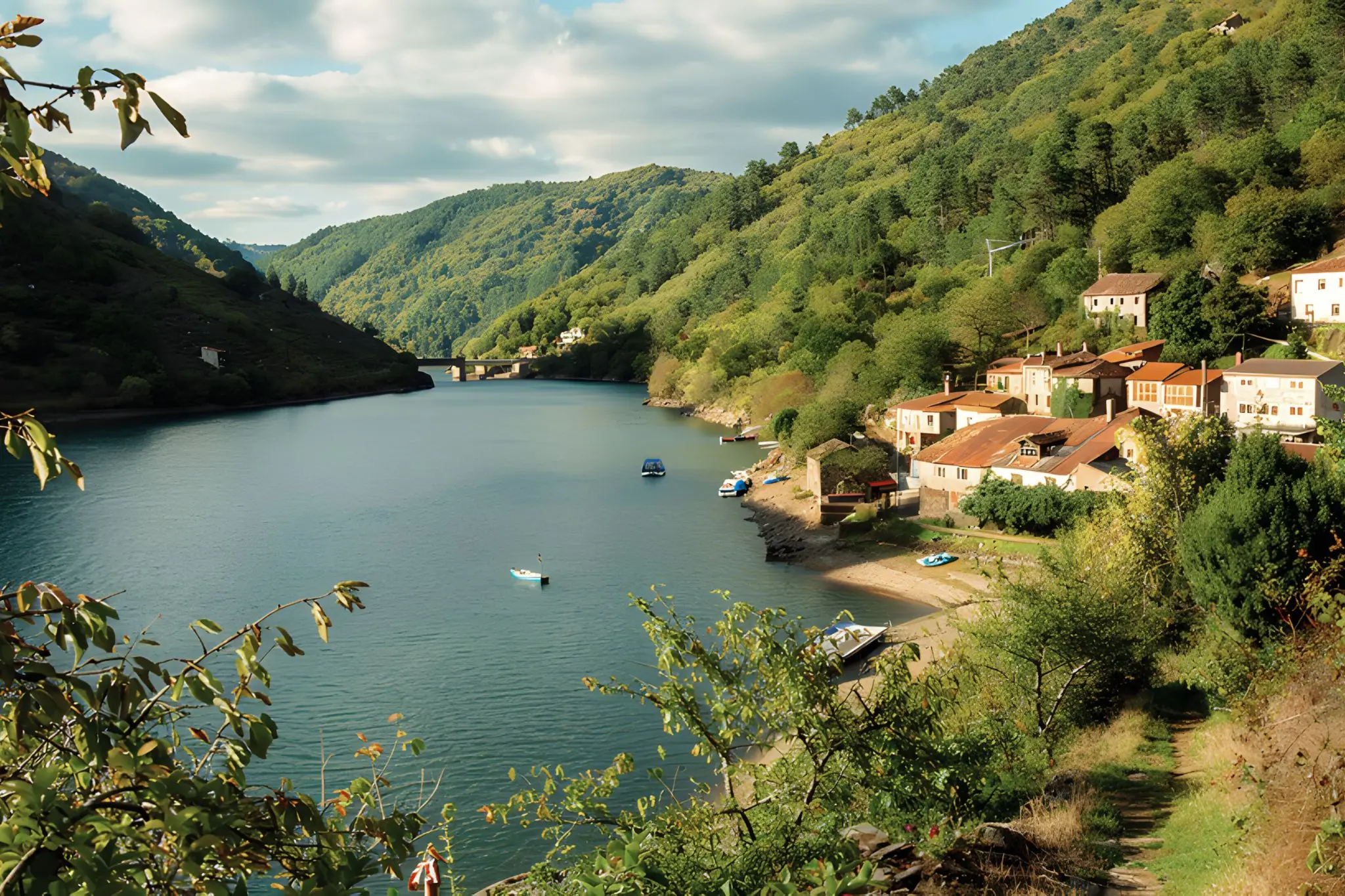
The path drops to O Pousadoiro, a few roofless houses on a shoulder above the water, and then to Pincelo, which is the reason to be walking here rather than looking at it from a boat. The hamlet sits at river level with its own embarcadero and a couple of batuxos still moored.
A few hundred metres on, the Portotide bridge comes into view — one lane, iron in the middle, and much bigger than it should be. The original was raised and stretched to 125 metres when the reservoir came up, keeping its old ironwork at the centre, and the same water took a good part of Pincelo’s riverside land. Leave it for now; the marked route carries on past a cruceiro and the mill at O Muíñovedro to finish at A Veiga.
The return is straightforward. Back to the bridge, across, and north along the road on the O Saviñao bank with almost no traffic and the morning’s terraces now opposite. A panel on this side of the crossing carries a photograph of Esther Teijeiro Lemos, born up the hill at Nogueira de Miño in 1936, who bottled her own wine while the valley was still selling in bulk and made the first organic wine in Galicia in 2000, at sixty-four. Her Adega Diego de Lemos is back in Pincelo; the five hectares that feed it are here, on this bank, across the water from the cellar door. That is what the bridge is for.
Turning at Portotide instead of going on to A Veiga makes a 7 km version that loses nothing except the hamlet, and is the sensible call in August, when the vineyard sections offer no shade at all and the schist holds the heat well past six. In the other direction, anyone still keen on reaching A Veiga can carry on uphill for a kilometre and about 110 metres of climb to the Miradoiro do Cabo do Mundo, which sets the meander below you from the inside; it sits off the marked route and costs the best part of an hour there and back. Spring and late October are the obvious windows. There is a bar at the Belesar embarcadero, easy to walk straight past if you have come only for the path, and nothing else on the route.