~34 km drive · 5 stops · 4–5 hours · Start: Os Peares · End: Ferreira de Pantón
The Pantón cluster does not announce itself. There are no canyon panoramas at the start, no signposted approach. The peninsula between the Miño and the Sil simply tightens around a working agricultural municipality, and inside that perimeter sits the densest concentration of rural Romanesque in Galicia — four parish churches and one still-active monastery, all within thirty-odd kilometres of road. The buildings reward the drive. The parishes around them reward staying longer than planned.
Start at Os Peares, where the Sil meets the Miño, and follow the right bank of the Sil up to San Vicente de Pombeiro. Documented in 935, the monastery was ceded to Cluny by Countess Urraca in 1108 and stayed Cluniac until the early sixteenth century, when it passed to Santo Estevo de Ribas de Sil. The church is twelfth–thirteenth century, basilical plan with three apses — unusual in the cluster. The murals inside are the reason to book the interior; through the north-wall glass panel they are partially visible, but the booked visit is what earns them.
Cross the Miño at Os Peares and climb to Santo Estevo de Atán, on the left bank above the river. The church reads as a transitional twelfth-to-thirteenth-century building, with pre-Romanesque latticework embedded in the tower — fragments of a cenobitic site that may go back to the eighth century. The interior, when open, holds fifteenth- and sixteenth-century murals: the Annunciation, the stoning of Saint Stephen, Santa Lucía with her eyes on a tray, a Last Judgement on the south wall. Access is via guided visit only; outside those hours it is firmly closed.
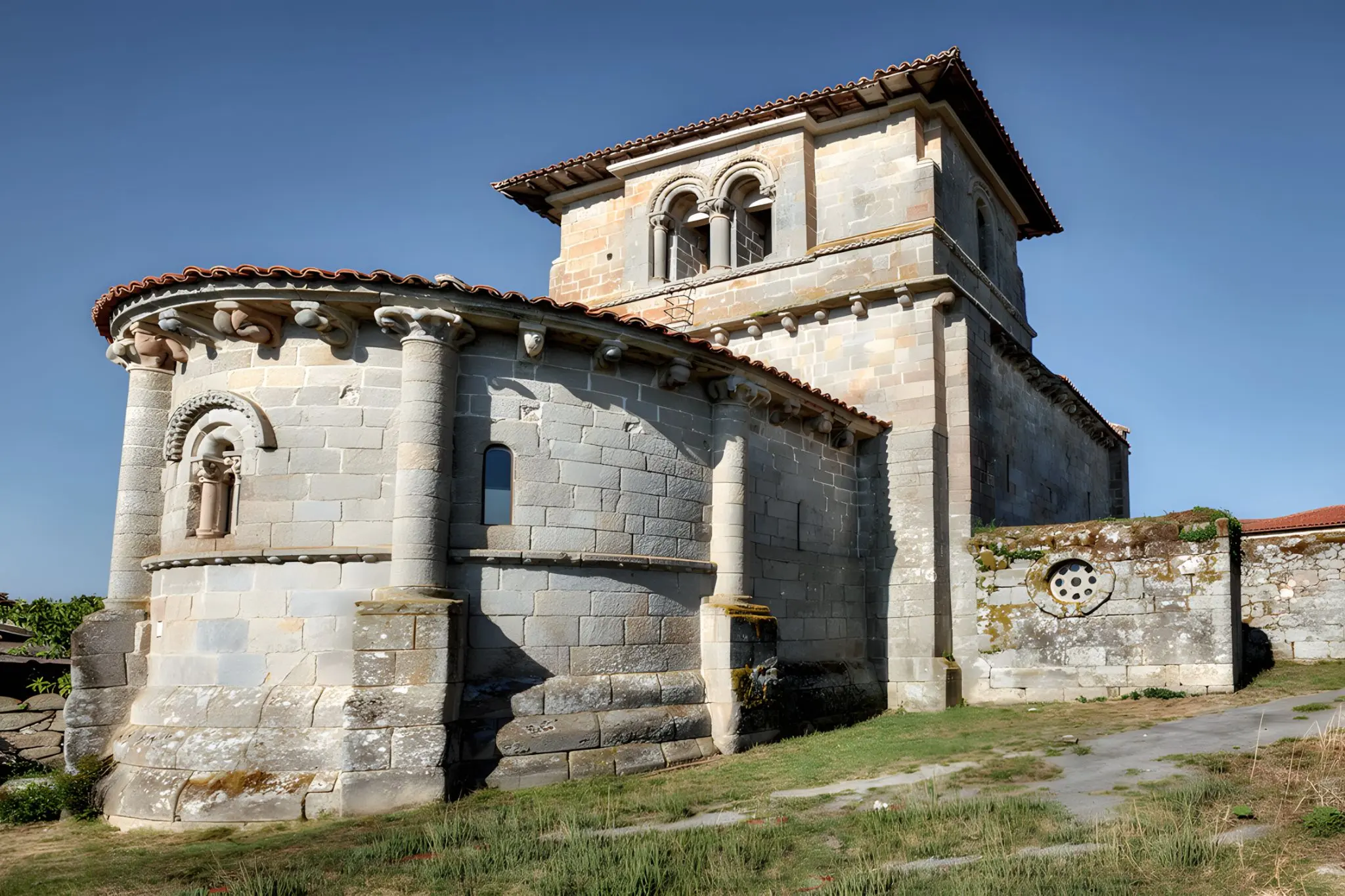
From Atán, drop inland to San Miguel de Eiré. The squat frontal tower is the giveaway — there is nothing else quite like it in Galician Romanesque. It is the only surviving piece of a twelfth-century Benedictine nunnery, declared National Monument in 1964, with the Agnus Dei on the north portal and three Romanesque baptismal fonts inside. The hamlet that grew around it is still called O Mosteiro. Key access is informal and via the neighbouring house — the kind of arrangement that either works on the day or doesn’t.
A short drive south brings you to San Fiz de Cangas, another former Benedictine nunnery, this one suppressed in 1494 when the abbess’s seat fell vacant and the property was annexed to San Paio de Antealtares in Santiago. The church is the last working fragment, late twelfth to thirteenth century, with an unusual basilical plan that originally projected three apses — one was replaced in the seventeenth century by the Torre Novaes funerary chapel housing the tomb of Rodrigo López de Quiroga. Outside the gate stands a fourteenth-century calvario, easy to miss.
Close the loop at Ferreira de Pantón — San Salvador, also known as the Mosteiro das Bernardas. First documented in 924, Benedictine, Cistercian from 1175 onwards, and the only monastic community in Ribeira Sacra that has held continuous female religious life through the entire arc. The twelfth-century Romanesque church is the architectural anchor; the cloister is fifteenth century, the rest eighteenth. The nuns sell their almendrados, coconut-honey balls and other pastries from a small shop, daily, 10:00–12:45 and 16:00–18:15. The cloister access is one euro. Of every stop on this route, this is the one that runs on its own schedule rather than yours.
Practical points fold in around the buildings. Most interiors require advance arrangement — the Consorcio de Turismo da Ribeira Sacra’s pilot opening programme is the cleanest single channel, and Pantón’s town hall (982 456 005) can point you toward the parish key-holders when the Consorcio is closed. October–November and late April–May are the right windows: the chestnut light through the souto stretches between Eiré and San Fiz is the second reason to come, after the stones. Combine fewer churches and longer interiors rather than the reverse — five exteriors in a day is feasible; five interiors is not. Lunch lives in Ferreira itself or in Monforte de Lemos, fifteen minutes south.
Igrexa de San Miguel de Eiré, Pantón, Lugo — photo by Á. M. Felicísimo, edited with AI.