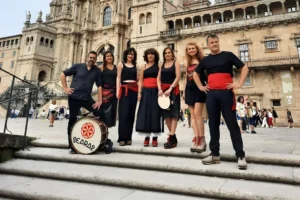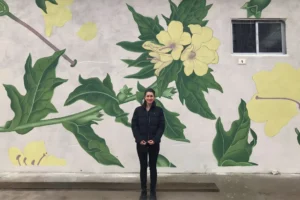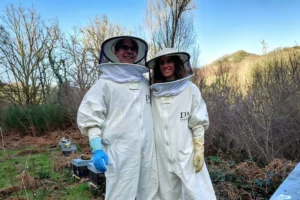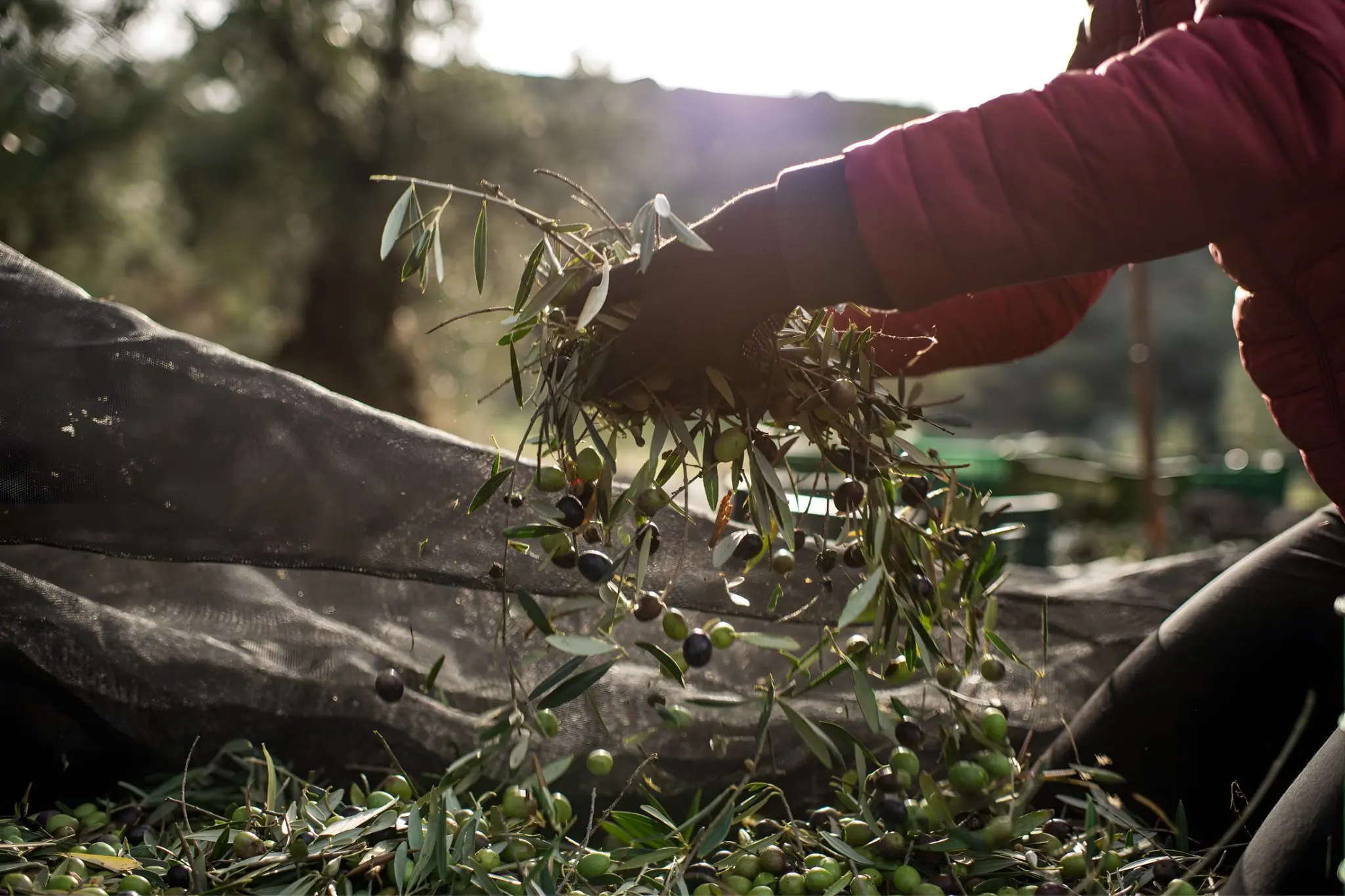
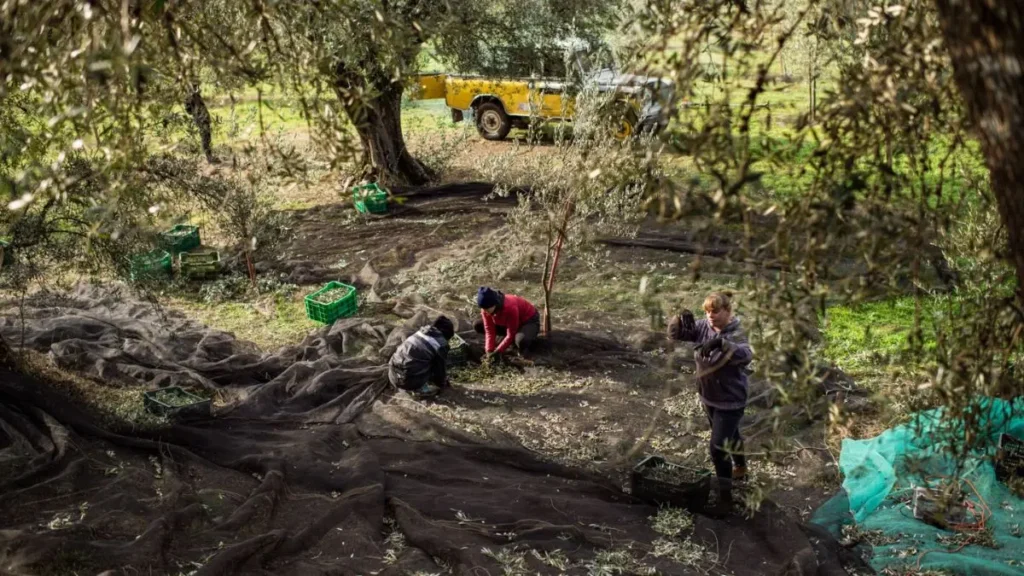
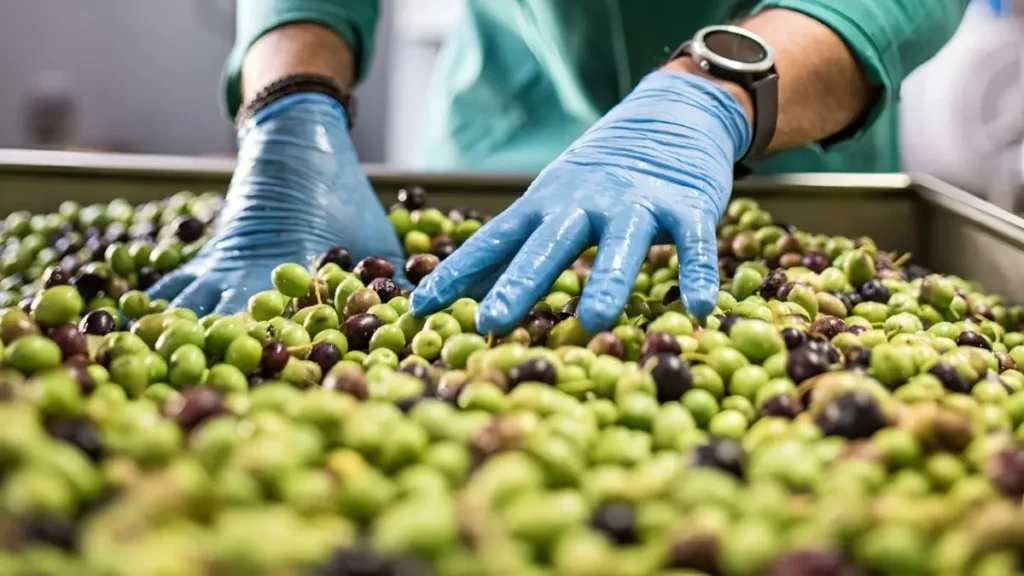
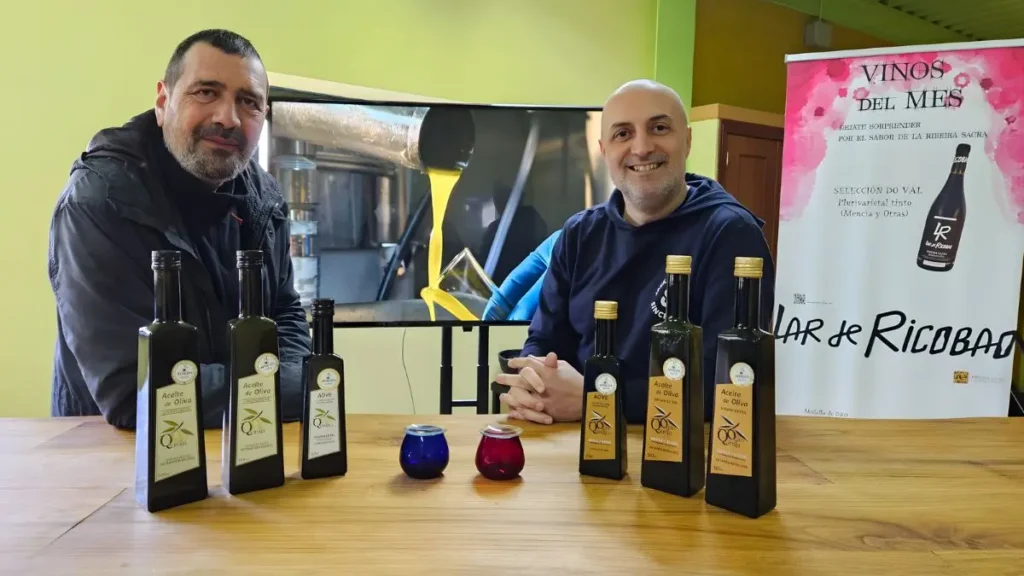
The Quiroga–San Clodio valley sits at the eastern hinge of the Ribeira Sacra, where the territory thins into the foothills of the Montañas do Courel and the Mediterranean reach of the inland Sil. It is also UNESCO Biosphere Reserve and Global Geopark territory. This is the part of Galicia that grows olives — quietly, in small plots, on varieties most of the wine country forgot it had. Ouro de Quiroga was set up in 2014 and today brings together four partners — Julio Quiroga, Suso Bao, Agustín Valcarce and Ofelia Ballester — to press olive oil from native trees and recover the abandoned plots, both olive and vine, around them. The bodega, Lar de Ricobao, came a year earlier, in 2013. Both projects work from the polígono industrial of Quiroga, run largely on renewable energy, and produce on a scale that sits closer to slow craft than industrial agriculture: about 4,000 litres of oil a year, 12,000 litres of wine. In May 2026 their Antiguo Reino Coupage 2025 took a Gran Oro at the CINVE international AOVE competition in Cáceres — the first Galician olive oil to do so.
Q. Start with the project. What is Ouro de Quiroga, in your own words?
Julio: A project to bring the best products of one very specific territory out of it — the Geoparque Montañas do Courel. The southern part of the territory, where it opens to the Sil canyon, has a Mediterranean microclimate that’s unusual at these latitudes. It gives us a raw material exceptional enough to make wine, AOVE, honey — the kind of things you can transform. What matters as much as the products is the recovery work: with the oil, recovering native varieties that were being lost and hadn’t even been identified. With the wine, going back into old vineyards nobody was working and pushing the native varieties.
Q. What olive varieties are these?
Julio: We’re still in the identification and recovery work, with the CSIC‘s Misión Biológica de Pontevedra and APAAG, the Galician olive and oil producers’ association we belong to. The project is funded by the Fundación Juana de Vega — the only institution that picked up the glove when our comarca kept saying it had native olive varieties, and the administration kept ignoring us.
The old growers always told us there were two types: bravas, smaller, lower oil yield, and mansas, bigger, higher yield. Today two are formally catalogued — brava gallega and mansa gallega. Nine more are in the catalogue process, with working names: susiña, carmeliña, bretema, maruxiña. The next step is mother plants for nurseries, so growers can plant them again.
Q. And you, Julio. Where did you come from to end up doing this?
Julio: My family is from Quiroga, and I came back constantly even after I trained as an electronics and telecoms technician and worked across Spain and abroad for years. My generation got told what everyone got told back then: study and leave, the village has no future. The roots stayed planted here anyway. In 2013, with a few friends, we started Lar de Ricobao with all the enthusiasm in the world — a bodega inside the DO Ribeira Sacra.
Q. And you, Suso?
Suso: I was born in Ponte Soldón, in Quiroga. I grew up here, studied, left like everyone else — and I still combine the work at the almazara and bodega with another professional life. The point of doing this was to give something back. We grew up watching the villages empty: thirty or forty inhabitants down to one or two, or none. This is a way to generate a little business here, create a few jobs — we have two or three employees now — so other people might have the option of staying.
There’s a lot said for the headlines, but when you get to the reality, you find inaccessible roads, half-done maintenance, and more obstacles every year for running a small operation like this one.
Q. And your relationship with Ribeira Sacra — territorial, emotional, in practice?
Julio: Territorially, total. The Quiroga–San Clodio valley, crossed by the Sil, is the natural gateway into Galicia and into a territory as diverse as Ribeira Sacra. Working inside a Geopark pushes you to do things as well as you can, so the comarca gets the recognition that usually goes elsewhere. Our climate, soils, orientations, altitudes — we produce almost everything here. To put it another way: we’re the comarca that supplies the most grapes to the DO.
Q. Are you inside the Ribeira Sacra DO?
Julio: We were. We believed, and we learned from the experience. We reinvented ourselves applying to wine the same criteria we apply to the oil — quality and differentiation, not volume. The problem with these regulatory bodies is that they get bureaucratised and politicised, and that affects small bodegueros and growers the most. If you wanted to try a sparkling, or a sweet wine, or work small multi-varietal plots, it was impossible. Innovation wasn’t facilitated, and without innovation the future of the wine sector isn’t bright. We’re very happy with this new phase, and we’ll be releasing new labels this year that won’t leave anyone indifferent.
Q. Your corner of the territory — somewhere that defines your bond with it. One each.
Suso: The Soldón river basin. The Soldón is born in A Seara, up in the mountain inside the Serra do Courel, and ends in my village, Ponte Soldón. What it gives me is calm. The autochthonous forest is still there — chestnut, dehesas — with its streams and waterfalls. You walk slowly along the paths and the world stops. It’s a wonderful place to disconnect. It’s becoming a little better known now: the Camiño de Santiago — Camiño de Inverno — passes through. But the pilgrim it brings is a different kind, the one who’s already done the other routes and is looking for something quieter.
Julio: For me, without a doubt, the Castillo de Os Novais. My home.
You have to make the most of the raw material that’s unique to this area — that’s what positions you internationally. — Suso
Q. The legacy question. What would you want remembered?
Julio: That we put this place into value. That young people here see they can build a life in the rural — that quality products from our territory are appreciated outside Galicia, that they don’t have to carry the complex my generation got handed, the one that said you had to leave because there was no future here. If we can shift that even a little — more people coming back, more people staying — that’s the legacy I’d want.
Suso: Same. That the project works as an example. Not just wine or oil — tourism, market gardens, whatever. The point is people see it can be done. You have to do things very well, make products of very high quality, take advantage of the raw materials that are exclusive to this zone — both wine and AOVE — and that positions you internationally. It’s already happening: we just took a Gran Oro at the CINVE international competition with Antiguo Reino Coupage 2025, the first Galician AOVE ever to do so, and a Diploma de Oro for our godello. And if the land stays worked, the hills stay clean, you don’t end up with the fires we get every year. A worked landscape doesn’t burn the same way an abandoned one does.
Q. One piece of advice for a first visitor. You can’t say “drink your wine”.
Julio: Come without a hurry. Get your bearings, and don’t stop at the Instagram shot from the viewpoint. It looks like a small territory, but it’s diverse — and everything inside the UNESCO Geoparque Montañas do Courel, the geology, the villages, the rivers and waterfalls, the forests and dehesas, will be an experience that I guarantee they’ll fall for.
Suso: Same. Integrate, even for two days. Go to the bars where locals go, take the wine, walk through the villages that aren’t in the guidebooks — the inland ones. Soak up the rhythm. It’s a completely different one from the city.
Q. What’s on the horizon?
Julio: A new oil line — Antiguo Reino — plus new wine labels rolling out over the coming months. And an experience programme: not standard group tastings, which we’ve paused, but proper pairings in the bodega for visitors who want something more considered. Anyone who turns up is still welcome — there’s product on display, oil to taste, wine and honey — but the full version arrives when the new experiences launch.
Q. One thing you’d change about how Ribeira Sacra is perceived from outside?
Julio: I’m not sure I have enough contrasted knowledge of how outside visitors perceive the territory. What I can say is that we lack the infrastructure for mass tourism, and the gaps are already showing in certain zones and at certain times of year. We’re small dispersed nuclei with poorly maintained infrastructure and low accommodation capacity. Depopulation makes daily life harder. None of that should stop us pushing for excellence in what we offer — and attracting a visitor who values the quality of the experience over crowding into a handful of spots.
Fire Round
A place
Suso: The meander of A Cubela, in Ribas de Sil. Julio: The Castro de Penadominga, in Bendollo.
A dish
Julio: Bread with our oil. Suso: A good churrasco.
A route
Julio: The Ruta da Encomienda. Suso: The Fervenza de Vieiros.
A word
Suso: Pegada — footprint. Julio: #UnValUnSoño — one valley, one dream.
A misconception
“That Ribeira Sacra is only the canyon of the Sil. Only the photograph. We’re more than a photograph.” — Suso
All photos courtesy of Ouro de Quiroga. Not for reproduction without written permission.