Three different UNESCO programmes touch this territory, and they were never meant to do the same thing. They share an acronym and a tendency to appear on the same brochure, but they operate on different criteria, different perimeters, and different timelines. None of them, on its own, protects the place. Two of them weren’t even designed to.
The oldest of the three covers the smallest area. Montañas do Courel was declared a UNESCO Global Geopark in April 2019, the first in Galicia. It covers 577 square kilometres across three municipalities — Folgoso do Courel, Quiroga, and Ribas de Sil — and sits on the eastern flank of Ribeira Sacra rather than inside it. The Geopark designation is an educational and interpretive framework — museums, geosites, geological routes, the Campodola-Leixazós fold, the Roman gold workings. It does not bring any new protective status with it. The Geopark cannot stop a quarry; it can only contextualise one.
The second label is the largest in scope. The Reserva da Biosfera Ribeira Sacra e Serras do Oribio e Courel was proclaimed by UNESCO’s Man and the Biosphere programme in September 2021, covering 306,535 hectares across 23 municipalities — 18 in Lugo, 5 in Ourense. A Biosphere Reserve is administrative scaffolding. It asks the territory to reconcile biological and cultural diversity with economic development; the actual protective force still comes from the underlying instruments, mostly Red Natura 2000 zones that predate the designation. Being inside a Biosphere Reserve does not, by itself, stop a wind farm. It commits a region to a plan. The plan’s authority is local.
The third is still unfinished. Ribeira Sacra: Paisaxe da Auga — Cultural Waterscape — is the current candidature for World Heritage status, covering 26 municipalities. A first version was withdrawn in 2021 after an unfavourable ICOMOS report; the rewritten dossier, reframed around water as the organising element of the landscape, was submitted to UNESCO in early 2025. A technical mission visited the territory later that year. The decision will be taken at the 48th session of the World Heritage Committee in Busan, South Korea, in July 2026. If it succeeds, Ribeira Sacra becomes Spain’s 51st World Heritage site. If it doesn’t, the candidature can be reworked again.
This is where the confusion starts. The three perimeters overlap unevenly. The Geopark sits inside the Biosphere Reserve, but not inside the proposed Waterscape. The Waterscape and the Biosphere Reserve share most municipalities, but not all. Ferreira de Pantón hosts a Geopark interpretation centre but is not in the Geopark. Monforte is in two of the three. The visitor sees an acronym repeated and infers a single status. There isn’t one.
What each label does well is also different. The Geopark is the most self-contained: visit a geosite, read the panel, the work has been done. The Biosphere Reserve is mostly a planning framework — its outcomes depend on which concello picks it up and which leaves it dormant. The World Heritage bid, regardless of the July 2026 outcome, has already produced the most material effects: roughly eight million euros in patrimonial conservation across more than forty sites in the candidature dossier, plus a recent line of aid for terrace erosion protection.
What none of the three labels does is keep people here. They restore monasteries, panel geosites, fund terrace walls. They don’t bring back the bakery that closed in the village last spring, or the school that’s down to nine pupils, or the young winemaker who took an offer in Madrid. Those decisions are made elsewhere — at the concello, at the kitchen table, at the bank. UNESCO is good at protecting the things made by people who used to live here. The question of whether anyone still will is a separate one, and the answer is being written without any acronym on it.
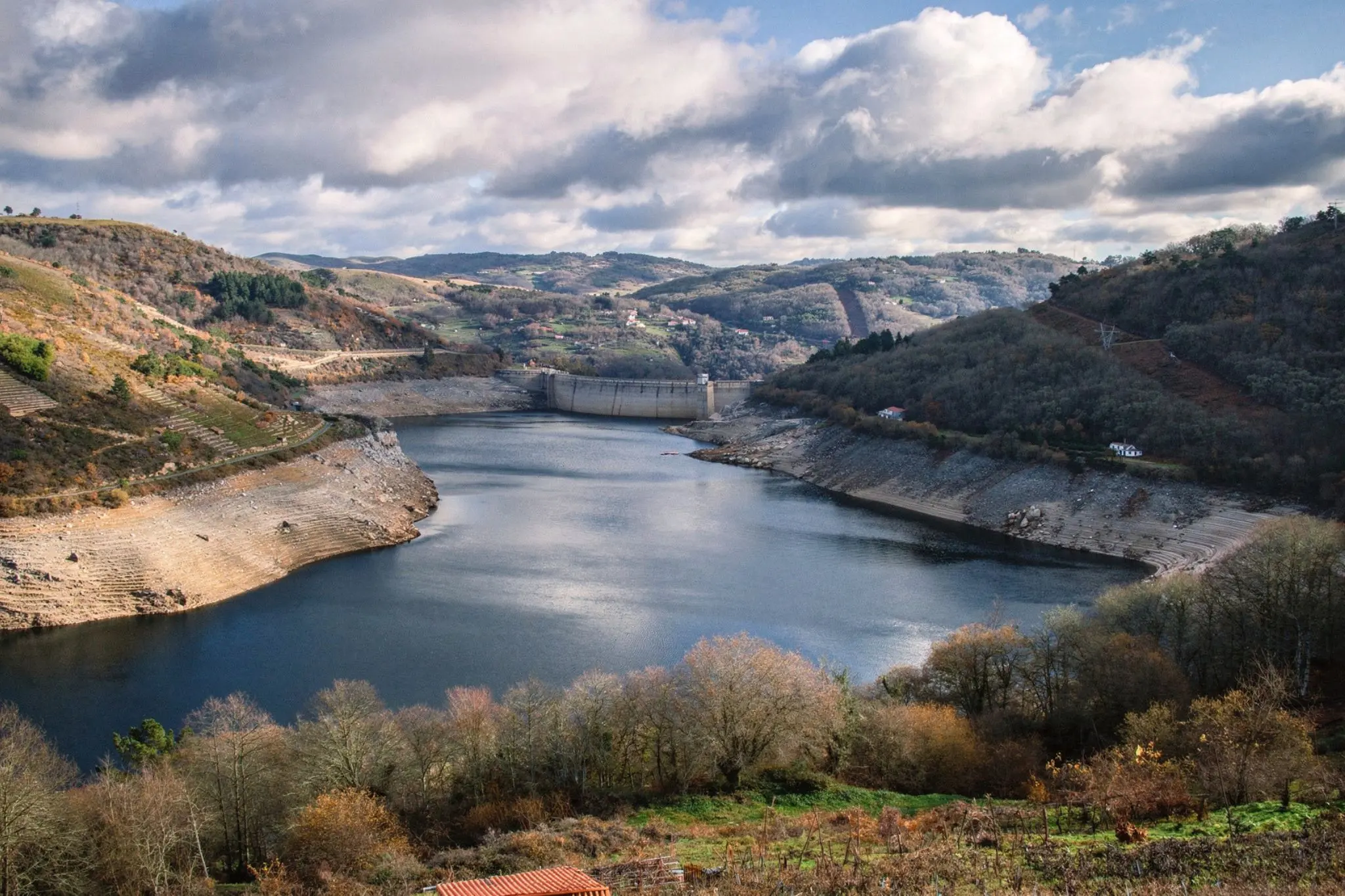
Belesar Reservoir from Pequeiras, Chantada — photo by B. Riobó, edited with AI.