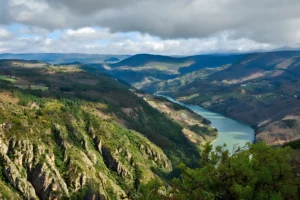
Leaving Monforte eastward, the large panel over the road names the Sil canyon. It does not name Quiroga, which is where the road actually goes. What follows is half an hour without a reason to stop: burnt slopes on both sides where the fires came through, the Lor valley with its shuttered roadside restaurants, and nowhere to pull over for a coffee until the valley opens out.
Then it does open out, and the reason to be here starts making sense. Quiroga is one of the few corners of Ribeira Sacra that repays booking somewhere and unpacking, and half an hour of empty road is a poor introduction to it.
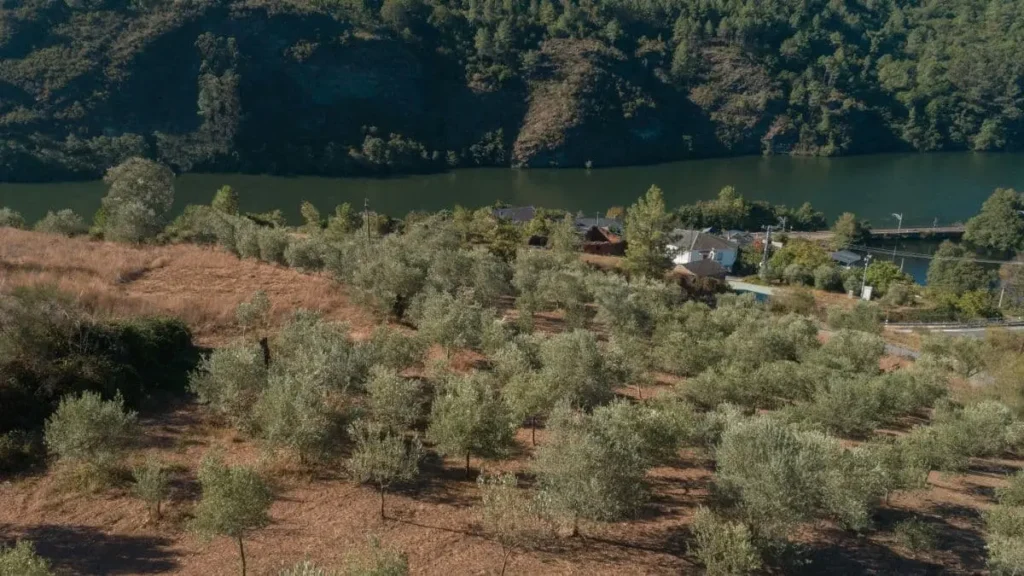
The case is density, and it is a specific kind. Elsewhere in the territory the good things are strung along a route — you drive, you look at a church, you drive to the next church. The pleasure is real but the register never changes. Around Quiroga the things within a short radius are not variations on each other. There is a Roman tunnel driven through a mountain to move a river. There is a fold in the rock half a billion years old that you can see with your eyes. There is olive oil in Galicia. There is cold mountain water at the top of a valley warm enough to grow the olives. These are not five more apses. They ask different things of you, and a day spent rushing between them leaves you having looked at four things and understood none.
This is measurable rather than atmospheric. When we mapped the gold and rock drive, it would not fit into one day — not because of distance, which is trivial, but because the Roman extraction story and the geological one run on incompatible rhythms. One is industrial and sequential; the other asks you to stand still. Splitting it across two days was a structural decision, not a concession to slow drivers.
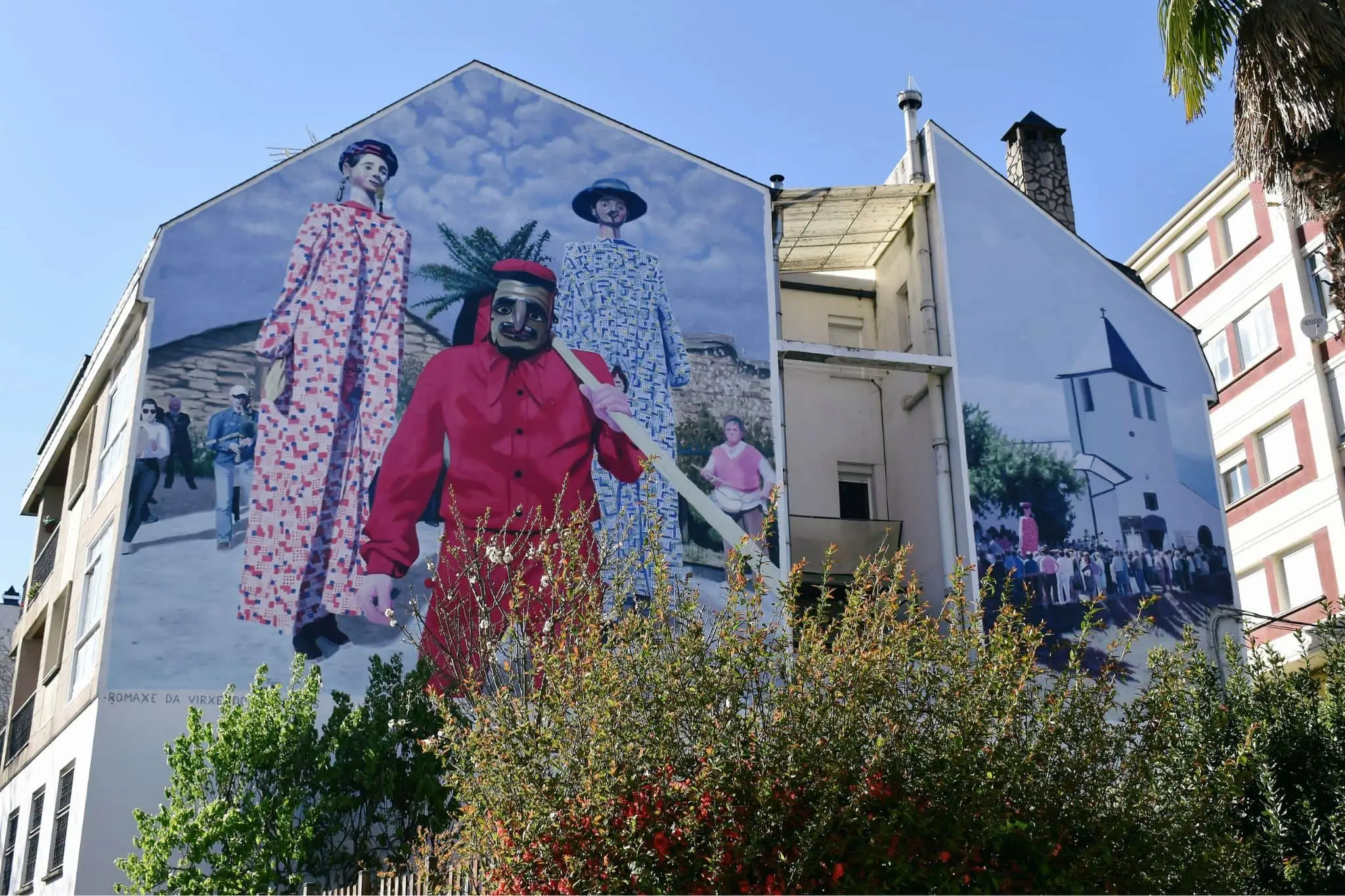
Quiroga itself is the part that surprises people who arrive braced for a service town. It is small, it is losing people, and it has decided to be pleasant anyway. A metal grape cluster stands beside the letters spelling QUIROGA at the entrance, which is fair — this is DO Ribeira Sacra ground, a couple of hundred hectares split between nearly two hundred growers — but the wine is the least surprising thing here. Nineteen murals are painted across its buildings on a marked urban art route, added over roughly seven years, and the subjects are the valley’s own material rather than generic brightening — the wine festival, honey, oil, a pilgrim on the Winter Way, an alvariza, the Sil laundrywoman out of local legend, Rosalía de Castro. Several stops carry audio recorded by students at the local secondary school, reading their own town’s walls. The route is publicly funded and could easily have been the usual municipal decoration; it is better than that, and it changes who walks around. You notice a different sort of visitor here, moving on foot and unhurried, which is not the pattern anywhere else in the territory.
The demographic floor under all this is stated plainly in the register: 3,035 people, ten births in a year against fifty-six deaths. Nearly six to one. Nothing about the murals or the museums changes that arithmetic, and the guide would be dishonest to imply otherwise. What the arithmetic does not tell you is that the place is good to be in, which is a separate fact and also true.
Two museums anchor Quiroga — geological and ethnographic — and the geological one is the reason most outsiders stop. Both keep hours that are a matter of local arrangement rather than published fact, so call before you plan around them. Up the valley, the falls and pools run cold off slate and quartzite, the exact inversion of the olive ground below: Mediterranean at the valley floor, Atlantic mountain twenty minutes above it. The Camiño de Inverno enters Ribeira Sacra just east of here, following the road the gold traffic had already surfaced a thousand years before any pilgrim used it.
Practically, this is the far end of the territory and the distances are real — the western concellos are an hour and a half away on roads with no motorway. That is the argument for staying rather than the obstacle to it. For a town this size the range is better than you would expect — a well-regarded small hotel, a few hostales, some apartments — which is what a pilgrim route does to a place; August still needs booking ahead. Go after rain if the water is why you came, since the falls thin exactly when the heat makes them most appealing. Autumn is the valley at its most itself, with the chestnuts and the olive harvest starting together. On the way in, when the panel outside Monforte sends you toward the canyon, keep going east.
Romaxe da Virxe da Ermida Mural in Quiroga, Lugo — photo by A. Estévez.
Olive terraces above the Sil at Quiroga — photo courtesy of Ouro de Quiroga.