A grower who has spent his life on these slopes said something recently that has been difficult to shake. In the old days, he said, the vines were money. Not a metaphor — money. You could turn grapes into cash whenever you needed it, at almost any moment, and for a long time it was the only hard currency a family here reliably had. The wine was secondary to the liquidity. The row of vines was a bank account you could walk out to and draw on.
Read against the latest figures from the Consello Regulador, that sentence stops sounding nostalgic and starts sounding like an accountant’s footnote to a business that has quietly changed what it is for.
The Two Years Nobody Wants to Frame
For a decade the story you could tell about the appellation was one of a plateau: production bouncing between five and seven million kilos, never quite growing, never quite breaking. That story is over. The 2024 and 2025 harvests are two consecutive drops — 6.7 million kilos in 2023, then 4.9, then 4.6. A fall of just over thirty per cent in two years, and the lowest output since 2008. Red grapes took the harder hit, down almost forty per cent across the same span; the mencía that is supposed to be the region’s signature fell from 5.2 to 3.2 million kilos.
The people figures are worse, and they are the ones that matter. Registered growers have gone from 2,906 in 2005 to 1,878 in 2025 — a loss of more than a third. But the shape of that decline changed abruptly last year: between 2024 and 2025 the register lost 291 growers, a drop of over thirteen per cent in a single twelve-month span. Two decades of slow bleeding, and then, in one year, almost three hundred people simply gone from the books. Ribeiras do Sil, the emptiest sub-zone, shed nearly thirty per cent of its growers in two years.
One curve, and only one, points up. White production hit a record in 2025, with godello alone accounting for a fifth of everything the appellation made. As the reds fall away, the white grape that arrived without the burden of unbroken tradition keeps climbing. The region is quietly becoming something other than the red-wine territory its own marketing still describes.
What a Slope Is Worth, in Euros
In June 2026 the regional government published, in the official gazette, the list of growers receiving aid “for the conservation of the landscape and the fight against erosion” in Ribeira Sacra’s vineyards. Seven hundred and twenty-eight names, more than 1.5 million euros, entirely from the region’s own funds. Set against the 1,878 growers on the register, that is thirty-nine per cent of them — nearly two in every five — receiving a public payment to keep their terraces from being abandoned.
The rate card says the rest. For vineyards on stone terraces worked by hand, up to 2,000 euros per hectare. For anything mechanised, half that. The administration is, quite literally, paying double for the slope that a machine cannot reach — putting a public price on exactly the difficulty that the phrase “heroic viticulture” was invented to sell.
The vines were once the asset that generated the money. Now they are the asset that has to be paid to survive.
This is the inversion the grower’s sentence points at, without meaning to. The terraces have not changed; their economic direction has. A row of vines that a family could once cash out at will is now, for a large share of the people who own it, something that runs at a loss unless the state makes up the difference. What used to be a source of income is now a cost to be covered.
The Terrace Finds a Second Job
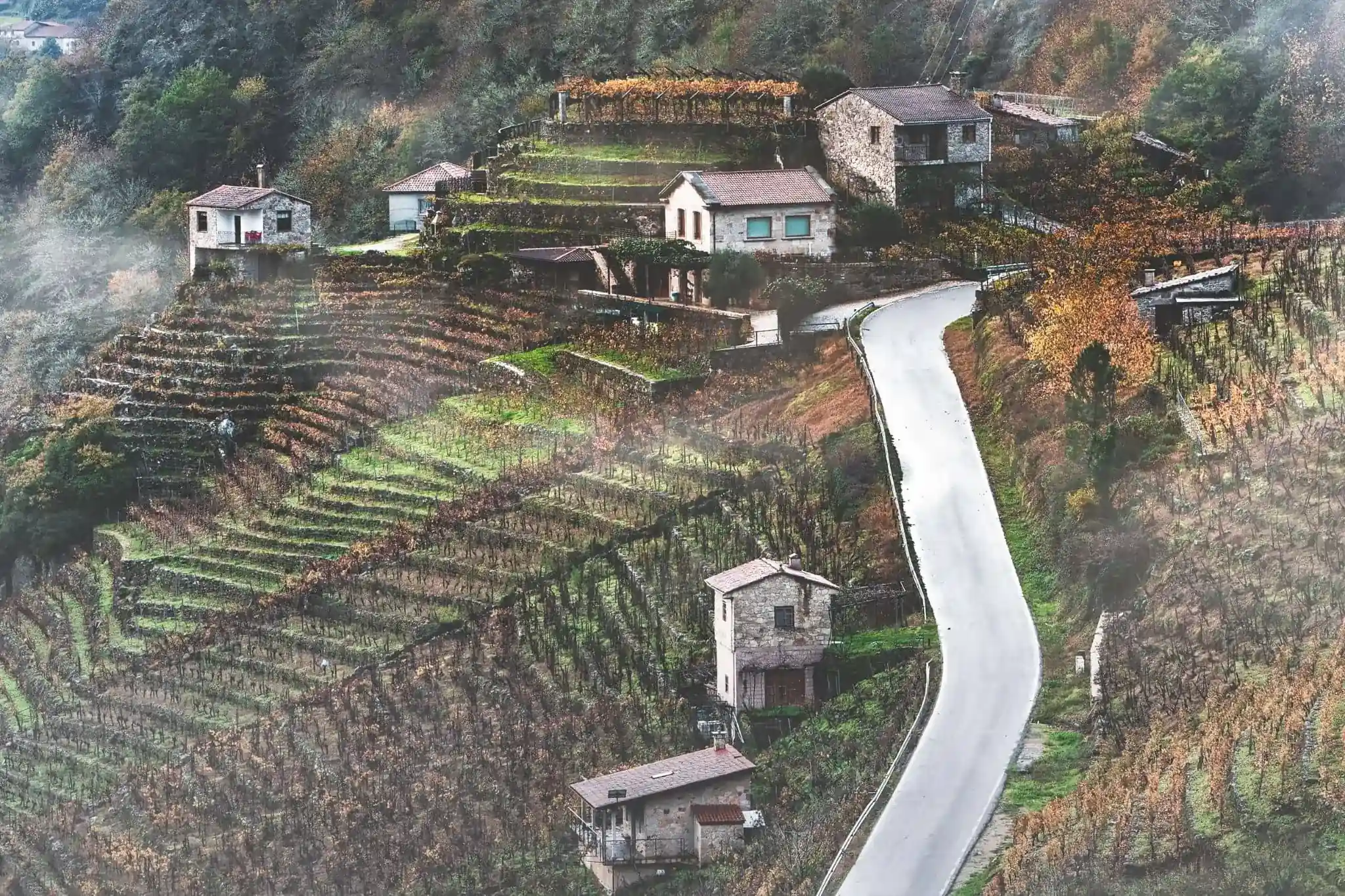
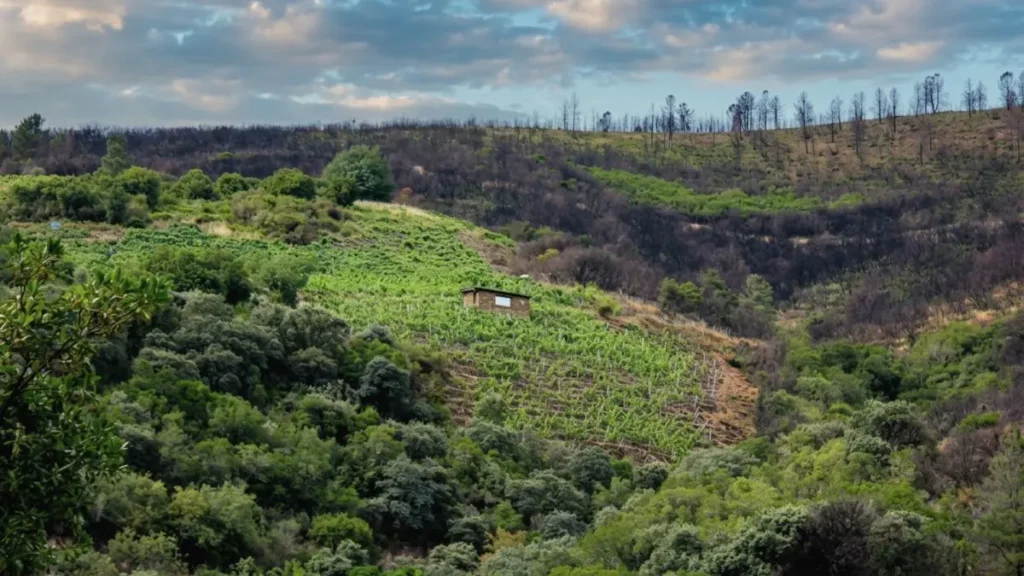
There is, of course, another way to make a terrace pay, and the market has found it. The casas rurales that filled up during the pandemic — shared, sociable, a room in someone’s converted farmhouse — have given way to a newer word: casa vacacional. The demand now is for privacy, for a whole small building to oneself, and the supply is sitting all over these hillsides in the form of old adegas and stone casetas de viña, the little vineyard huts built to store tools and shelter from the rain.
Converted, insulated, fitted with good linen and a wood stove, one of these sheds now lets for two hundred and fifty euros a night. The socalco that no longer reliably produces wine has been repurposed to produce sleep. It is, on any honest accounting, better than abandonment: a maintained terrace with a cabin on it is a terrace that still has a reason to exist, still gets its walls repaired, still keeps the scrub back. The landscape survives because someone is paying to wake up inside it.
Whether that is the same landscape is a quieter question, and not one the numbers can answer. A terrace that grows grapes and a terrace that hosts a couple from Madrid are, from the viewpoint boat on the river, indistinguishable — the same stone lines on the same impossible gradient. They diverge only in what they are for. One is the tail end of a thousand-year agricultural system. The other is that system’s masonry, kept standing by a different economy entirely, and doing what it has quietly learned to do: converting the difficulty of the slope into a premium someone will pay for.
None of this is decline dressed as tragedy. The wine is, in the glasses that survive, better than it has ever been; the growers who remain are more deliberate than the bulk producers who left; the terraces that have found a paying guest are terraces that will still be there in twenty years. But the direction of the thing has quietly reversed. The vineyard once turned into money on its own. Now it is kept going by money that comes from somewhere else — a subsidy line, a guest, anywhere but the grape.
Ribeira Sacra — terraces holding vines, homes and guests — photo by N O E L | F E A N S.
Sil canyon — a vineyard hut below the burn line — photo by P. Vanossi, edited with AI.