~10 km circular · ~3.5 hours · moderate · Start: Salcedo, A Pobra do Brollón
The PR-G 236 is named for two things you can eat, and it keeps the promise. It loops out of Salcedo, in A Pobra do Brollón, on the stretch of ground between the Ribeira Sacra and O Courel, and it passes the structures that chestnuts and honey once required: a drying house in a chestnut grove, and a stone enclosure built to keep bears away from the hives. There are older things on it too, and the oldest comes first.
You leave the village on a wide dirt track that soon forks. Keep right. It loses height gradually, across meadows, reforestation and native trees, and a couple of kilometres out a short marked detour leads to Penas do Castelo, an Iron Age site hanging over the Lor a few kilometres above its meeting with the Sil. Digs in 2021 and 2022 uncovered a wall six metres wide and both sides of a monumental gateway into the main enclosure. Take the detour. Nothing later on the route goes this far back.
Back on the track, the Miradoiro da Pena dos Pasos lays out the descent ahead: the valleys of the Lor and the Loureiro below you, and on a clear day the O Courel ridges behind them. The 2022 fire is still visible from here. Most of the slope has come back green, but the marks are there, and the recovery work is still under way.
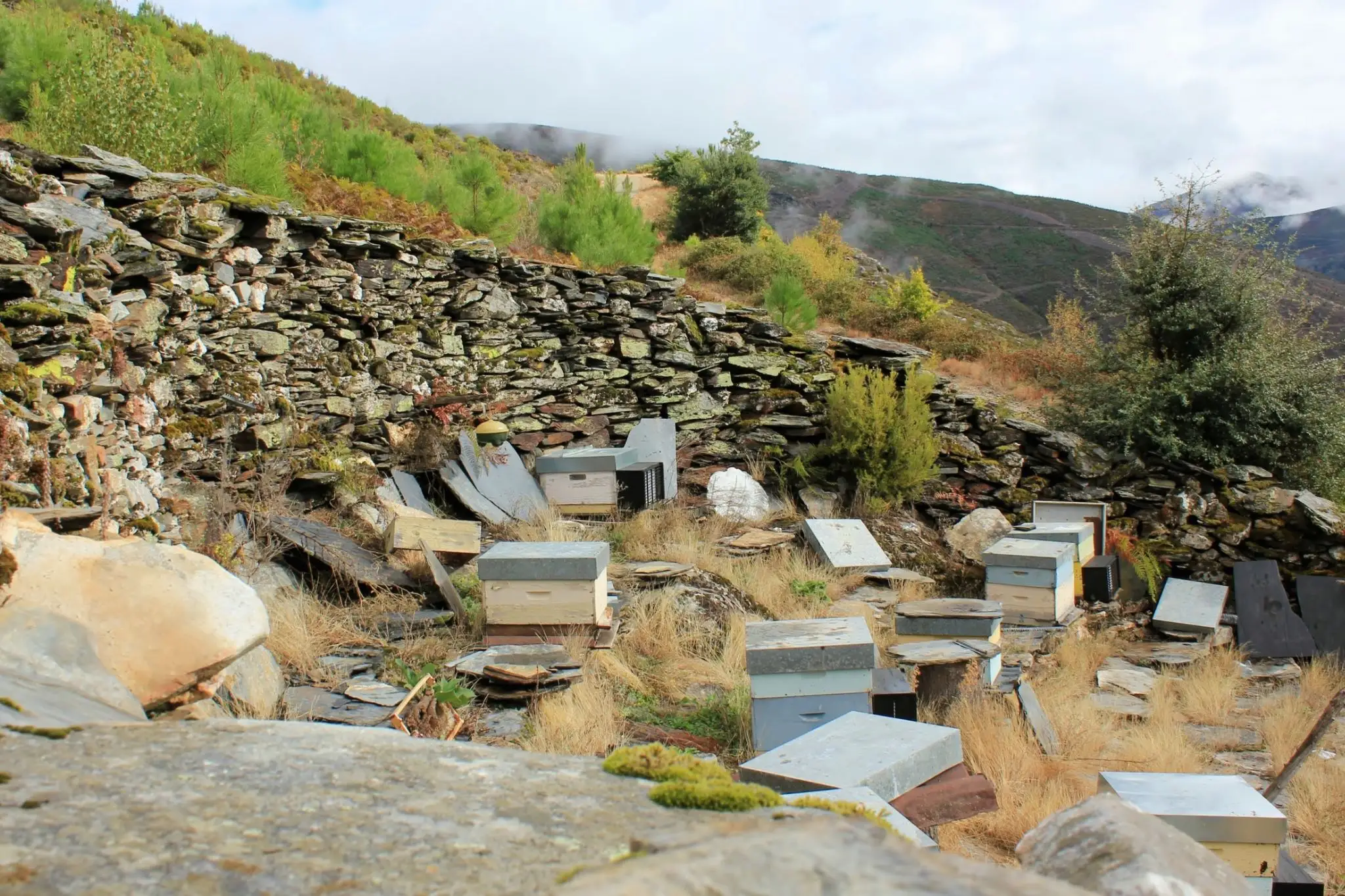
Below the miradoiro comes the honey half of the name, in the form of an alvariza, a stone enclosure built on the hillside so that bears could not reach the hives inside. This one still holds working hives; others stand further off on the slopes, out of use and visible only from a distance. The bear has a place in Salcedo’s calendar as well as its walls: the parish is known for the Entroido do Oso, its bear carnival.
From here the descent gets serious, down to a wooden footbridge over the Loureiro, and on the far side lies the souto de Paramedela, a chestnut grove managed by the Xunta de Galicia. In it stands a restored sequeiro, the drying house where the harvest was dried, and you can walk inside. This is the chestnut half of the name.
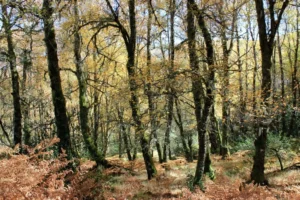
The climb back is where the route turns into mountain. You leave the grove on the old Paramedela path, a trail rather than a track, working mid-slope through oak and chestnut towards Salcedo. The ground is rough in places, and the wild boar have clearly been through before you. What carries you up is the madroño, the strawberry tree, which grows along this stretch. Its fruit takes a full year to ripen, so in autumn it hangs yellow, orange and red among the flowers of the following year’s crop, and by then it is sweet enough to eat off the branch. It is the same tree that stands beside the bear in Madrid’s emblem, which makes it fitting company on a walk built around bear walls. Its Latin name, unedo, is usually glossed as “I eat only one”, a warning about fruit ripe enough to go to your head.
Autumn is the season to come, when the souto turns, the ground is loud with fallen chestnuts and the madroño is ripe. The walk works on any day of the week, but from Friday to Sunday it can end at the Cantina de Julia in Salcedo, with lunch at midday and the bar after that. A place like this is rare in this part of Galicia: the cooking is good, the welcome is real, and most of the tables are taken by locals. Phone ahead to check it’s open.