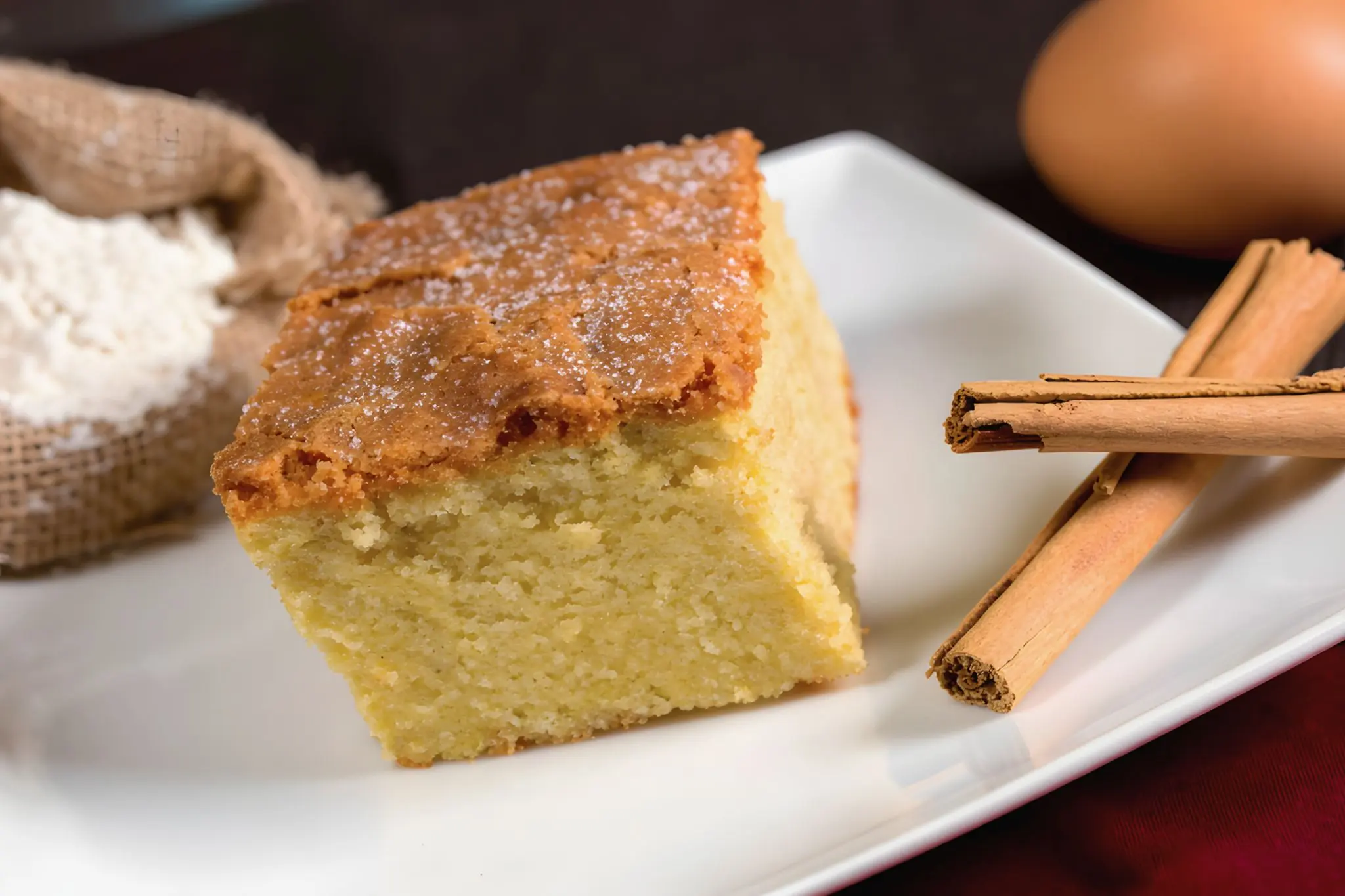
Almost everyone who visits A Pobra de Trives leaves with the same object: a flat cardboard box tied with string, riding home on the passenger seat. Inside is a bica, a slab of dense yellow sponge under a lid of caramelised sugar and cinnamon. About twelve hundred people live in the town. The cake is the thing they are known for, and it has been for well over a century.
Butter Money
Read the ingredients and something is out of place. The bica de Trives is made with cooked cow’s butter, sugar, cinnamon, a great many eggs and sifted wheat flour. This is a comarca that lived on chestnuts, rye and cattle, in mountains that used to close for the winter. Rye bread and chestnuts were the everyday calories. Wheat flour and white sugar had to be bought, cinnamon came from the other side of the world, and the butter — the one thing Trives made itself — had to be cooked and clarified to survive a week in a kitchen without refrigeration. This was never everyday food. It was a feast-day cake, for households that could pay for the parts they could not grow. The town still gives it a day of its own, the Bica Festival, held on the last Sunday of July since 1972.
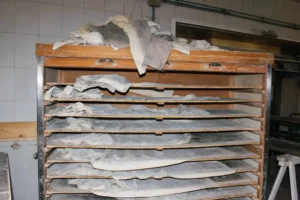
The method is as old as the shopping list. It starts the night before, with a prefermento of flour, water and yeast left to work until morning, because the recipe never took up the chemical raising agents that reached Spanish kitchens in the twentieth century. That is why the crumb is close and damp rather than airy, nearer to brioche than to a birthday cake, and why a bica keeps for a week and is better on the third day than the first. What the confiterías sell today is a pre-industrial recipe nobody got round to modernising.
The bica is an Ourense family rather than a single cake, and A Pobra de Trives did not invent it. Castro Caldelas bakes the same buttered version, and the argument over which of the two does it properly is permanent and enjoyable. In Laza, down in the south of the province near Verín, they make a pale bica blanca of egg whites and cream for Entroido, the Galician carnival. What Trives won was the name — and it is still working at it: in neighbouring Manzaneda the Amarelante cooperative bakes a version with chestnut flour from soutos it has brought back into production.

Nobility, Fish and Chocolate
The obvious question is how a town this far into the mountains developed a taste for butter and cinnamon. The answer is standing in the streets.
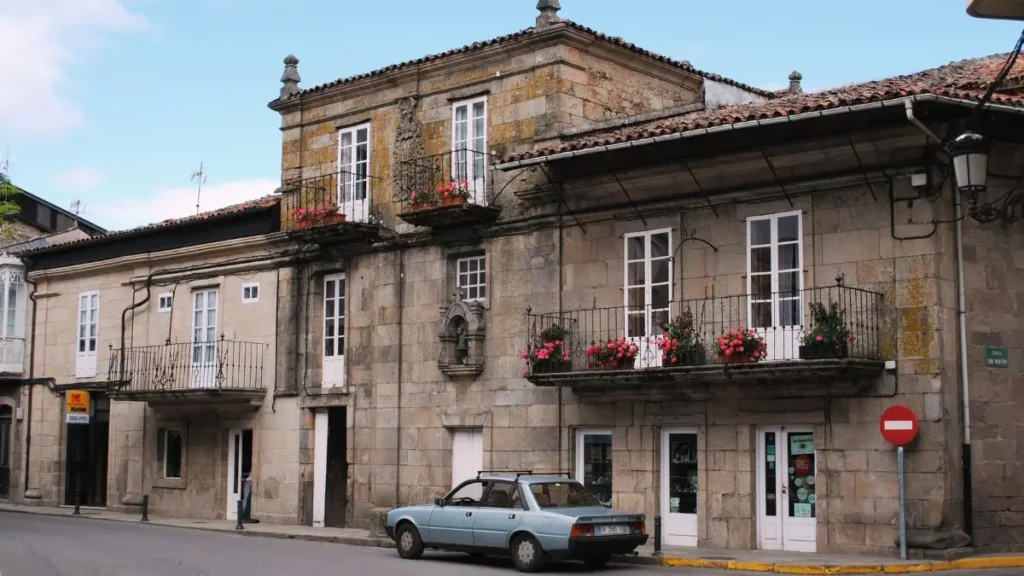
Through the eighteenth and nineteenth centuries, A Pobra de Trives was wealthy. Prosperous families settled and formed a local bourgeoisie, and by the 1800s the town had become where the Galician nobility gathered in summer, the inland counterpart to A Toxa. They built the Casa Grande, the Pazo do Marqués, the Pazo de Casanova and the Casino, and glazed the galleries that still run along the Rúa Real to hold whatever heat the mountain allows. The small square now named after Doctor Paz was the fish market, selling sea fish carried up from Vigo. By 1889 the town could support a chocolate factory: José Salgado ground his own cacao down on the río Cabalar, generated the town’s electricity as a sideline, and supplied the royal household under Alfonso XIII.
That is the company the bica keeps. Butter, white sugar and cinnamon make sense in a place where sea fish came up the mountain and cacao was ground by the river.
Then the century turned. Salgado took his mills to Buenos Aires in 1910 and reopened as Chocolates Fénix, still trading four generations later and still printing the Ponte Cabalar on its wrappers. Trives had around 5,500 residents in the whole municipality at the time; when the N-120 was routed through Monforte de Lemos instead, the through traffic went with it and the population settled where it is now. The pazos are all still standing, the galleries are still glazed, and the ovens still start the prefermento the night before.
The Town in Half an Hour
A Pobra de Trives is a mountain municipality that climbs from 300 to nearly 1,800 metres, with twenty aldeas, a castrexo and Roman past, canyoning on the Navea, walking routes, a ski station and a full calendar of festivals.
If you have the choice, arrive over the Ponte Bibei, on the OU-636 through the Codos de Larouco: three granite arches, seventy-five metres, built under Trajan for the Vía Nova and a national monument since 1931. It still carries the road, articulated lorries included, which is largely why it has survived in the condition it has. A Roman milestone stands at the far end.
The old town is half an hour on foot. The tourist office, the Museo da Escola e a Infancia and an interpretation centre share the old Santa Leonor school, and it is worth phoning ahead rather than trusting the posted hours. From there you pass the Casino, the Pazo do Marqués, the Casa Grande, its façade bearing the arms of the Quiroga family, the Pazo de Casanova and the Rúa Real, and then the clock tower on Praza do Reloxo, worth stopping for. It belonged to the old church of San Bartolomé. It came down when the new church went up, was rebuilt, was demolished again in the 1960s, and was raised for a third time in 1995 after public pressure. The plaque by the door reads Como son xa fun, deixádeme para sempre así — as I am I already was, leave me like this forever. It is thirty years old.
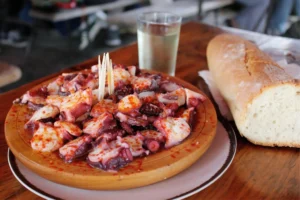
Two and a half kilometres out on the OU-636, at the turn for Manzaneda, a track drops to Ponte Cabalar and the roofless remains of Salgado’s factory. With more time there is the castaño de Pumbariños at Rozavales, twelve metres round the trunk; San Salvador de Sobrado, Romanesque, with what is left of a Benedictine nunnery beside it; and the Ruta dos Sequeiros through the old chestnut drying-houses. The feira comes round on the 1st and the 15th of every month, pulpeiras included, which is also the easiest day to catch the town at its busiest.
Bica de Trives: butter, sugar, cinnamon, eggs and wheat flour — photo by R. García, edited with AI.
The Bica Festival 2026, sold out under the primary school’s covered court — photo by P. Vanossi.
The Casa Grande de Trives, its carved arms set into the granite façade — photo by HombreDHojalata.