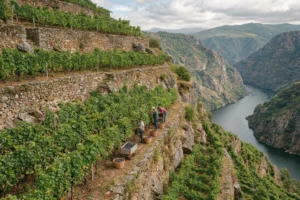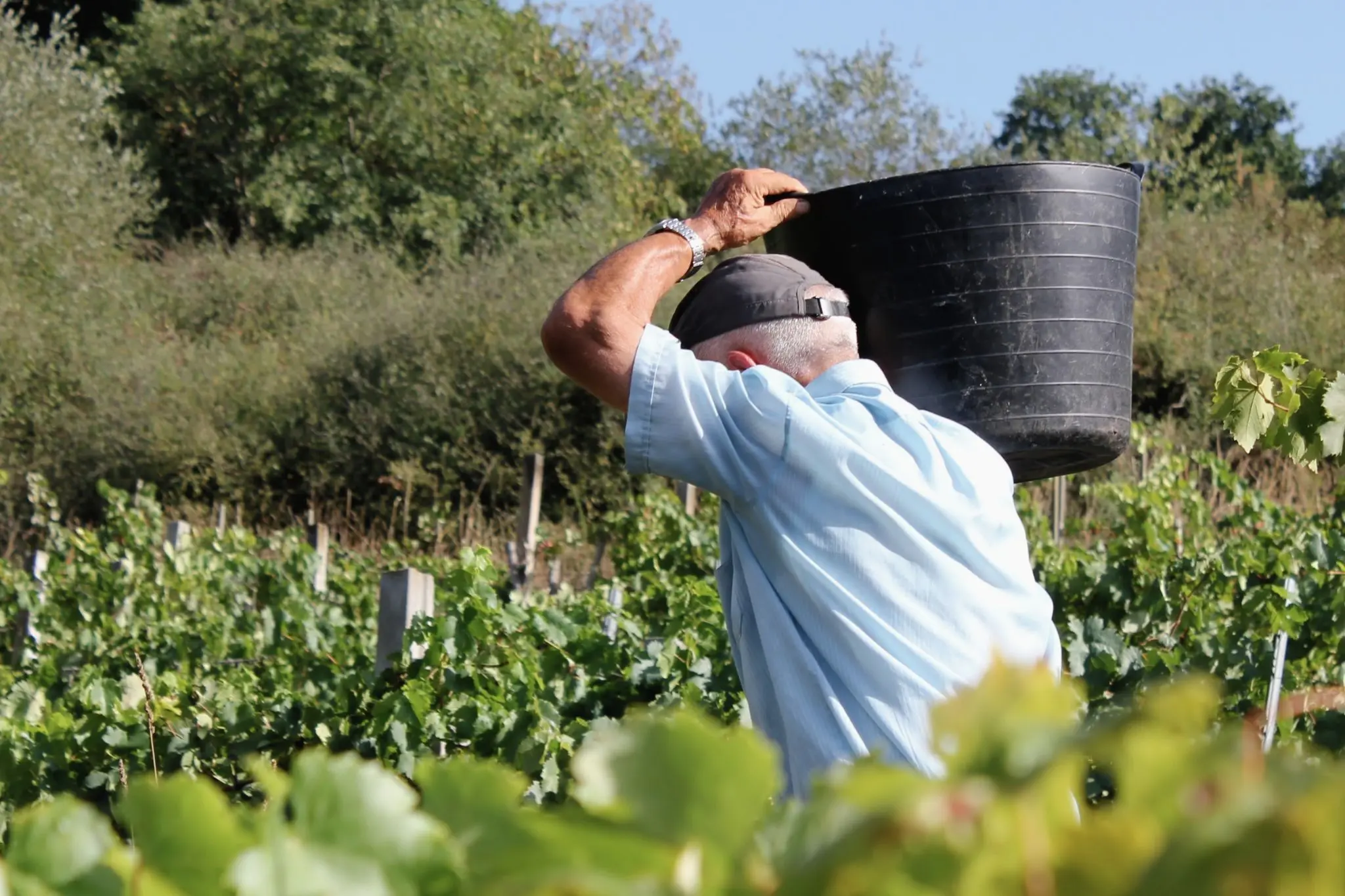
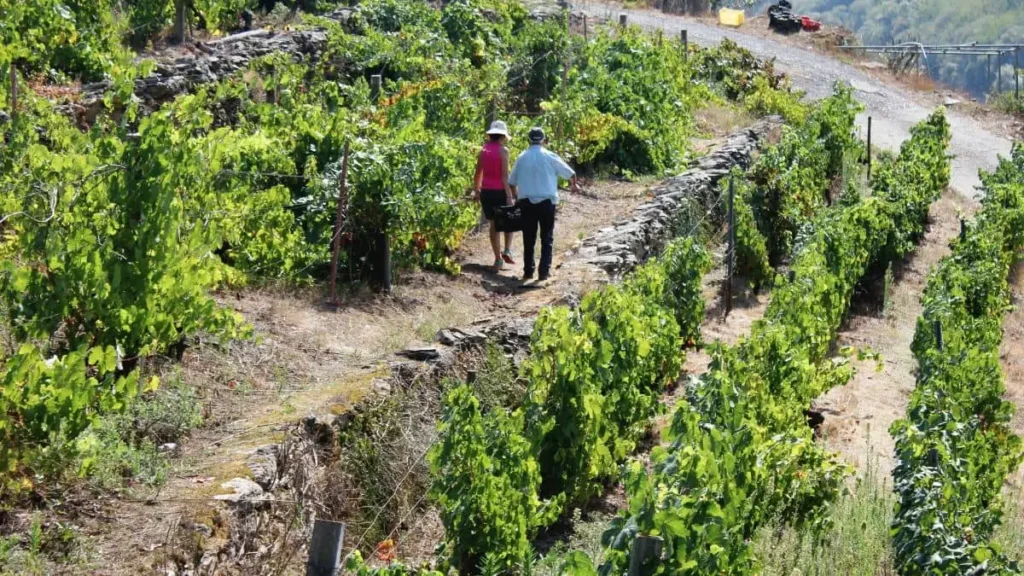
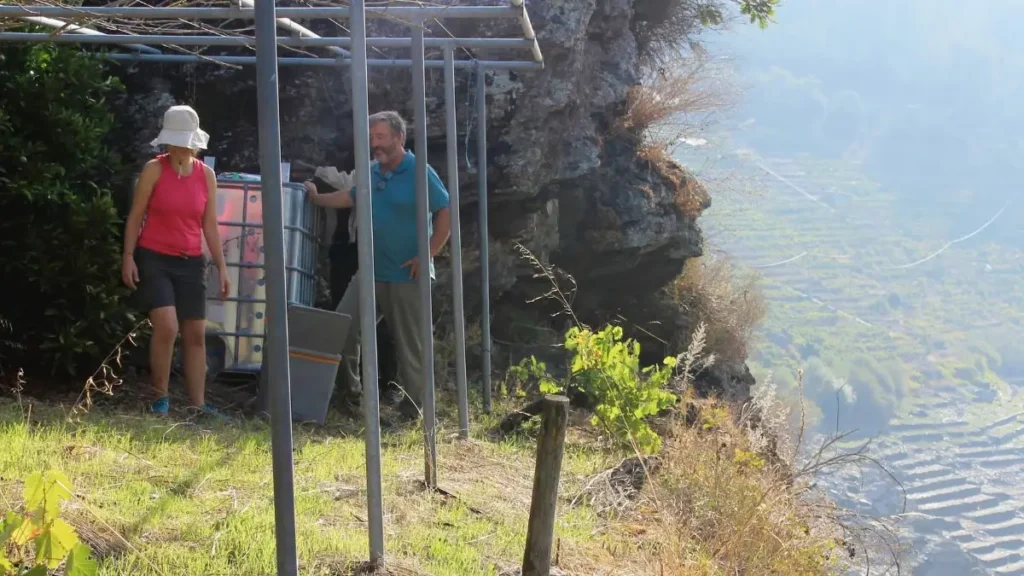
The instruction took about as long as it takes to read: spread out along the row, fill the bucket, empty it into the tub at the top. Six of us had shears, most of them blunt. It was the fifth of September, already hot at nine, on two plots either side of a paved road above Ponte Mourulle, on the Taboada bank of the Miño. Below the socalcos the reservoir sat low and green. Between them, the going was loose stone and vine canes that catch at the ankle.
Across the territory the vendimia runs about a month, plot by plot, household by household. A single household’s share of it is one day. That is how it is built, because a day is how long you can ask people to come. By midday, with six of us picking, seventy or eighty per cent was cut. In the afternoon three of them finished the rest, leaving a few vines where the fruit had gone too far to be worth the walk.
What a Day Is Worth
The two plots gave between 1,100 and 1,200 kilos, which will become around 600 litres, the equivalent of eight hundred bottles. That is the year’s drinking for Victor’s parents, some of it given away. Last year it ran out early and his brother, who has his own vines a few parishes inland, made up the difference.
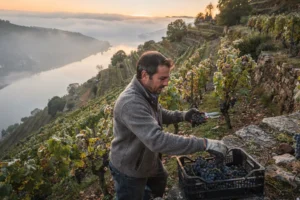
The crew was Victor working the crates and the trailer, his father Claudio, his uncle Freddi, an employee, the two of us, and one picker hired for the morning. The rate here is about ten euros an hour, so his morning came to forty. He was the only person on the hillside who was paid anything.
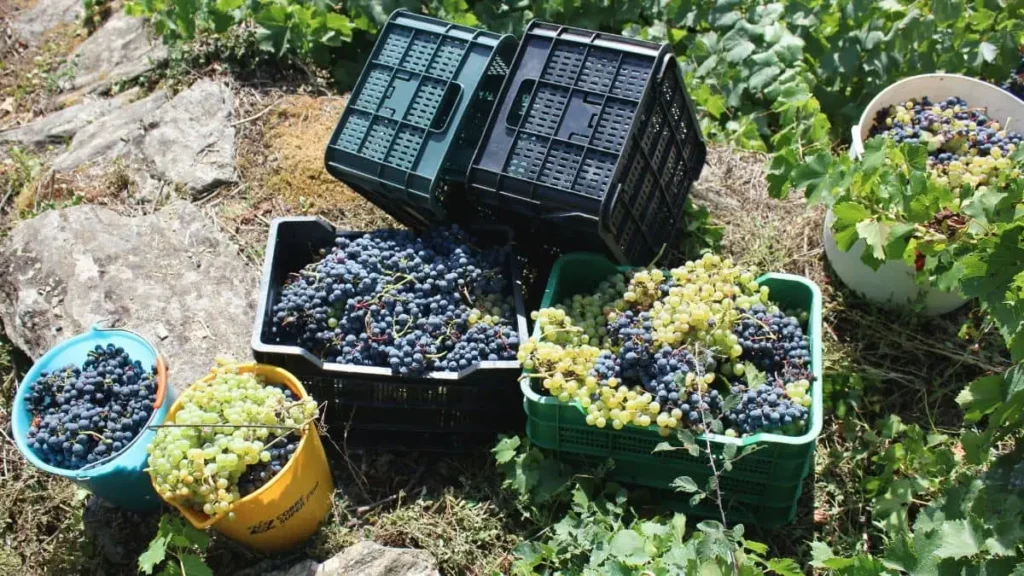
Red and white went into the same tubs, the same crates and the same vat, and nobody counted the proportion. These plots are eighty or ninety per cent mencía, and have been since the vines went in. The parents drink red. White at this level is a few rows nobody thinks about much.
What circulates, when a household falls short, is mencía. A dry year, a rotten row, a plot given up: the gap gets made up between neighbours, and red is what gets asked for. We have a few white vines in our own garden, nothing anyone planted on purpose, and we offered the grapes free to a neighbour who makes wine. He had white already, so ours will rot where they hang. The awkward part is that on this hillside the white comes through cleaner, and the mencía we cut had been the harder summer’s work. The red is still what everyone wants.
Forty-Five Days
The day is the part of the year you can see. Behind it, Victor prunes from January, later than the neighbours who start in mid-December, on the reasoning that a vigorous vine given an early cut comes back with too much cane. He dislikes the local habit of topping the shoots in May and June, and says that when they tried it the vines suffered for it.
From late May, when the bunches set, he sprays roughly every twenty days until the end of July. That comes to five or six sprayings in a season, and he says doing it in fewer is not realistic here. He buys the product eco-certified and says frankly that he cannot read the composition; most of the vineyards around him use systemics, which move inside the plant. Then he applies a rule he invented himself, reasoning from the withdrawal period on a treated animal: forty-five days between the last spray and the first cut.
Which is where 2026 pressed on him. He finished spraying at the end of July. The heat brought the harvest forward to the fifth of September. His own quarantine held, with very little to spare.
In the Vat
It pressed at the other end too. Crushed fruit normally takes two or three days to start fermenting; this year it went the same day, with the must so hot that Victor decided against sending a sample to be analysed. Nine or ten days later it was still working — en la aguja, as he calls it, the stage where it tastes of a process rather than a drink.
This is also the first year they will rack. His father never wanted to, and the old advice was to do it on a clear cold day under low pressure. Victor is racking anyway, into a better-insulated tank, because the cellar was not built for a September like this one. Nothing is filtered. The wine settles by its own weight, and the bottom tap is opened a little high so it doesn’t drag the sediment up with it. The pomace goes off within days to be distilled, about thirty litres of aguardiente from the same 1,200 kilos.
Four or five days after racking, the first carafe gets drawn. There is no ceremony to it; you taste it to find out what you have. The fiestas at Friamonde fall on the last weekend of September, and the old measure of a household was which few could have wine ready by then. This year, Victor says, everyone already does.
He will not be drinking it. He doesn’t drink.
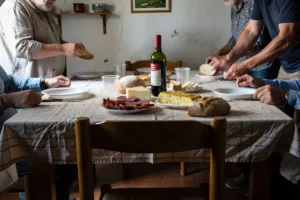
Claudio and the tub; down the row; red and white, uncounted; a break at the edge — photos by P. Vanossi.