~11 km linear · ~3.5 hours · moderate · Start: Aldosende · End: Mirador de Cabodevila
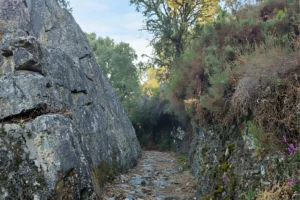
The name promises an old road, and it is only partly one. When the Belesar reservoir filled in the 1960s, the tracks that linked Aldosende with Portomarín along the valley floor went under, and the path now signed as the PR-G 249 was fitted out to replace them. Where the valley offered nothing gentler, the line was cut into the rock. The old road you walk is the one the parish was left with once the river rose.
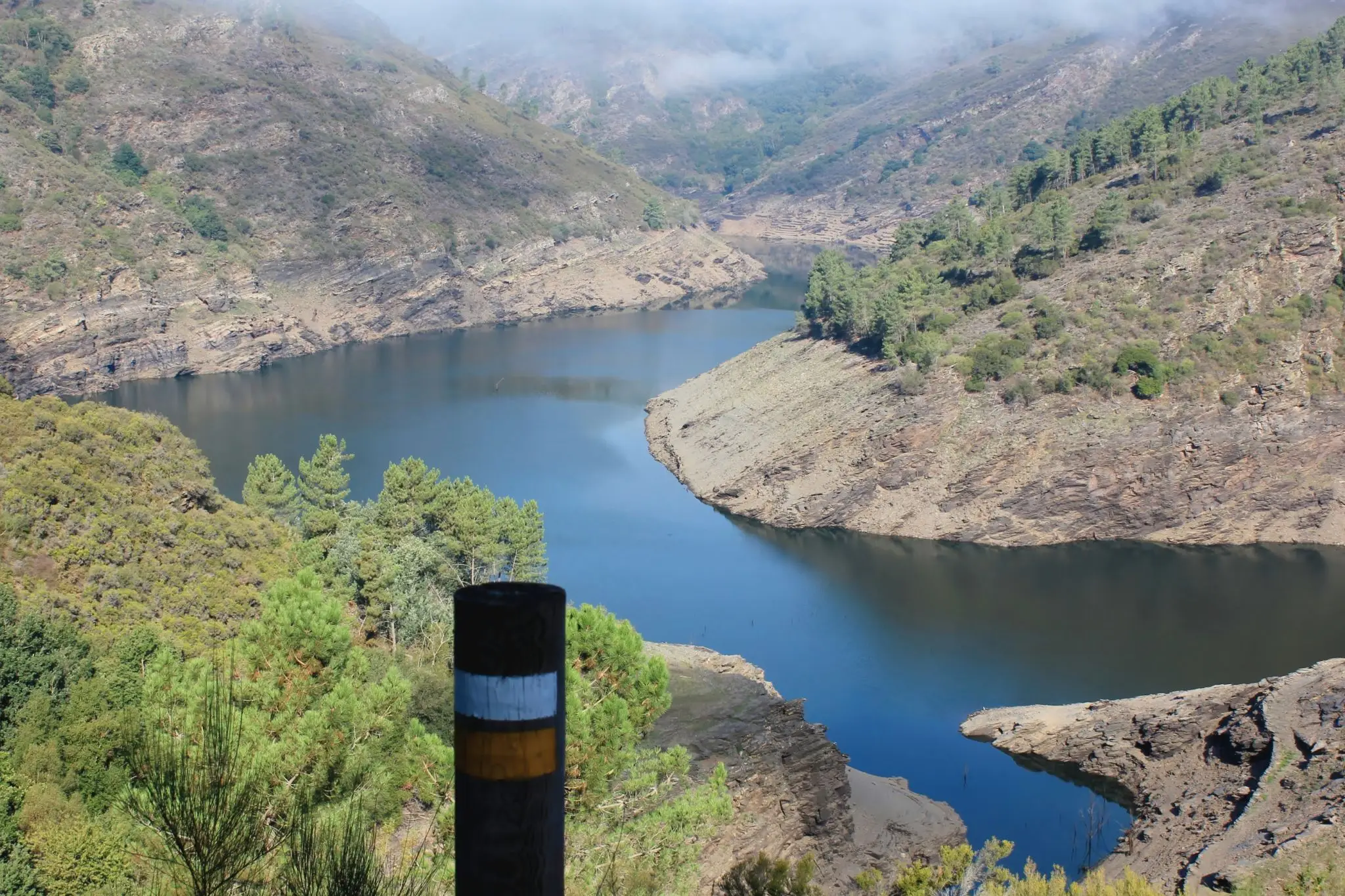
Leave the car by the church of Santiago de Aldosende, in a hamlet where the land around the houses is still worked, and follow the path out through fruit trees, chestnut and walnut. Mist tends to sit in the valley well into the morning. The Mirador de Aldosende, 1.7 km from the start, is the first stop worth making: the reservoir bends below it, and from here the path starts to lose height in earnest.
The descent into the gorge of the Rego do Bacelo is the hardest part of the day. The ground turns to rock and stone steps, slippery in the wet, with steel cables fixed along most of it. Partway down, a panel at the Pena de Alfredo tells of Alfredo Rodríguez Arias, a neighbour from Aldosende who came down to the river to fish in the 1960s, the same decade the path was made. He sheltered under the rock when it rained, sometimes for more than a night, with firewood stacked close by. Shortly after, a footbridge crosses the Bacelo above a string of small waterfalls. Few trails in the Ribeira Sacra feel this much like a mountain path, and this one is kept in excellent condition.
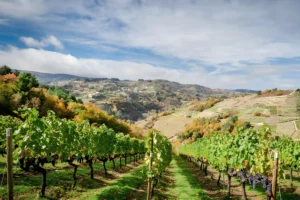
Past the stream the path threads a vineyard fenced tight on both sides, like walking through a stage curtain, and a little further on reaches the Mirador da Volta do Castelo, where the Miño lies still enough to pass for a lake. This first part of the route would make a complete walk on its own.
What follows is an interlude. The path runs flat along the reservoir shore, exposed and easy. It passes strawberry trees and oaks, decorated birdhouses hung in the pines and propped against the low walls, and a line of hives on a terrace. At the Mirador de San Facundo, where the Rego do Lombao comes down to the Miño, dry months pull the water back far enough to uncover old terraces and the walls of houses that normally sit below the surface.
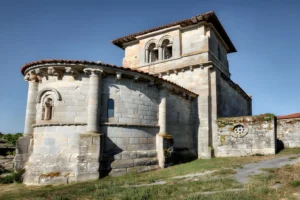
A sharp turn beyond the mirador, the church of San Facundo de Ribas de Miño appears with almost no warning, rectory attached and vineyards all around. Benedictines founded it in the twelfth century to ferry pilgrims across the river. At harvest time the pickers are out on the terraces that surround it. The path cuts through the vines and comes out onto a paved road, which leads to A Adega dos Penedos: a few abandoned houses sitting on top of the road’s tunnel, with a viewpoint over the river and a small ethnographic display of old objects in one of the buildings.
Santa Marta comes next, a hamlet with a pull out of proportion to its size. Quartz shows up along the path and in the walls of the houses, and at low water a long pale strip opens in front of the village like a beach. A panel records that it was known for its eel empanada. There is nowhere left in Santa Marta to eat one. A last uphill kilometre brings you to the Mirador de Cabodevila e Penedo do Bico, with Portomarín on the horizon, the town this path was made to reach.
Walking back to Aldosende would double an already full day, so arrange a lift from the final mirador. Without one, the route splits into two out-and-backs: Aldosende to the Mirador da Volta do Castelo, about 7.6 km with the gorge in both directions, or Cabodevila to the Mirador de San Facundo, about 9 km of shore and parish. Keep the gorge for dry days, and come in the drier months to see the ruins the low water uncovers along the shore, most impressive below the Mirador de San Facundo.
The lift, in any case, has an obvious destination. Restaurante Río Loyo is two kilometres down the road, and it is where a local in Santa Marta will send you for the empanada. The dining room is always full. The eel now travels a long way to get there, since the river’s own have gone, and the empanada is still made.