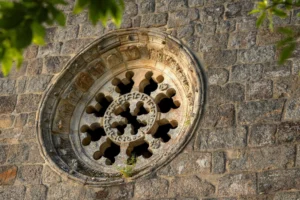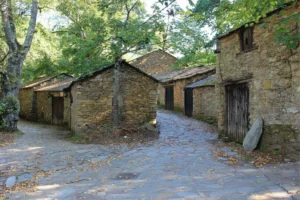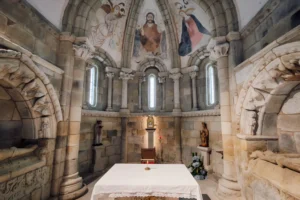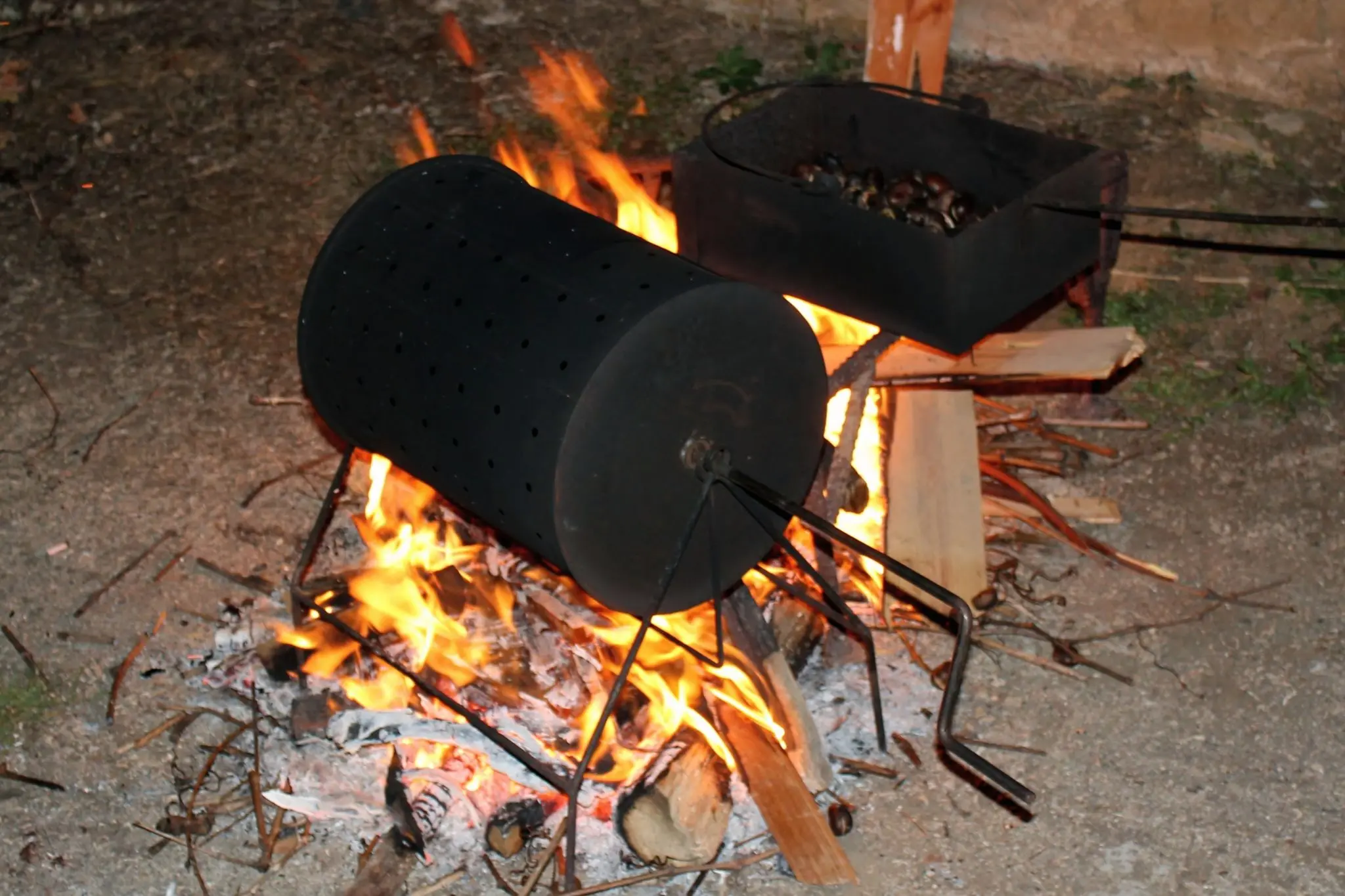
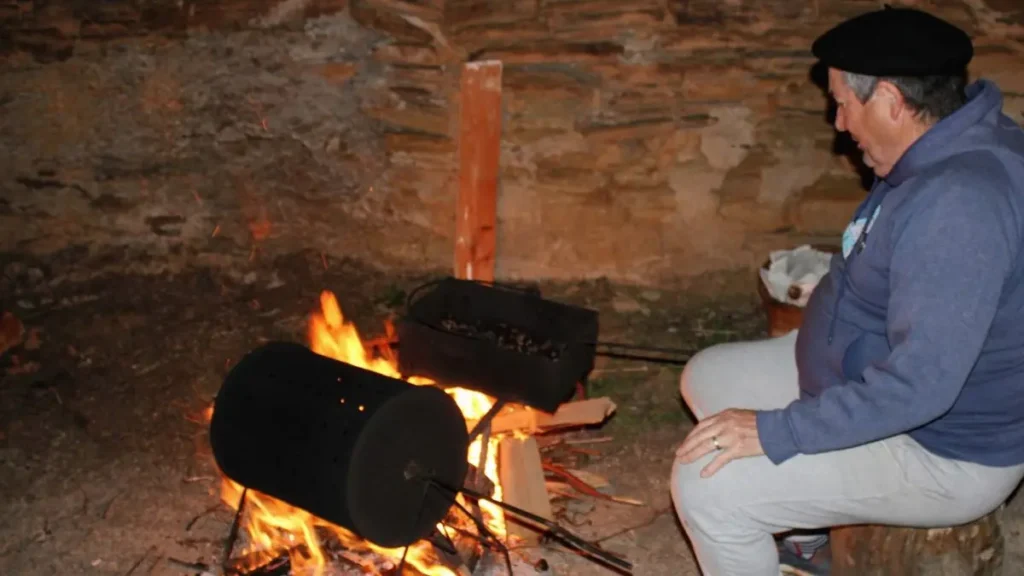
On the last evening of October, in Os Anguieiros, a hamlet above the Sil in the parish of Montefurado, the Asociación Boca do Monte held its magosto on the eira, the threshing yard, of one of the two families who still live there, next to the small church. The chestnuts went into a perforated iron drum set over a fire, and the men took turns at the handle. Manuel sang while he turned it and kept announcing “esto é moito precario“, this is all very makeshift. There was not quite enough wood, and the first batch came out half raw. Nobody was fooled: Ramón, Xosé Manuel and the rest of the association knew exactly what they were doing, and the air of improvisation was part of the fun. On the walls around it, carved pumpkins glowed.
Gervasio, who has lived in the hamlet for some seventy-six years, remembers it differently. There was one big fire, and baskets of chestnuts were thrown straight onto the embers, where they burst; the children raked them out black and painted their faces with the charcoal. Pumpkins, he says, did not exist. Asked whether the new wine was opened for the occasion, he shrugged: “el vino nuevo, viejo, o lo que sea“, new, old, whatever there is. Even the chestnuts are no longer the village’s own. Disease killed most of its trees years ago, and they are only now growing back, so these came from the Courel mountains next door.
Two Dates and a Saint
The magosto is the chestnut feast of inland Galicia: chestnuts roasted in the open air and eaten with wine. Its traditional day is 1 November, All Saints. In Ourense and Quiroga it falls on 11 November, the feast of San Martiño, their patron saint. Elsewhere it now follows the free weekends, from the second half of October well into November.
The old magosto was held in a clearing in the chestnut wood, the souto, or on the eira. It was the last of the year’s outdoor festivals, and after it social life moved indoors, to the fireside.
A Banquet for the Dead
Falling on All Saints, the eve of the Day of the Dead, the magosto was never far from the cemetery. Manuel Murguía, the nineteenth-century historian who founded the Royal Galician Academy, saw it as a funeral banquet in which the chestnut might stand for death and the wine for life. The anthropologist Xosé Ramón Mariño Ferro saw it the other way round: the chestnut as the food that holds death off, which is why it turns up in funeral rites. The old records support both. In the sixteenth century the church synods of Mondoñedo noted that on the Day of the Dead the poor ate the lords’ leftovers, and chestnuts. The eighteenth-century English traveller Swinburne found Galicians eating chestnuts on the eve of the dead in the belief that each one released a soul from purgatory. And after the magosto nobody put the fire out, because in the night the souls of the dead, the ánimas, came to warm themselves at it.
Samaín and the Children
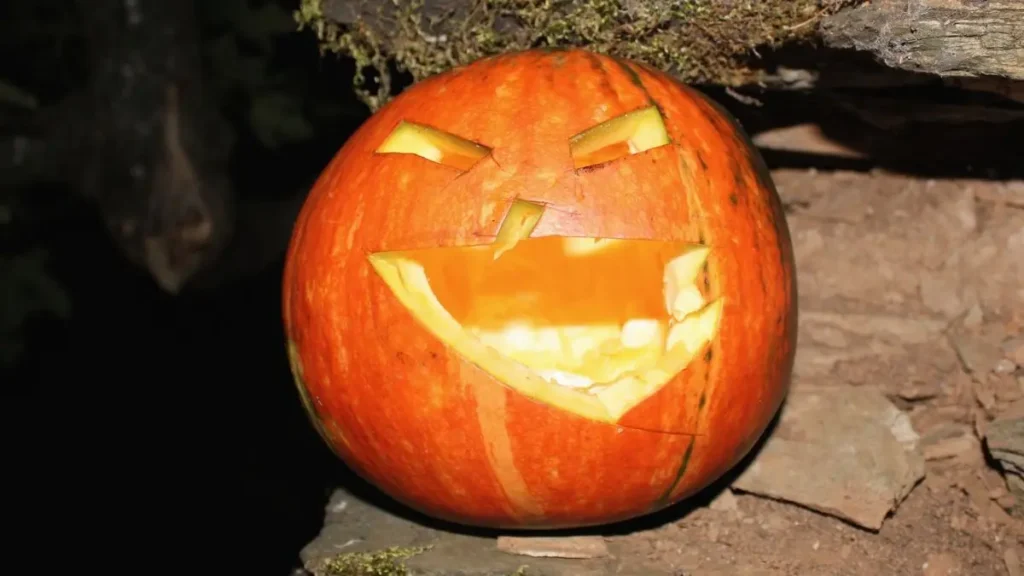
Since the 1990s a second feast has settled beside the magosto. Samaín is the Galician name for Samhain, the Celtic festival that opened the dark half of the year, and in practice it means carved pumpkins, costumes and parties for children. Across the Ribeira Sacra it now fills the late afternoon, with games and merendas for the little ones, and the magosto takes the evening for the adults.
The split is older than it looks. In a 1989 study of Galician popular traditions, J. A. Tarrío described two magostos running side by side in Ourense: a heavy one for the older youths, “with wine, chorizo and sex”, and a light one for the younger, with chestnuts and soft drinks. Samaín has moved into the children’s half of an evening that was already divided.
A Name Borrowed From a Book
Samaín’s critics dismiss it as Halloween in Celtic dress; the writer Xosé Luís Méndez Ferrín called it a false tradition imposed by American imperialism. The man who revived it would partly agree. Rafael López Loureiro, a schoolteacher in Cedeira, tells the story himself. In 1989 his seven-year-old daughter came home from her English lessons with a gourd carved into a skull: her Canadian teacher had thrown a Halloween party. He recognised it at once. As a boy he had carved dozens of the same skulls, caliveras, from fodder melons, but by then nobody in Cedeira had lit one for some twenty years. It dismayed him that his children were receiving a custom of their own as an American novelty.
He set out to bring it back. The Celtic name came from a popular book on Celtic mythology, and he admitted that his evidence was thin. He organised the first Festa de Samaín in Cedeira in 1990, and the following year he had schoolchildren carving pumpkins at the time of the magosto. His later fieldwork found the carved skull across Galicia, but already fading, and possibly absent around Ourense, where the magosto filled the autumn on its own.
The custom, then, was local and the name was borrowed. In Os Anguieiros both views sat at the same fire: Gervasio said there were no pumpkins in his youth, while a journalist who had come up for the evening said her father had always carved them. Both can be true.
The Fire Out of Sight
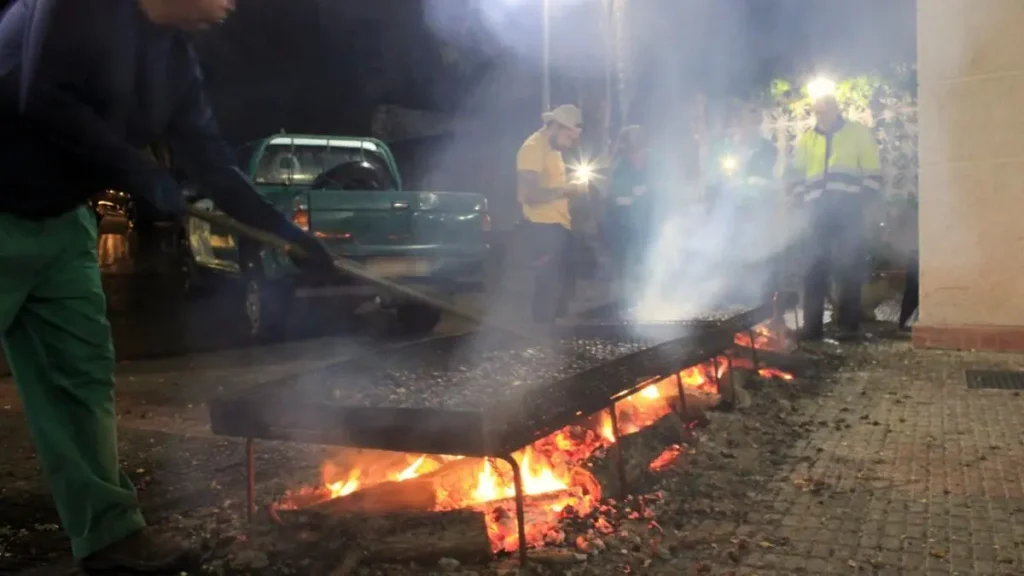
In Quiroga, on San Martiño, it rained. The magosto was held under a large tent in the Praza Maior, but the fire was elsewhere. The chestnuts, once again from the Courel, are now roasted by council workers on a long grill in front of the Centro Social, two hundred metres away and under cover. They arrived in the square already cooked, and there was not a pumpkin in sight. The wine was free, donated by a local bodega, and nobody could say which harvest it came from: “vino joven” was enough.
The older people said it used to be better, with the chestnuts roasted in the square itself and new wine drawn from wooden barrels for anyone who wanted it. “Es lo que hay,” they said, it is what it is, and nobody left. One of the town’s councillors filled a plate of chestnuts for an elderly woman and poured her a cup of wine. In Os Anguieiros the neighbours put on the feast for each other; in Quiroga the town hall lays it on for them.
Murguía’s banquet for the dead has lost most of its parts: the chestnuts come from another mountain, the wine belongs to no particular year, and in Quiroga the fire has moved out of sight. People still come. Asked in the square why the feast is called magosto, a man of ninety did not reach for etymology. It is, he said, a thing for bringing people together.
Os Anguieiros on the night of the magosto; Manuel at the drum; San Martiño in Quiroga — photos by P. Vanossi.