The road into Parada de Sil announces nothing. You arrive through chestnut forest, past the odd granite house, along a ridge that feels neither dramatic nor particularly memorable. Then the ground runs out, and the Sil canyon opens eight hundred feet below — and only then do you understand what the village is perched on.
That’s the trick Parada de Sil plays on every first-time visitor. It sits at the lip of something vast without performing the fact. The viewpoints are real, the geology is extraordinary, and the monastery hidden in the forest below is among the finest Romanesque buildings in Galicia — but Parada itself remains discreet about all of it. It’s a small working municipality of around six hundred people, a concello with a main square, a monument to the barquilleiros, and a Saturday rhythm that has nothing to do with tourism.
The Wrong Comparison
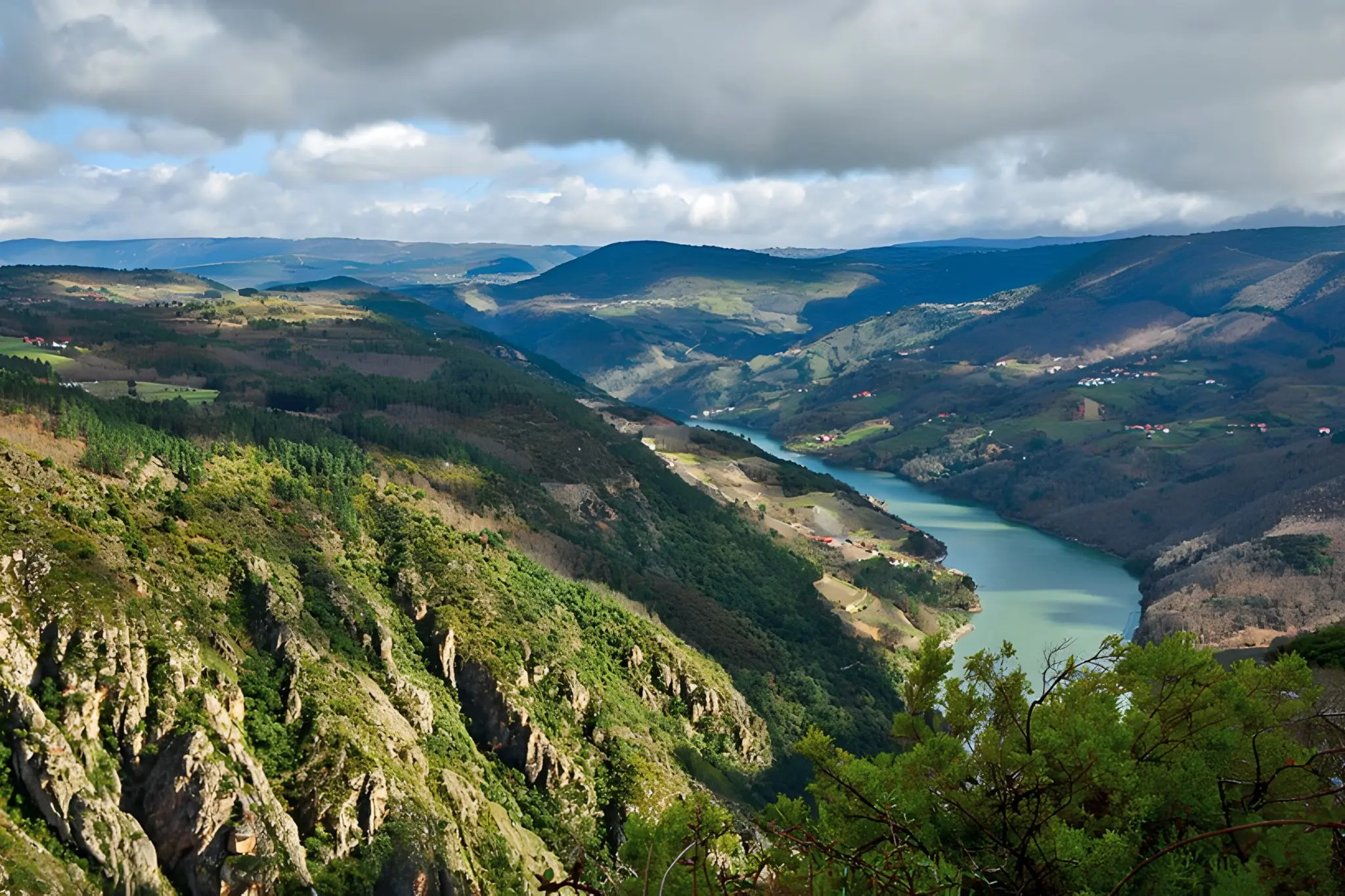
Visitors often arrive expecting something spectacular, primed by drone footage and social-media close-ups of the miradores. The Balcones de Madrid — the most photographed viewpoint, set five hundred metres above the river — will not disappoint on that front. But going to Parada de Sil for the views is roughly equivalent to going to a monastery for the ceiling. The ceiling is remarkable. It is not the point.
The name of that viewpoint, incidentally, comes from the people who left. Barquilleiros — wafer sellers who worked Madrid’s verbenas and street fairs from the mid-twentieth century onward — were a specialty export of this concello. To reach the train at Monforte they had to descend the canyon on foot, cross the Sil by boat, and climb the far bank. Their families watched from the high ridge until the figures disappeared. That ridge became the Balcones de Madrid. There is a bronze statue in the main square dedicated to them. The story is quiet, specific, and stuck — which is more or less what Parada does to you, if you give it enough time.
The Descent
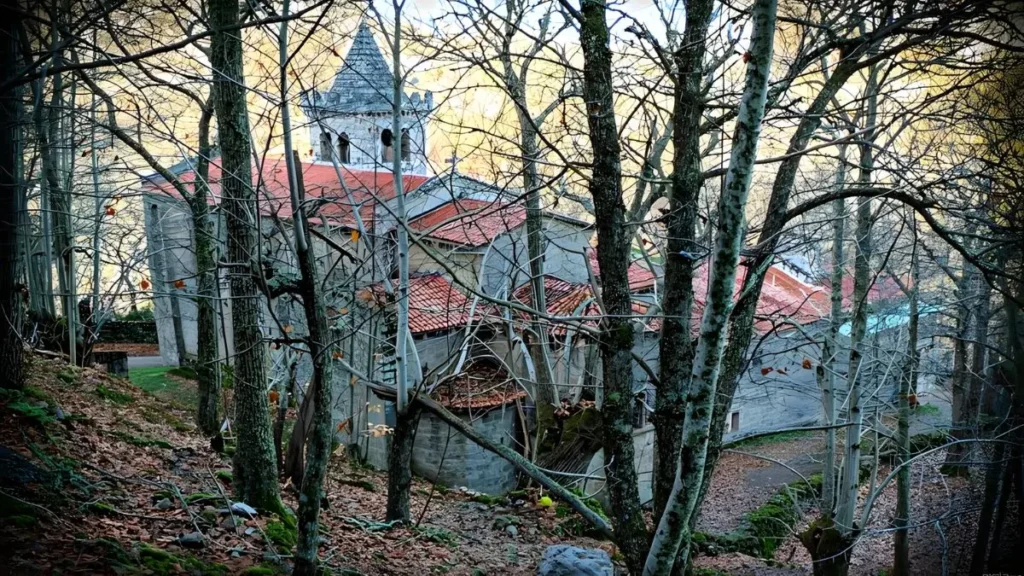
The path to the Monasterio de Santa Cristina de Ribas de Sil begins unremarkably — a road off the main square, then a track through chestnut canopy — and takes roughly forty minutes on foot each way. What changes along the way is the quality of silence: the forest absorbs road noise quickly, and by the time the bell tower appears through the trees you have been walking long enough to arrive somewhere rather than simply show up.
Santa Cristina dates to at least the ninth century, though the existing church was built in the twelfth and thirteenth. It spent its later centuries in visible decline — absorbed into the priory of Santo Estevo in 1508, stripped by the Mendizábal disentailment in 1835, briefly a farm — and emerged from restoration more legible as a place that outlasted several plans for its own extinction than as a managed heritage site. The two surviving cloister wings, the defensive bell tower, the sixteenth-century murals in the apse: none of it has been tidied into comfort. In peak season (Easter, July–September) access is managed via shuttle from the village; at other times, you can drive down yourself on a road that requires attention. Check current opening hours before going — the monastery closes on Mondays outside summer.
On Viewpoints
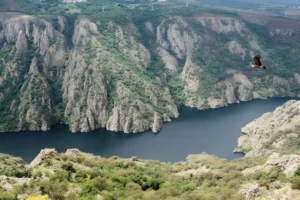
There are several miradores within the municipality: Cabezoás, A Columna, Triguás, the Balcones de Madrid. All are worth stopping at, none of them is why you stay. The views from the high rim are vertiginous — five hundred metres of canyon wall dropping to the green thread of the Sil — but they produce a feeling of spectacle rather than understanding. You see the canyon from outside it. The forest path to Santa Cristina puts you inside it, briefly. That’s a different thing.
The PR-G 98, a 17.5-kilometre circular route beginning and ending at the Plaza do Barquilleiro, combines the Sil canyon rim with the descent to the Monastery of Santa Cristina in one loop. The PR-G 177 is of similar length and difficulty, but the landscape shifts in scale: the Mao gorge is narrower and more humid, with walkways, hydroelectric channels, and rock-cut necropolises instead of viewpoints and exposure.
Where to Stay
Parada de Sil makes more sense as a base than as a day trip. Two or three nights let you cover the monastery, the main walking routes, and the surrounding parroquias without hurrying. The village has several rural accommodation options. If you’re here for the walks, the Fábrica de Luz — a restored hydroelectric building on the Río Mao, now operating as a hostel and bar — handles the less formal end of the scale.
There’s enough to eat in the village without planning ahead: the local restaurants run on market-kitchen logic, meat-heavy, honest, priced correctly. The bica cake from the area around Chandrexa is worth a specific detour if you come across it.
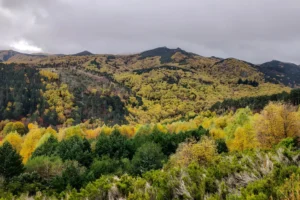
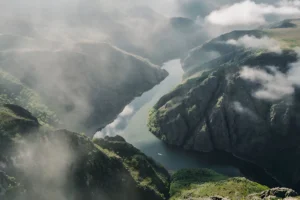
The season matters. Spring and autumn are the obvious answers — the chestnuts turn amber in October, the forest in late April is extraordinarily green, and visitor pressure is lower. Summer brings the crowd and the shuttle. Winter closes the monastery on Mondays, shortens the days, and makes the canyon fog in ways that are either atmospheric or inconvenient, depending on your tolerance for both.
What It Asks of You
Parada de Sil is not a place that organises itself around your schedule. The monastery descends; the viewpoints are on roads that require doubling back; the best walks need a full morning. It asks for the kind of unhurried movement that is, in theory, what you came to the Ribeira Sacra for in the first place. Whether the theory holds is the only question worth answering here.
Sil Canyon from the Balcones de Madrid viewpoint — photo by P. Vanossi, edited with AI.
Monasterio de Santa Cristina, half-hidden in the trees — photo by lomarper, edited with AI.