Somewhere between the second Sunday of August and the end of San Froilán, someone will tell you that pulpo á feira is the most Galician dish there is. Ingredient by ingredient, it is close to the least Galician dish in the repertoire.
The octopus is Atlantic, which in a territory ninety minutes from any coast has always meant hauled. The olive oil is southern; Galicia’s own survives in Quiroga on a handful of recovered varieties and came close to vanishing altogether. The pimentón reached La Vera from America in the sixteenth century and arrived here later still. The cauldron and the wooden plate are the only two components that could plausibly have been made within fifty kilometres of the square they are used in. Even the method for tenderising the animal has been outsourced, which is the part worth coming back to.
Two Origins, Both Half-Documented
Ask in Castro de Carballedo or Chantada and the answer runs through the monastery. Santa María de Oseira, in San Cristovo de Cea, held properties and fishing rights that reached the Atlantic; octopus came inland as payment in kind, dried, cheap and durable, and what the monks and the farmers on their land could not eat was sold on at the fairs. The parishes said to have turned that surplus into a trade are Santa María and San Xoán de Arcos, in what is now O Carballiño. It is a good account and it is largely inference — a chain of plausible steps rather than a documented one. Half record, half legend, and better kept that way.
The rival version comes from outside Galicia entirely. From roughly the seventeenth century the maragatos — muleteers out of La Maragatería, around Astorga — ran goods between the northern ports and the Meseta, and dried octopus travelled well. They rehydrated it, dressed it with Andalusian oil and paprika, and the same dish surfaces across El Bierzo, Sanabria, Aliste and La Carballeda: inland places, every one of them, none of them Galician. This version has the advantage of explaining the dressing, which the monastic one does not.
Neither can be closed. The maragatos’ own name has three competing etymologies attached to it, which is a fitting amount of evidence for a people credited with inventing the national dish of somewhere else.

O Carballiño Presses Its Claim
Whatever the origin, the distribution is not in doubt. O Carballiño sits twenty-five kilometres west of Ourense, outside Ribeira Sacra and about fifteen from Oseira, and it has been arguing its case since 1962, when it began holding its octopus festival on the second Sunday of August. The sixty-fourth edition falls on the ninth. The event carries international tourist-interest status, draws crowds in the tens of thousands and cooks octopus by the tonne in a municipal park.
The festival is the loud version of the claim. The quieter one is genealogical: the pulpeiro families working the fairs at Monforte, Lugo, Verín and Chantada descend, in good part, from Carballiño households. The trade spread the way emigration spread — one family does well, a cousin follows, and inside two generations half a parish is doing the same job in a different province.
The Copper and the Stone
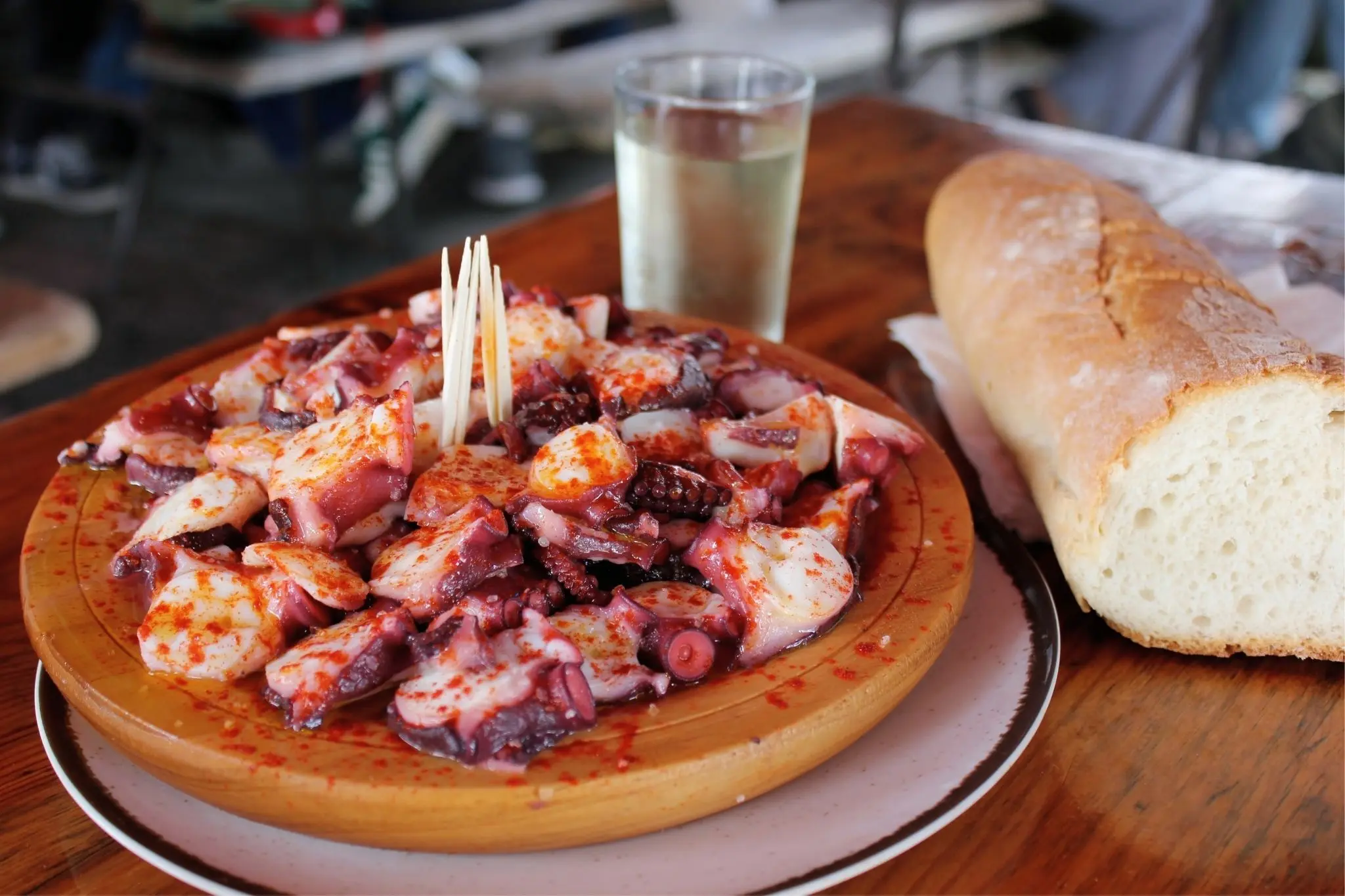
For a dish with no agreed author, the method is unusually fixed. Whole and cleaned, dipped into boiling water and lifted out three times before the long cook — asustar, to frighten it, which holds the skin on and curls the tips. Twenty to fifty minutes depending on size, then a rest off the heat. Cut with scissors onto wood, coarse salt, oil, sweet or hot paprika and never smoked, which is held to bury the animal under the spice. Wooden picks. Wine, not water.
Two parts of it have changed completely. The copper cauldron is gone: hygiene rules retired it in favour of stainless steel. And octopus used to be beaten against stone to break down the muscle, until freezing did it better and replaced the practice entirely. The texture people call traditional now depends on a cold chain — the same cold chain that makes it immaterial whether the animal came off the Galician shelf, the Canary shelf or Dakhla. Purism about provenance arrived after the technology that dissolved it.
Nobody standing over a cauldron is having that argument. Ask a pulpeira where her octopus is from and the answer is that you have to know how to buy it, which is a claim about judgement rather than geography, and is not an evasion. It is the same answer a good buyer would give about lamb, or about wine.
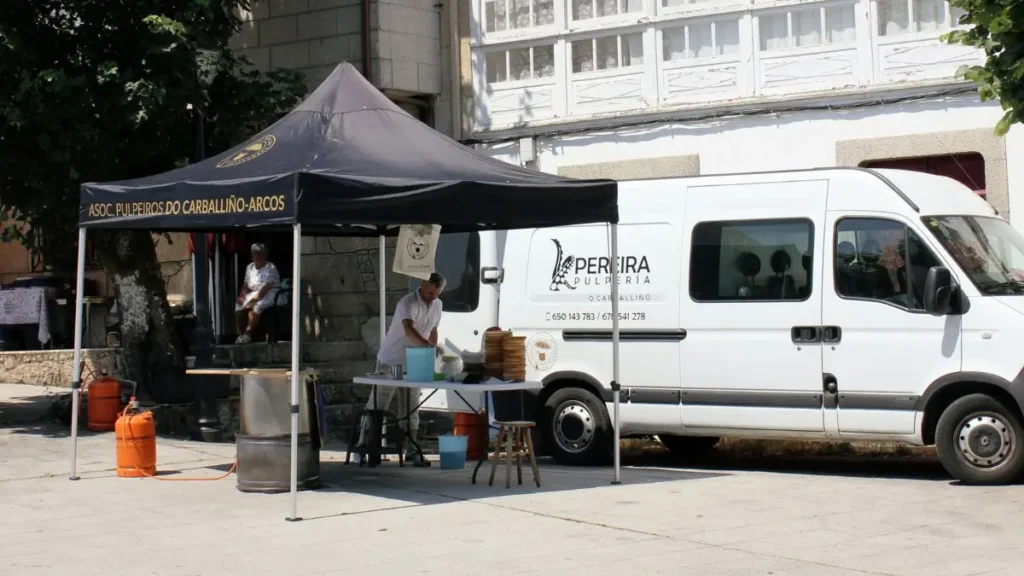
Most of the year, the claim travels by van. Turn up at almost any feira in Ribeira Sacra and it is there by mid-morning, O Carballiño painted down the side, unloading a small tent, several gas bottles, two or three cauldrons, folding tables and a few chairs set around them. The plates are wooden. Nothing else on them started here — not the octopus, not the oil, not the paprika, possibly not the recipe. By early afternoon the whole operation is packed up and on its way to another square with another date.
Pulpo á feira with bread and godello, Sober; Pereira Pulpería, O Carballiño — photos by P. Vanossi.
Pulpeiros at a Galician feira, undated. Copper, since retired by hygiene rules — photo by W. Knorr.