On 12 August the moon’s shadow crosses Galicia at dusk, and Monte do Faro will be one of the places people gather to watch it. We went up in May, on foot, along the ridge track.
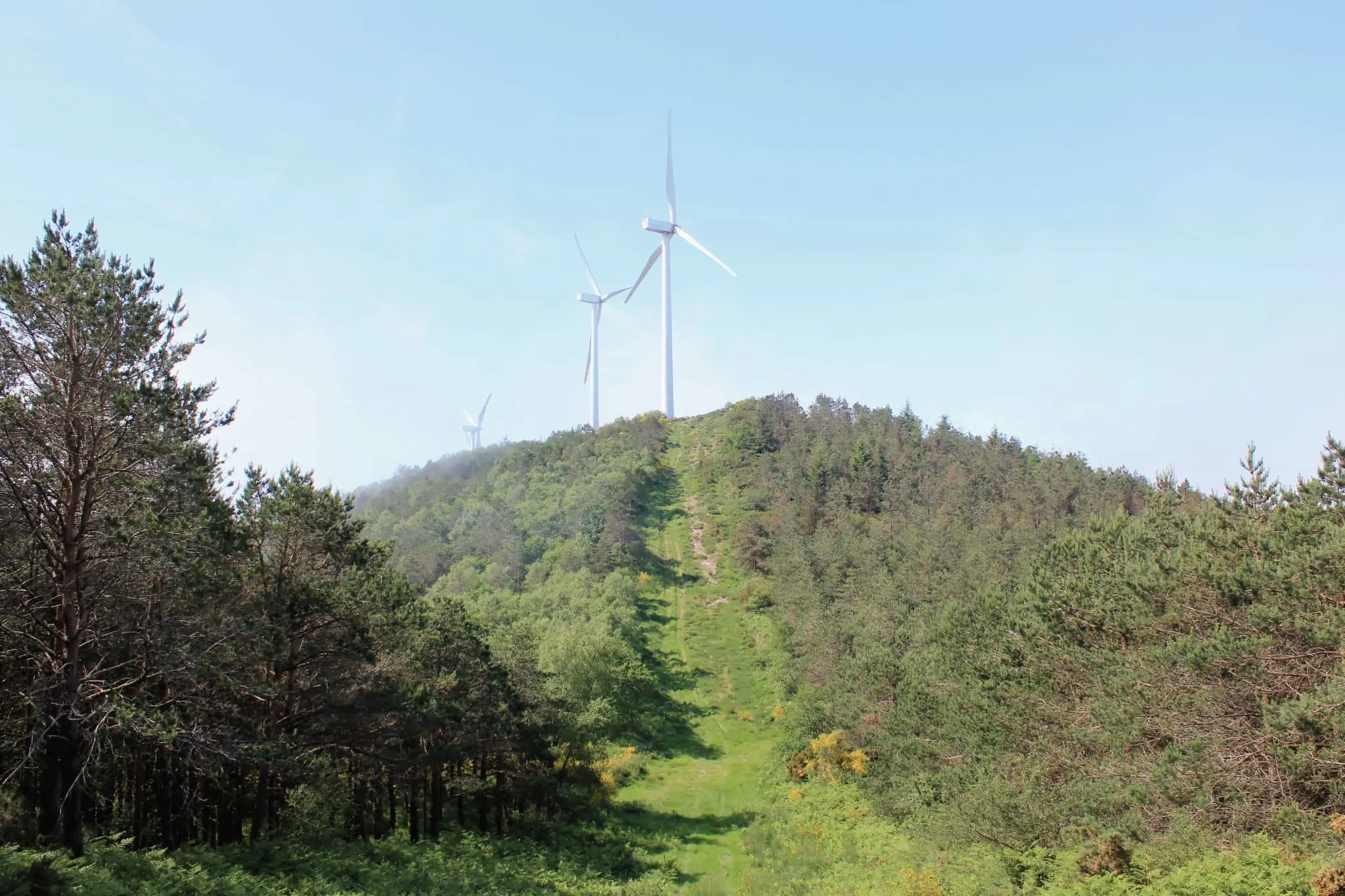
The turbines are with you the whole way. The track climbs at their hub height, so they stand at eye level rather than above you, a line of them running north into the cloud. Thirty belong to the Chantada wind farm; nine more sit southwest, across the boundary toward Rodeiro. Walking below a machine that size is not unpleasant. It is simply the dominant fact of the ridge, and there is no stretch of the climb where it isn’t.
Then you reach the top, and they are gone.
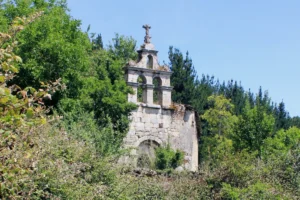
The chapel at A Ermida stands at 1,155 metres, the summit at 1,180, and the turbine bases sit around 1,050 — below and behind the skyline you find yourself looking at. From the meadow between the two, with cloud lying below the track you have just climbed, there is not a machine visible in any direction the place invites you to look. Nothing has been hidden. The geometry works out, in one direction, from these two points.
They are also the two points named when Chantada was certified as a Starlight municipality in March 2025, and the two the car park sits between.
That coincidence is worth understanding rather than resenting. A Starlight assessment measures sky brightness at the zenith, transparency, cloud statistics, the openness of the horizon. Turbines do not brighten the sky. Their aviation lights — required to international standard by the wind farm’s environmental authorisation — are intermittent red flashes: ruinous to a long exposure and to an evening spent looking up, close to invisible in the numbers a certifier records. The assessment isn’t ignoring the machines. It was built to measure something else.
And the two things the site is being sold for turn out to have the same cause. Certification wants access — a road, somewhere to park, a surface to stand on — and the road along this ridge exists because thirty turbines had to be assembled on it. Altitude is the best defence against the territory’s real astronomical problem, which is fog; but the height that lifts you clear of the fog is exactly what makes a ridge worth building on. The massif is a Natura 2000 site, a wind farm and a certified dark sky, and it is those things for one reason: it is high, empty and windy, and nobody lives there.
Which leaves 12 August. From the summit the moon covers the sun completely for twenty-six seconds — the IGN‘s figure for that exact point, and one of the shortest readings in the comarca. The southern edge of the band runs across the middle of Chantada. In Taboada, Bóveda, A Pobra do Brollón and Quiroga the sun stays covered longer; in the Courel it lasts more than twice as long.
The Faro will be fuller than any of them. It has a road, a car park, a name and a certificate, and on an August evening those are the things that decide where people go. The sun will sit eleven degrees above the horizon, just north of west, and here the ground falls away toward Rodeiro and the Deza — the quarter that matters is open, so nobody who drives up will have been misled.
They will simply have gone to the place that was easiest to reach. That is what this ridge has been good for since the turbines went up.