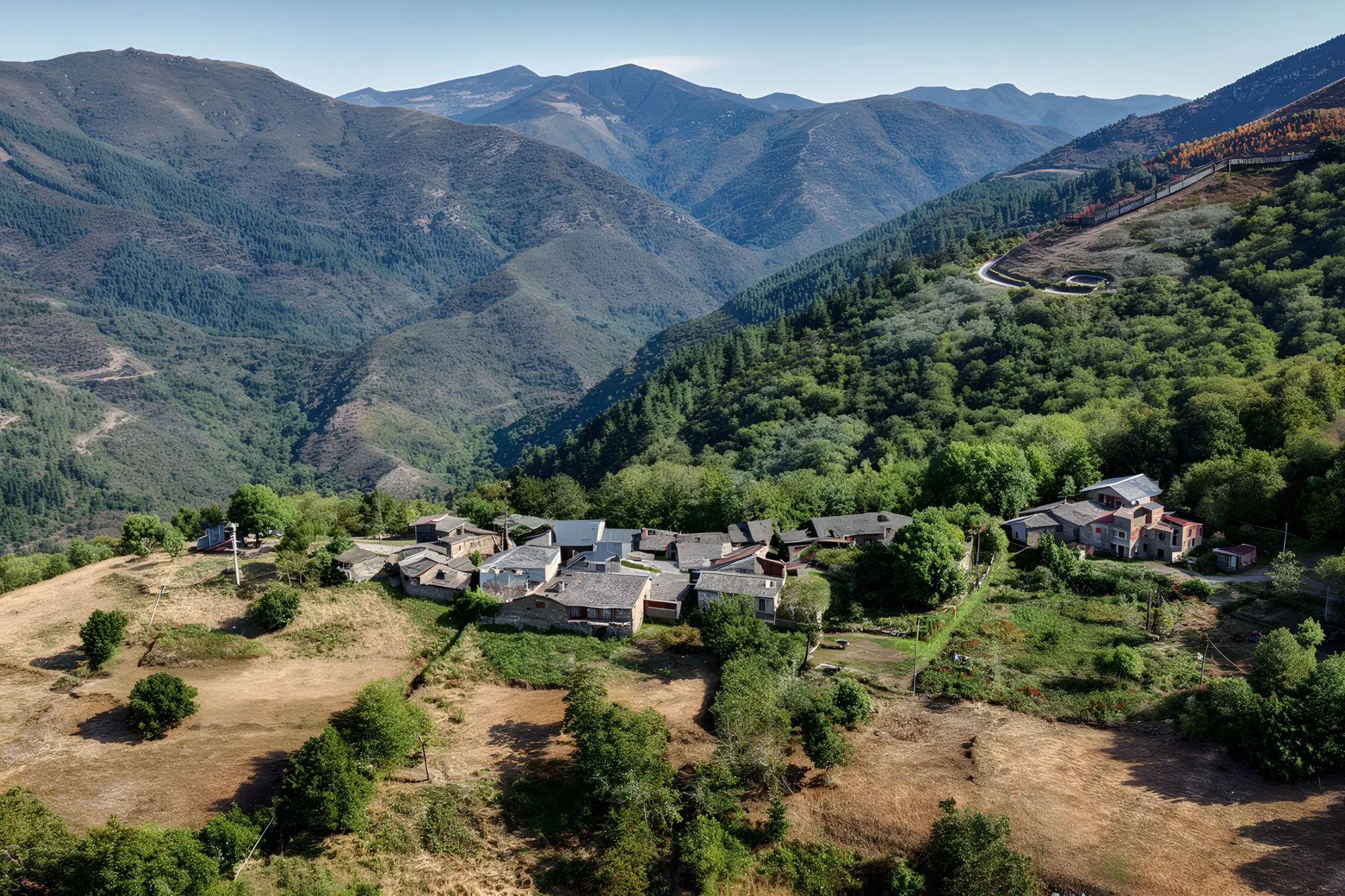
There is a hamlet near Monforte de Lemos where a chestnut grove has been gaining ground on a vineyard for about fifteen years. Nobody planted the chestnuts. Nobody pulled out the vines. The owner died, the heirs scattered, and the slope went on doing what slopes do when nobody intervenes. The Xunta has two different plans for that hillside, and they are not the same plan.
The first is the Aldeas Modelo programme, an instrument of the Lei 11/2021 de recuperación da terra agraria, which identifies abandoned villages and reorganises the surrounding land for productive agroforestry use. There are 21 declared so far across Galicia, fourteen of them in Ourense, where the abandonment has been quickest and the photographs of empty stone houses most useful to the bid. In July 2025, AGADER announced that the Val de Lemos — the irrigated plain immediately west of Monforte, taking in Bóveda, Pantón and Sober — will receive Galicia’s first partial catalogue of agricultural and forestry soils. The framing is technical: a dynamic document classifying each parcel by productive aptitude. The intent is less technical: get the land back into the hands of people who will work it.
The second is the Lei do Solo, amended via Lei 5/2024 and Lei 5/2025 (in force since January). Among the permitted uses in rural land, Article 35 now includes, in plain Spanish, construcciones y rehabilitaciones destinadas al turismo que sean potenciadoras del medio donde se ubiquen. The bureaucratic friction around converting a derelict stone house into a rural hotel, a rural rental, or a private second home has been deliberately reduced. The intent is also less technical than the wording: get the buildings back into circulation, by whatever route circulation arrives.
Both laws look at the same hamlet and see a problem worth solving. They do not see the same problem. One sees a slope that has stopped producing food. The other sees a roof that has stopped being a home. The instruments designed to fix each version operate on the same parcels — and frequently on the same family’s inheritance — without a visible mechanism for coordinating which takes precedence when both are interested.
This is not a scandal. Galician rural law is genuinely trying, and the 10,000 hectares mobilised since 2021, 58% of them in Ourense, are a real number describing real reactivation. Foreign buyers rehabilitating quintas in Pantón or Sober are not the villains of the story; in plenty of cases the buyer is the only entity that arrived with capital and a plan when the heirs had neither. The slow conversion of stone shells back into inhabited buildings is, on its own terms, recovery.
The question is what kind of recovery, and whether anyone is choosing. Aldeas Modelo recovers land for productive use by people who, in the policy’s own framing, live there. Lei do Solo enables rehabilitation for uses that may not require anyone to live there at all. Both are legitimate. They produce different villages.
Walk through a parish where the catalogue work is about to begin, and the question becomes parish-scale rather than ideological. Which buildings are being rehabilitated, by whom, on what timeline. Which plots are entering the catalogue, with what designated use. Whether the concello — the Monforte planning office, the Pantón one, the Sober one — is reading both processes at the same desk, or in different offices that do not share a map. The Xunta is not coordinating this. The concellos may be, parish by parish, on the strength of who walks through the door first. The buyer with the architect, or the young farmer with the lease.
Both have a claim on what the slope becomes. The legislation has so far been clearer about granting the claims than about adjudicating between them. That gap is the territory’s next quiet decision.