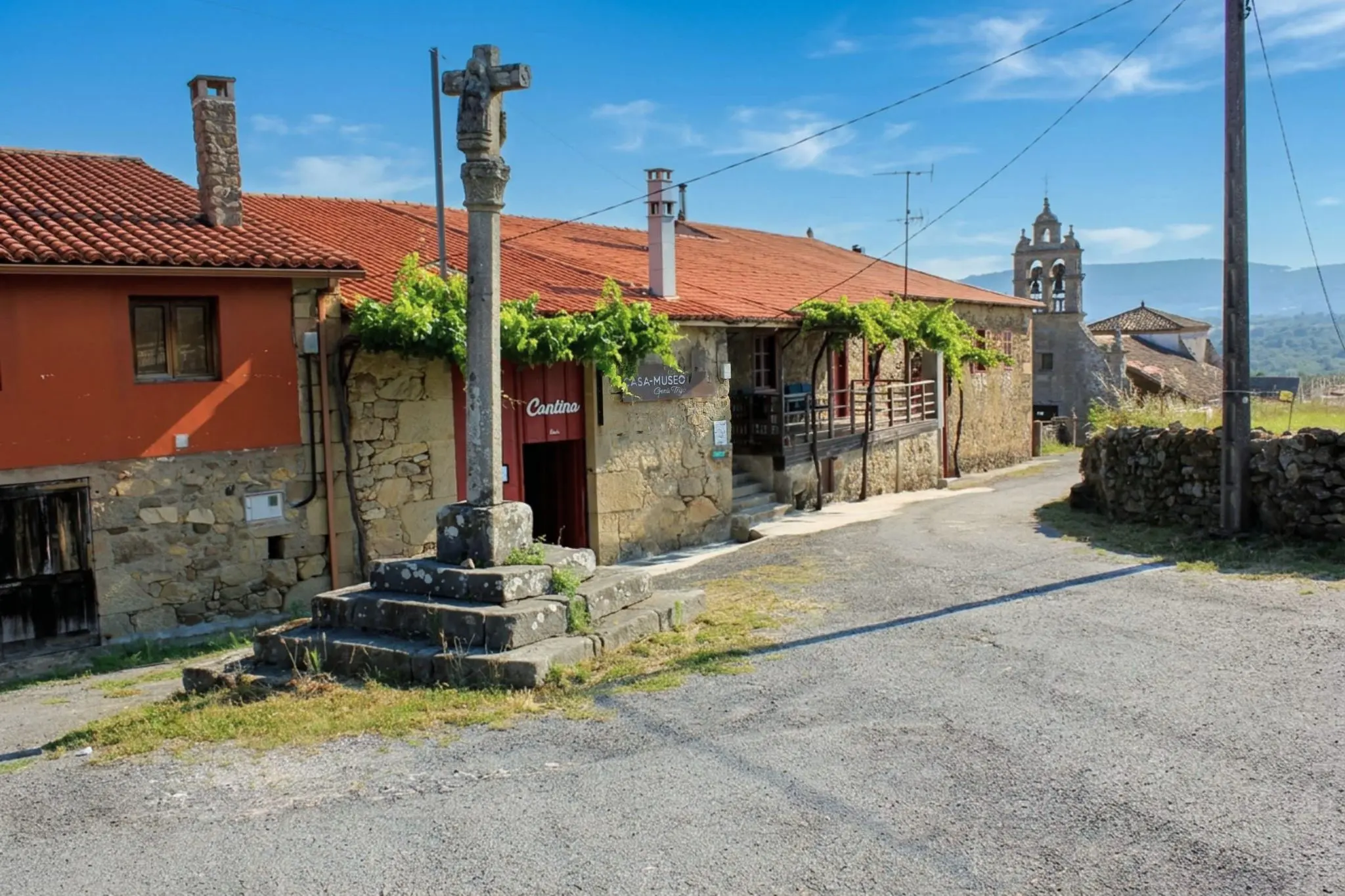
The old woman was already unlocking the church of Santiago de Gundivós when we arrived, early, before the heat settled in. She was proud of the retable — a polychrome tangle of gilt and green that she had helped to reassemble — and before we could ask anything she had drawn us a map of the morning. Three things to see, she said: the artist’s house-museum, the potter’s workshop directly opposite, and, ten minutes on foot down the road in Donelle, a project called Guardabosques that would open in September. The cruceiro outside stood between the first two, as if to confirm we were in the right place. All around, the ordinary evidence of a working parish: dry-stone walls, a scatter of vines, cachena cows looking for shade.
This is a corner of the concello of Sober, fifteen minutes from Monforte de Lemos — close enough to be an easy detour, far enough to have been left largely to itself. Gundivós appears in the guidebooks, when it appears at all, as a footnote to Sober’s wine: the parish that once made the black earthenware in which Amandi was stored and carried. That footnote is still true. It is simply no longer the whole story.
The pottery of Gundivós is among the oldest living ceramic traditions in Galicia, with forms and firing methods that reach back through the Roman wine trade to Iron Age precedents. Its signature is the deep black finish, achieved by smoking the pieces over a gorse fire and sealing them, after firing in a stone kiln, with pine-resin pitch. The wares were never decorative. They were made for the vineyard and the kitchen — jugs for wine and oil, pots for cooking and the matanza — and the good workshops still make them that way. The Museo do Pobo Galego in Santiago holds a fine collection; the craft itself is now kept alive by only two hands’ worth of people.
One of them is Elías González, at the Rectoral de Gundivós, an eighteenth-century rectory he restored into a workshop, small museum and shop directly across from the house-museum. Visits are by appointment; he throws on a low, hand-turned wheel, fires in wood, and demonstrates the smoking that blackens the finished piece. His personal collection runs to jugs a century old. He is, on the ground here, the last potter properly seated in Gundivós itself. The other active workshop, Figulus — Tomás López and Otilia Arias — sits just outside the parish, in Corbelle, Proendos, and offers guided visits, workshops and a small winery of its own. Two workshops for one shrinking tradition, and, if we’re honest, not much warmth between them. We noted it and moved on; the tradition matters more than the froth around it.
The Narrator
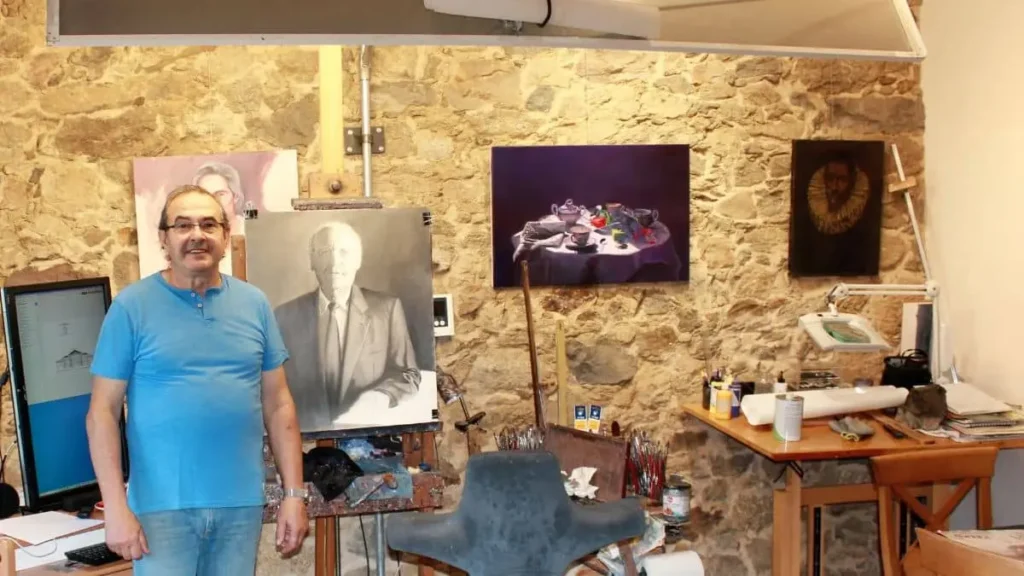
The person who introduced us to all of this — and who now, more than the clay, defines the place — is Modesto Trigo Trigo, painter, born in the village in 1960, returned after a career that took him from Madrid to Mexico City, China and the United States. His parents’ house is now the Casa-Museo Genia Trigo, named for his mother, Generosa, to whom he dedicates the whole project. He and his partner rebuilt it themselves — ninety per cent of the work, he says, done by his own hands and Elia’s.
It is not a cold museum. Rural tools and testimonies of vanished trades share the same rooms as his own oils — portraits, nudes, urban landscapes, the odd commission for the Madrid Ateneo drying on an easel. Objects are labelled; some carry QR codes that explain a trade. In one room hangs his mother as a young woman; in another, his father’s handprints, pressed into the plaster when the house was extended and never removed, over the grandfather’s objections. There is a guesthouse, a small “Cantina” shop, weekly painting classes for local children, and a hall he rents for talks and concerts. “It was important to me,” he said, “to describe what we were — not only what we want to be.”
What he wants to be is harder to summarise, because Modesto talks the way a river runs. But the argument underneath is coherent and, in this territory, familiar: that a village is not a museum of the past but a place from which to build a future. He points, repeatedly, to Tuscany — where a generation planted the groundwork decades ago and lives on it now — and to the French who planted chestnut avenues knowing they would never eat the fruit. He wants to bring artists here through his foundation, run art-therapy sessions with neurologists, teach children to paint before school teaches them not to. He is impatient with a version of the craft that only reproduces old jugs for tour buses. Ceramics, he insists, has a future as sculpture, as material — not only as souvenir. He would like his cousin Elías to see it that way too. That tension, affectionate and unresolved, is the most honest thing about the place.
The Neighbour Arriving
Ten minutes down the road, the arithmetic of the parish is about to change. Guardabosques is an ecosocial project run by the cooperative Ecooo, rehabilitating the deshabited — never quite abandoned — hamlet of Donelle: a seventeenth-century farmhouse and its outbuildings, wrapped in oak, chestnut, cork oak and strawberry-tree woodland the project is buying up to keep from being felled. The plan is a rural training centre with twenty-one rooms and a restaurant, funded by public money, the cooperative’s own capital, and participative loans — more than half a million euros of them, from hundreds of backers across Spain, France and Argentina, who invest rather than donate. “We want to inhabit the place,” their coordinator J. V. Barcia told us by phone, “not colonise it.” He calls Gundivós the parish’s new cultural nucleus, and Guardabosques its younger sibling, with much to learn from Elías and Modesto. When it opens, Modesto sees it as the room he never had: twenty beds and a kitchen to run the larger workshops from. Three small enterprises, in other words, quietly deciding they are stronger aligned than alone.
Come for a day and the logistics are simple. The house-museum keeps regular hours (Tuesday to Sunday, morning and late afternoon, closed Mondays) and asks three euros; the Rectoral and Figulus want a call ahead. Guardabosques, at the time of writing, is still finishing. The whole cluster sits within a quarter-hour of Monforte, which makes it a genuinely easy morning — one that rewards the visitor who arrives curious rather than ticking a list.
We had come, in the end, for pottery, and pottery is the least of what we found. What stays instead is the picture of a small slice of the Ribeira that looks active, motivated and determined to mend its own economic and social fabric — largely on its own initiative, without much visible coordination from above — and leaving behind that vague, characteristic Galician suspicion that we did not quite understand all of it. Which may be the point. Some places don’t hand themselves over on the first morning.
The cruceiro of Gundivós, A Airexa, Sober; Modesto Trigo Trigo in his studio — photos by P. Vanossi.