~26 km drive · 6 stops · ~4-5 hours · Start: Monforte de Lemos · End: San Xillao de Lobios
The parish network on this loop pre-dates the Amandi name by four centuries. It was the framework Sober was built on before the wine economy gave the subzone its identity, and three of its churches hold sixteenth-century mural cycles inside that still aren’t widely known outside the diocese. The structure here is parish geography first, viewpoint second — the canyon arrives only on the fifth stop, and by then the inland half of Amandi has already done most of the work.
The route begins in Monforte, leaving from A Compañía — the Jesuit Colegio de Nuestra Señora de la Antigua, the so-called Galician Escorial — and heading west on the N-120. About ten kilometres out, a signed turn drops down to San Pedro de Canaval. The church is closed to the public; the 13th-century portada is what survives of a building tied to the Order of the Temple, the vanished monastery of San Pedro de Valverde, and the Casa de Lemos. Exterior only, but the closed door is part of the history, not an obstacle to it.
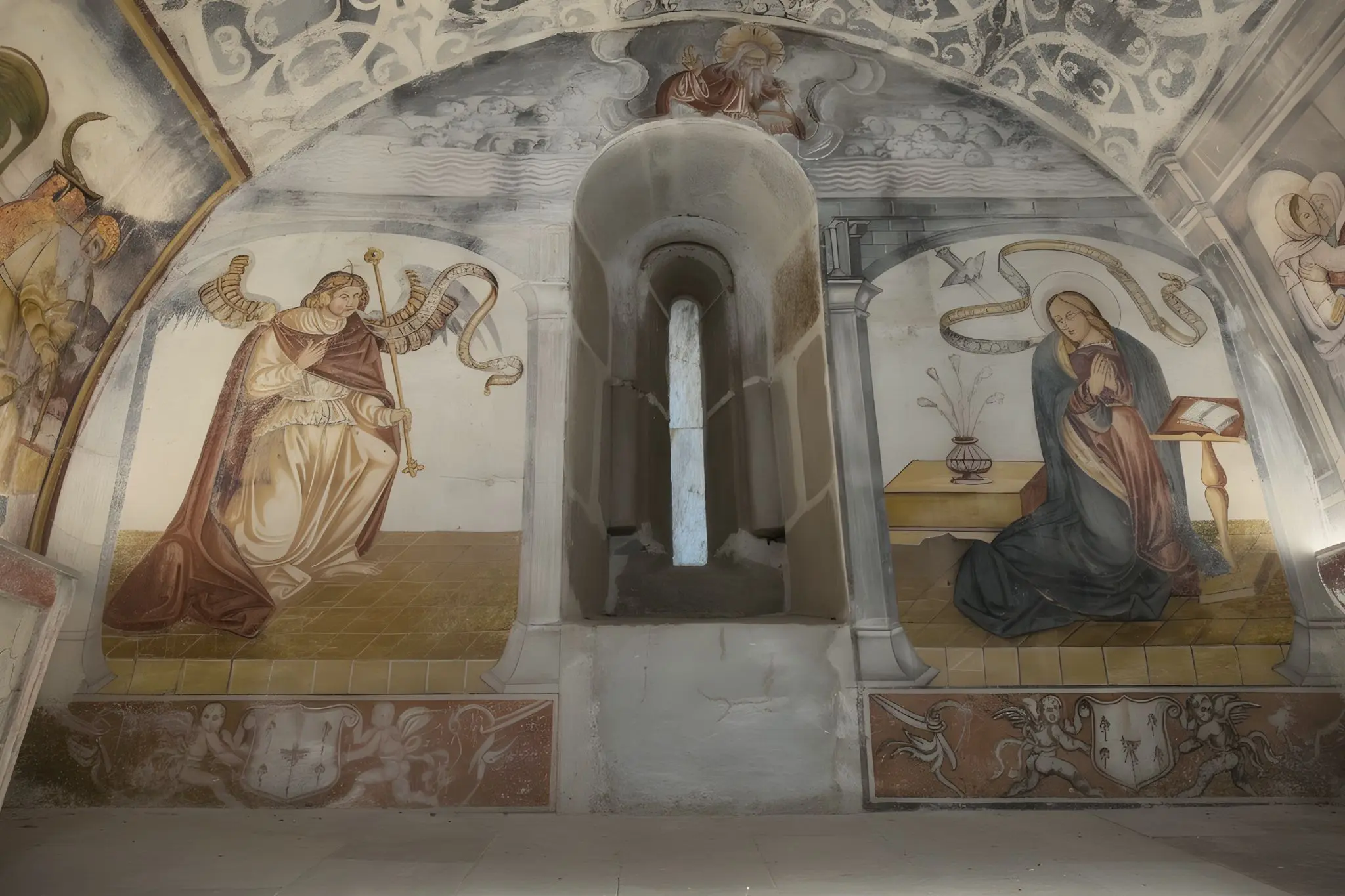
Back on the plateau, Santa María de Proendos is the first interior stop and the route’s first real argument. The building sits on a Roman villa — a settlement called Proencia, fragments of which are still embedded in the surrounding village walls — and the 12th-century fabric carries that layering through into the interior: a chequered triumphal arch, a capital resting on a recycled marble column, and a presbytery vault with 16th-century murals uncovered by the parish priest in the 1970s. These belong to the same Renaissance mural recovery that produced Chantada‘s Santa María de Nogueira de Miño, the Sistine Chapel reference point for the territory.
Santa María de Bolmente, ten minutes further south, is the route’s most modest stop — largely an 18th-century rebuild on a basilical plan, with Romanesque surviving in fragments: five plain corbels on the south face of the apse, an arrow-slit in the east end, the triumphal arch inside. Worth the stop for sequential honesty rather than monumental weight; a parish where the older stones were folded into the newer building rather than swept aside.
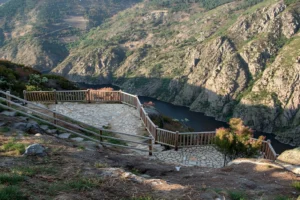
From Bolmente the road bends east towards the Santiorxo viewpoint, the route’s only non-Romanesque stop and its spatial turning point. The plateau drops away into the Sil canyon and the Amandi terraces become legible from above for the first time: the inland agricultural register you’ve been moving through and the riverine wine territory below it click into relation. The view does the explaining here, not the other way around.
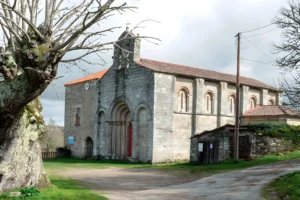
San Vicente de Pinol is the architectural peak — a 12th-century rural church of a kind unusual in Galicia, with an intact Latin-cross plan, a stone rose window framing a hexagonal star (variously interpreted, never conclusively), and 16th-century murals in the apse. About a kilometre away, the sanctuary of A Virxe das Cadeiras sits on a hill that carried devotion well before any Christian overlay — worth the detour for the asymmetric tower and the views, if time allows.
The route closes at San Xillao de Lobios, the third mural stop and the only church on the route substantially restored in the last decade. Single nave, semicircular apse, a portada retaining its original arch, 16th-century murals in the head of the church. A working chestnut souto behind it — sequeiros still visible — is the territorial register the building was always embedded in. Both Pinol and Lobios now open on scheduled hours under the Diocese–Consorcio programme launched in March 2026, €2 per church.
May–June and September–October are the right windows; the inland plateau gets seriously hot in summer and midday closures are common. To visit Proendos’ interior, call the concello of Sober (982 460 001) or the Casa de Cultura (982 460 513) before you go — access depends on staff availability. Canaval and Bolmente are exterior visits. The LU-P-5903 returns north from Lobios to Sober and Monforte in around half an hour — lunch either way.
The Annunciation, Santa María de Proendos, 16th century — photo by P. Vanossi, edited with AI.