~23 km drive · 5 stops · ~4 hours · Start & End: Taboada town
The Taboada day-trip is the one that resists the canyon reflex. There is no rim viewpoint here, no descent, no terraces. What there is, instead, is a plateau the canyon empties out of — and a parish network older than the wine economy that now defines the territory downstream. Local accounts describe Taboada as the natural entrada to Ribeira Sacra from the north; the route makes that concrete by staying on the inland side, where the seigneurial and monastic lines were drawn long before the vineyards became a brand.
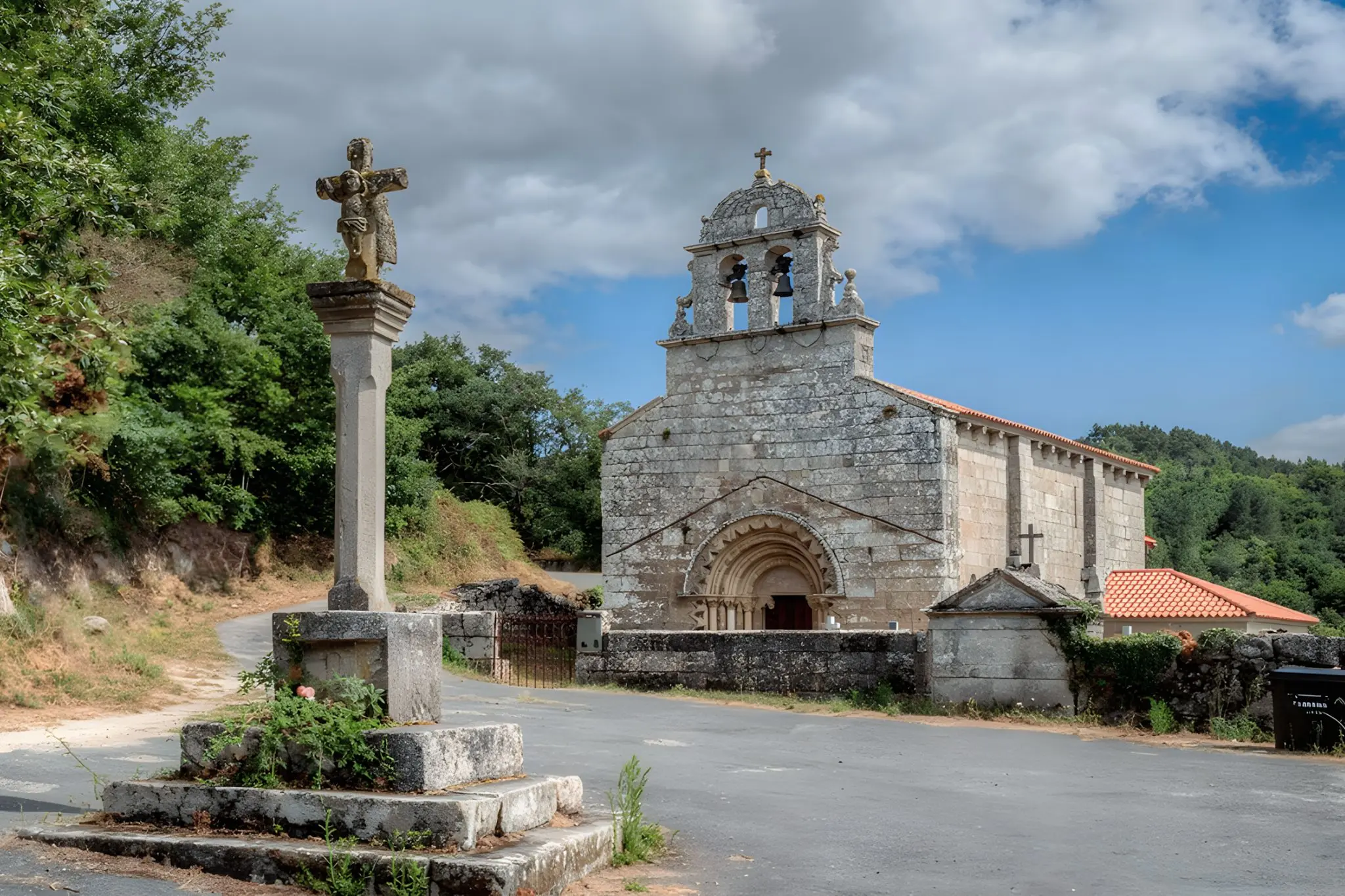
The loop opens at San Pedro de Bembibre, just outside the town. Bembibre belonged to a vanished cenobium and now sits a kilometre from the restored fortress-pazo of the Condes de Taboada, the family that organised this corner of the province from 1413 onward. The church carries that lineage inside: the sarcophagus of the first count, sixteenth-century murals on the nave walls, a triple-arquivolt portada that earns its Bien de Interés Cultural designation without raising its voice. The doorway ornamentation is the obvious thing to look at; the murals are why interior access is worth arranging through the concello.
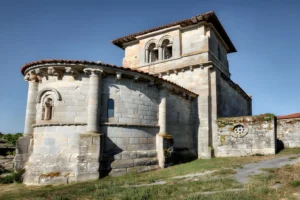
From Bembibre the road drops south along the N-540 axis to the next pair of stops, which sit a couple of kilometres apart on the same line. San Xián de Campo comes first: a twelfth-century church with mural painting inside, an ornamented western portada, and a tympanum with crosses that has led some scholars to speculate about a Templar trace here — the same order that, by 1233, owned the church a few kilometres further west. Santa María de Piñeira, a short drive on, is the largest and most architecturally accomplished Romanesque in the concello. The parish recorded at least two now-vanished monasteries; the surviving church preserves a three-tramo semicircular apse divided by engaged columns with carved vegetal capitals, a fifteenth-century polychrome stone altarpiece in late-Gothic register, and two stone sundials embedded in the south wall — one likely contemporary with the building, the other dated 1730. The fabric of the nave is essentially intact; the baroque façade and bell-gable were grafted later without disturbing what came before.
The route then swings northwest, climbing back onto the plateau to Santa Mariña de Cerdeda, the westernmost stop and the route’s quietest. A twelfth-century church with later baroque touches, austere from the outside — granite ashlar, single nave, two-pitched roof — its argument is carried by the canecillos and capitals along the eaves. It is the most straightforwardly parish-scale of the five. From Cerdeda the return road eastward passes through Santa María de Taboada dos Freires, the route’s historical centre of gravity and its last stop before Taboada town. The lintel above the western door carries a date — Era MCCXXVIII, 1190 — and a name, Pelagius Magister, the maestro whose workshop produced the Samson-and-lion tympanum repeated, in variants, at Moldes and San Miguel do Monte. The “freires” of the toponym are Templars: by 1233 the church belonged to the Order, attached to the encomienda of Canabal in Sober. The 1927 reform demolished the original apse, but the western portada, the tympanum, and the inscriptions survived — enough to keep this stop, materially, in the twelfth century.
From Freires the road runs the final kilometres back east to Taboada. The five Romanesque churches sit between roughly three and ten kilometres apart on rural LU-P roads; figure four hours including unhurried interior visits where possible. Bembibre and the larger churches handle interior access through the oficina de turismo (982 465 147) or the concello (982 465 301); the smaller stops are best taken from the outside, and lose little for it. October and late April carry the right light — the inland plateau shows best in the angled sun.
Church of San Pedro de Bembibre, Taboada, Lugo — photo by Á. M. Felicísimo, edited with AI.