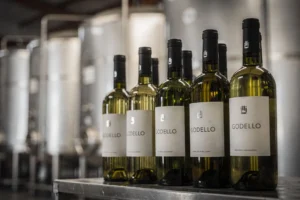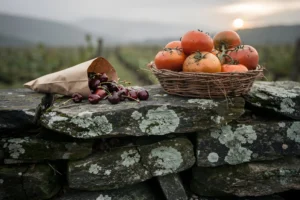
By the end of October the wine is in tank and the yards are full of everything the press refused. Skins, stems, pips, still wet, heaped against a wall or tipped into a corner, warm enough on a cold morning to give off a thin steam. Left alone it goes on fermenting quietly through November, sour and sweet at once, and the smell carries a good way down the road. Most of Europe now has this collected by lorry. In the parishes above the Miño it used to wait for the cold to settle in properly, because someone was coming for it.
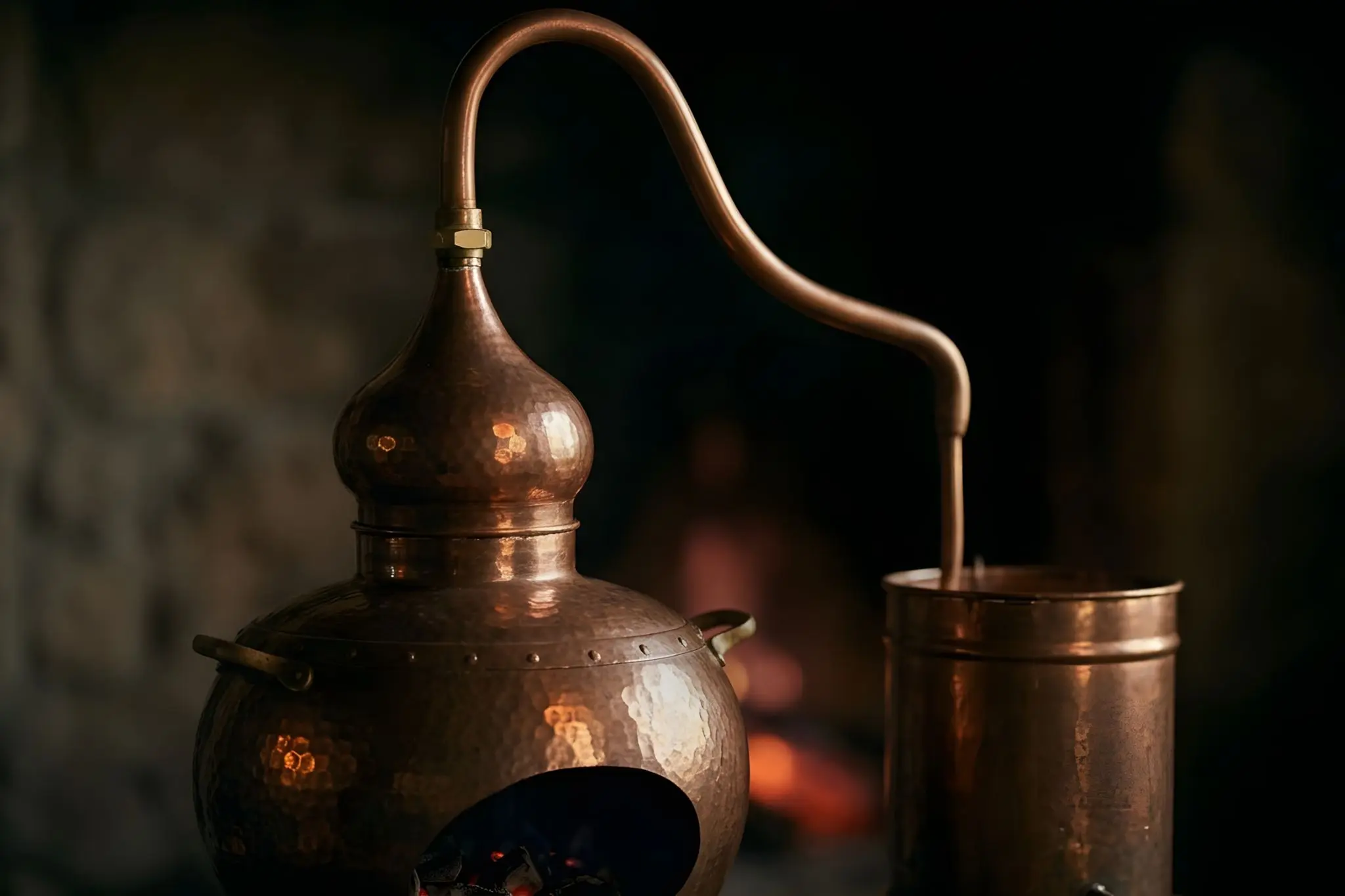
What came was a copper pot on a cart, or on a trailer behind a tractor, set over a wood fire in the yard with a coiled pipe running out of it through a barrel of river water. The first liquid out of the pipe was thrown away, the tail end went back for the following batch, and the middle — clear as tap water, warm, strong enough to burn on a spoon — was the augardente, and it stayed in the house.
The men who travelled with the pots were called poteiros, and they worked house to house all winter for a share of what came out. The word for that share was the same one the miller used for his cut of the grain, maquía: two travelling machines moving through the same parishes on the same terms, neither of them requiring money. Portomarín, up on the northern edge of the territory, had enough of these distillers to be known for them, and still fills its square with copper and small glasses every Easter. Two or three days of fire in a December yard, watched in shifts, is one of the last things in the agricultural year that could still be called an event.
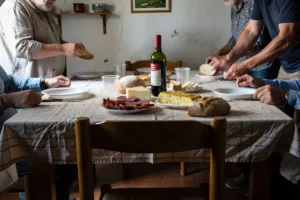
Nobody sold augardente. It went into bottles that had held something else, and from there into coffee on winter mornings, into the cupboard for visitors, onto the table at the end of the long lunches that follow a funeral or a killing of a pig. A litre or two went to a daughter in Barcelona at Christmas. Ask where the bottle in front of you came from and you get a name and a parish rather than a shop.
Spanish law has always taxed alcohol at the still, and the exceptions it makes are narrow. A grower may have their own pomace — the pressed skins — distilled, up to a fixed quantity each year, on the condition that the household drinks it and nobody is charged. That quantity is comfortable for a family and useless as a business, which is roughly the shape of what it was drawn around. The paperwork exists, the inspections exist, and the practice has always run a little wider than the allowance.
There is a licensed version as well, recognised in 1989 and registered in Spanish as Orujo de Galicia, in Galician as Augardente de Galicia. The current rules date from 2012 and cover five products: the clear spirit, an aged version, herb spirit, herb liqueur and the coffee liqueur. Some of it is very good: single-variety distillates off mencía or godello, small runs, time in oak, a bottle in a Monforte shop for the price of a decent wine. Thirty-one licensed distilleries serve the whole of Galicia and turn out something like 300,000 litres a year between them, all of it leaving under an excise seal and travelling with an invoice. That is a different chain of hands from the one that ends in your neighbour’s kitchen, and the two have never really met.
They are also moving apart faster now. Buyers have appeared — industrial distilleries, grape-seed oil, polyphenol extraction, compost, biomass — so the heap in the yard has a price on it and the man with the pot is bidding against a lorry. Meanwhile the DO’s register of growers lost more than a tenth of its names in a single year. Each of those departures takes away a press, a yard, a couple of hundred kilos of skins and any reason to light a fire in December. Furanchos are thinning for the same reasons, on the same demographics: both depend on a household producing more than it needs.
Most visitors meet augardente burning blue in a clay bowl at a queimada, which is a theatrical introduction to something that spends the rest of its life being handed across a table without comment. The bottles will keep coming — better made every year, better labelled, sold in shops with card readers. Harder to find is the other one, the used bottle with a strip of masking tape and a year written on it in biro, poured into a small glass at four in the afternoon by someone who did not buy it and will not let you pay for it.