~11 km circular · ~3 hours · easy · Start: Mosteiro de San Salvador de Ferreira, Pantón
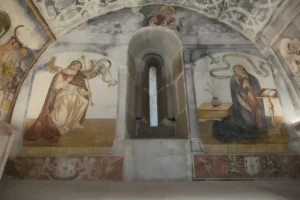
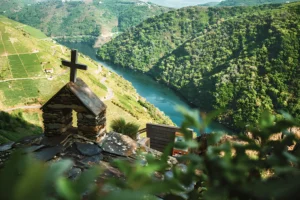
The walk begins at a monastery wall and ends at the same wall. The Mosteiro de San Salvador de Ferreira is one of the only continuously inhabited monastic sites in Ribeira Sacra — Cistercian nuns have lived inside it, with one nineteenth-century interruption, since the twelfth century — and the PR-G 274 traces a parish-scale arc around it. Three hours of vineyards, chestnut groves, a medicinal spring with its own balneario downstream, natural pools on the Carabelos river, and a small Romanesque church reached by a five-minute detour. None of it is dramatic. All of it is lived in. The walk reads as the territory the monastery has organised for nine hundred years, walked from the inside.
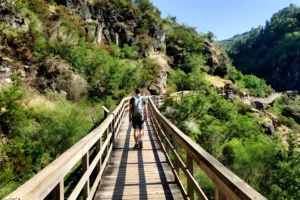
Start at the monastery and follow the vineyard tracks down to the Augas Santas spring. The water here has a long reputation for healing properties; the nineteenth-century balneario further along the loop was built on the back of that reputation, and the romerías to the spring once filled the surrounding parishes. From the spring the path climbs gently toward Verdeal, passes the Casa Grande das Bornogueiras and reaches A Serpentiña before crossing the Carabelos — a Red Natura tributary of the Cabe — and curling back through Palmelle to Cabo de Vila. So far, the homologated route. So far, agricultural Pantón at its most legible: stone walls, working chestnut groves, vineyards held by parish-scale plots.
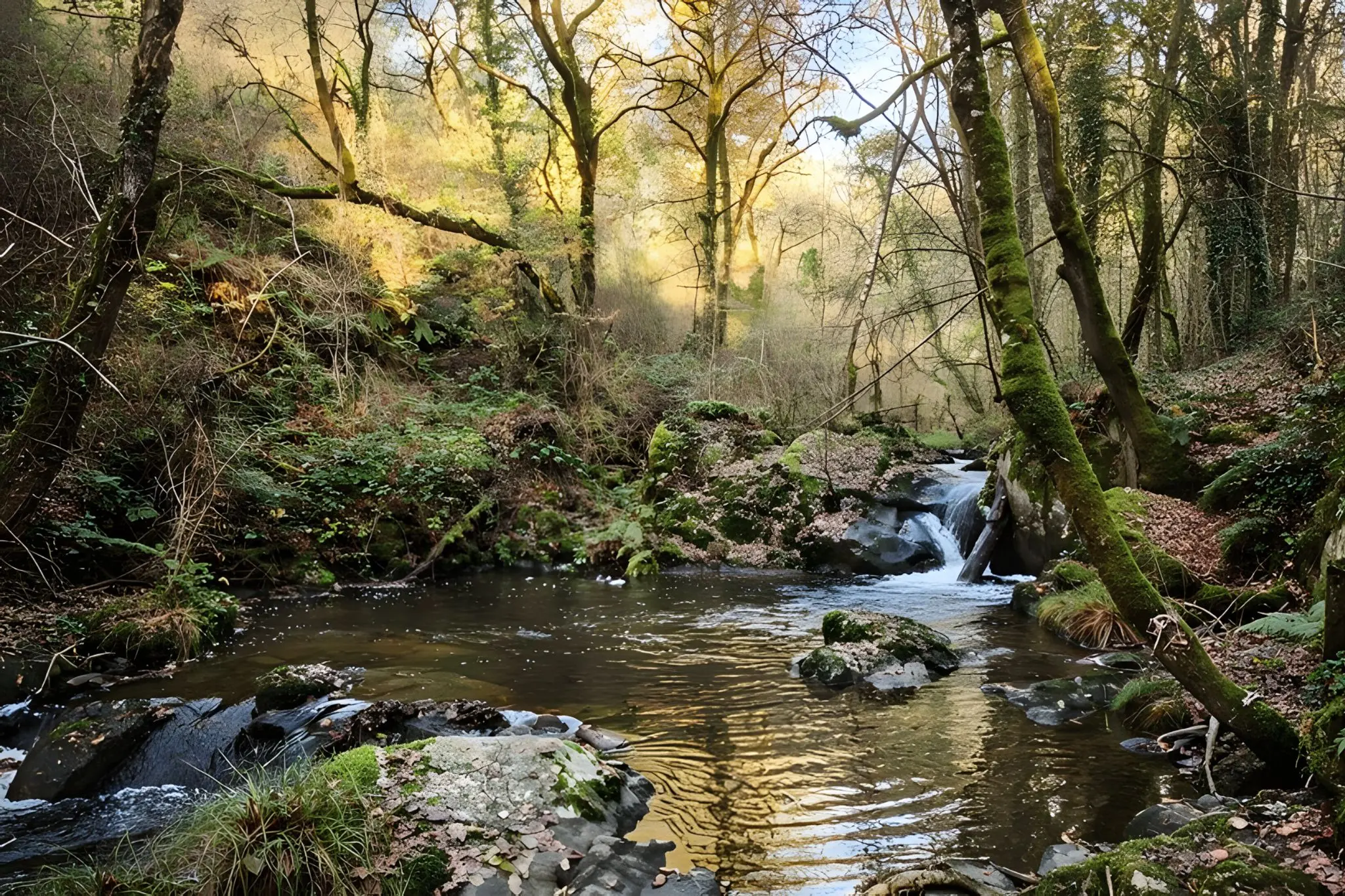
At Cabo de Vila the route loses its red-and-white waymarks but not its logic. A short asphalt section gives way to a dirt track that drops to the river and the Charca do Xanarteiro, a set of natural pools formed by the Carabelos. In summer the pools are the point; in autumn they are an excuse to descend through colour. Before rejoining the asphalt, the route loops briefly to the Iglesia de San Martiño de Pantón — a small parish detour that adds little distance and confirms the register: this is a walk through inhabited Pantón, not a circuit around a single landmark. The track then returns past the Hotel Balneario de Augas Santas and back to the spring where the morning began.
This is not a canyon walk and makes no attempt to be one. The drama is small-scale and parish-deep — the kind of territory Ferreira de Pantón rewards if you stay for more than a Romanesque day-trip. Three hours is honest at a non-rushed pace; longer if you swim or if the chestnut light insists. Sturdy trainers are enough outside winter. Sundays in summer find the Charca busy with locals; come weekday-early or late autumn for the place to itself.