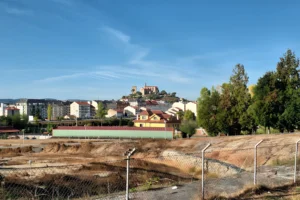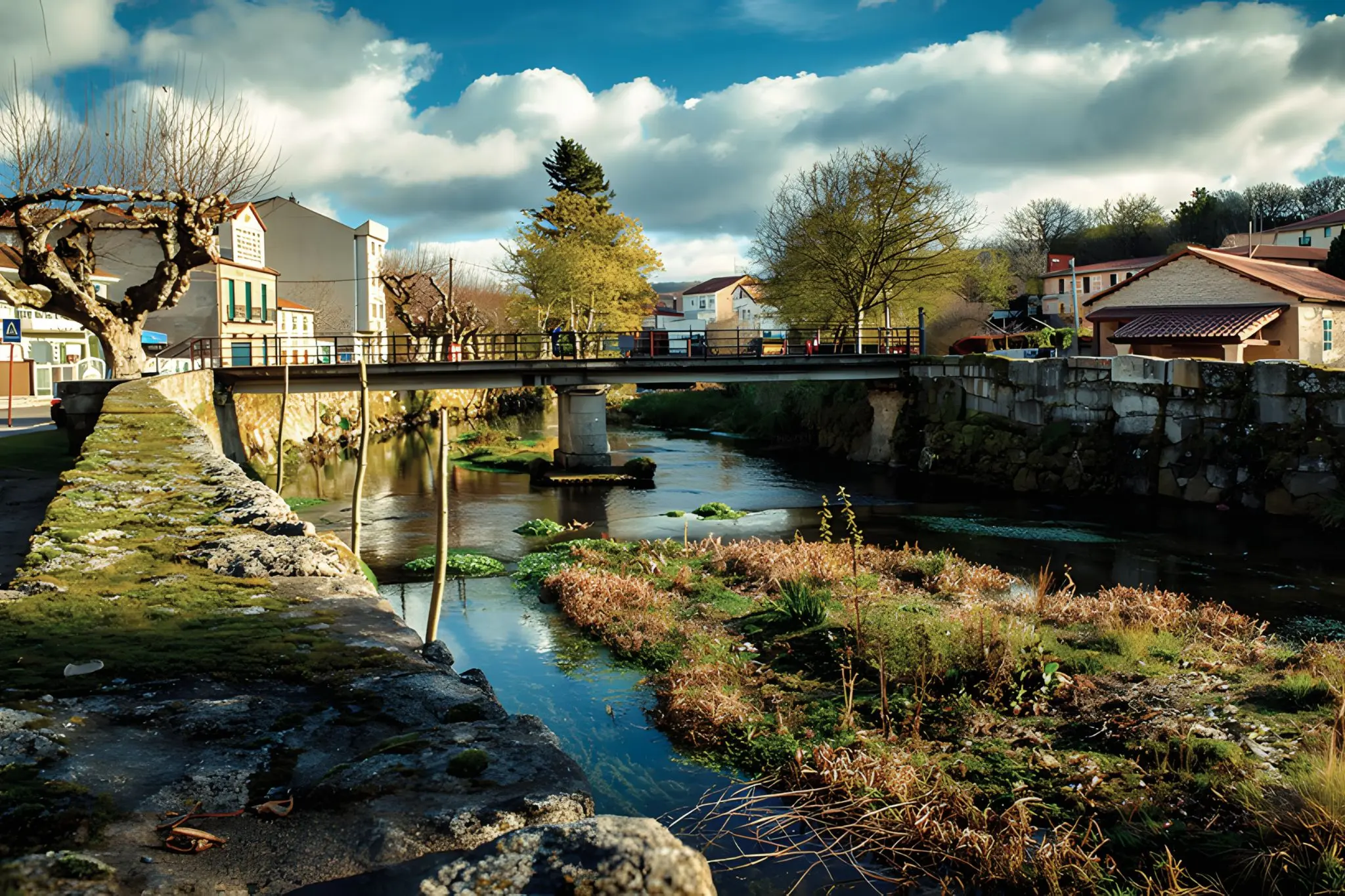
There are no cliffs here. No viewpoint pulling you to the edge of something vertiginous. Chantada sits on the left bank of the Río Asma, a small tributary that feeds the Miño without drama, in a wide agricultural fold of the land that bears almost no resemblance to the canyon territory that brings most people to Ribeira Sacra. That’s not a drawback. It’s the point.
The town is a working administrative centre — around 7,500 inhabitants spread across the municipality — with a covered market, a scatter of cafés, a monthly feira that hasn’t reinvented itself for anyone, and a social rhythm that doesn’t orient itself towards visitors. It doesn’t perform. It continues.
The Town That Stayed
Chantada’s history is longer and less tidy than most promotional materials suggest. The area is scattered with Iron Age castro sites — the fortified hilltop settlements that predate Roman presence across Galicia — and the town itself developed across centuries as an inland commercial node between Lugo to the north and Ourense to the south. The Monastery of San Salvador de Asma, founded in the early medieval period and rebuilt across subsequent centuries, anchored the town’s identity and its relationship to ecclesiastical land organization long before wine entered the picture as a formal category.
The Miño passes near, but it doesn’t define daily life here the way it does further downriver where the canyon tightens. The river is background, not foreground. You have to make the effort to reach it.
The Wine Without a Story
Chantada is one of the five subzones of the DO Ribeira Sacra, occupying the western bank of the Miño — directly across from Ribeiras do Miño on the opposite shore. The subzone benefits from more Atlantic influence than its counterparts to the east and south: cooler temperatures, slightly higher rainfall, granite and schist soils that produce mencía with more restraint than Amandi’s fuller expressions. The viticulture is terraced, still difficult, still hand-worked — but the canyon drama is absent.
This produces wines that are less legible to the story-hungry market. No vertiginous cliffs in the photographs, no parador with a view. The wines get made, the cooperatives stay active, and very little noise is made about any of it. For anyone paying attention to what’s actually in the glass, the subzone is worth the detour.
What the Feira Tells You
The Feira de Chantada is held on the 5th and 21st of every month and doesn’t market itself. It runs through the centre and along the Río Asma, with the livestock at the Feira do Gando, and what it tells you is more useful than any heritage framing: that this is a town where agricultural life and commercial life still occupy the same physical space without being aestheticized. Alongside it, the Feira do Viño (every March, on the Avenida de Monforte) and the Folión de Carros (late August, during the patronal festas) complete the town’s calendar.
The cafés around the main square are not interesting in the Instagram sense. They are interesting because people actually use them, and the conversations happening inside are about local things: harvests, prices, local politics, who has retired. There is a bakery or two that opens early. The rhythms are intact.
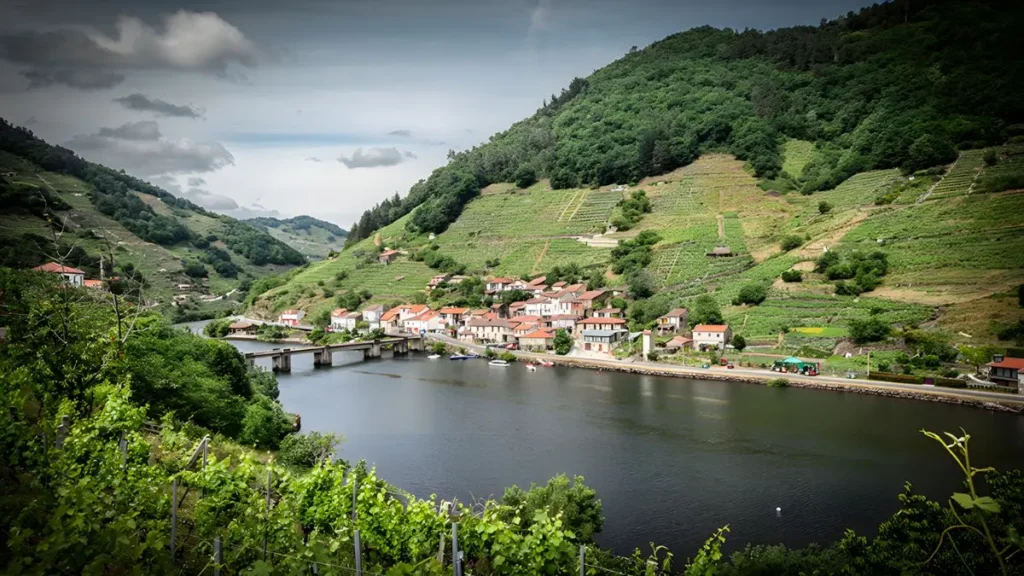
The Road Down to Belesar
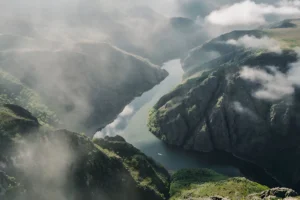
The real editorial function of Chantada — the reason a trip here makes the rest of the territory legible — is the road south toward Belesar. As the land drops toward the Miño reservoir, the terrain transforms. Agricultural plateau gives way to vine-dense slopes; the river opens below you; the canyon geography begins to assert itself. By the time you reach Belesar, you’ve understood the transition in your body rather than on a map.
The Ecomuseo Pazo de Arxeriz, situated across the river in O Saviñao on a 35-hectare estate built around a 17th-century manor, is fifteen minutes by car from Chantada and offers the most considered account of fluvial life in the territory — including documentation of the villages submerged when the Belesar and Peares dams were constructed in the 20th century, displacing over a thousand people and erasing more than thirty settlements. It is the opposite of the canyon spectacle. It is what was lost so the view could exist.
Chantada doesn’t ask you to feel anything in particular. It’s just there, continuing, which is precisely what makes it worth spending a morning.
Asma River as it passes through Chantada — photo by B. Riobó, edited with AI.
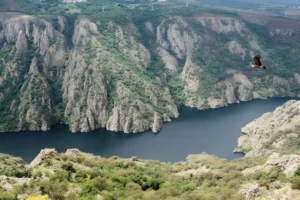
Belesar seen from the vineyards — photo by P. Vanossi, edited with AI.