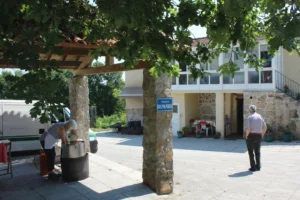
A piece of cardboard. Block letters in marker. Sometimes a branch of laurel or pine nailed above the door frame — a signal old enough that nobody is quite sure who started doing it. The door itself looks domestic, because it is. You knock, or you don’t. Someone opens it, or they don’t.
That’s a furancho. And that, more or less, is all the instruction you’ll get.
What They Actually Are
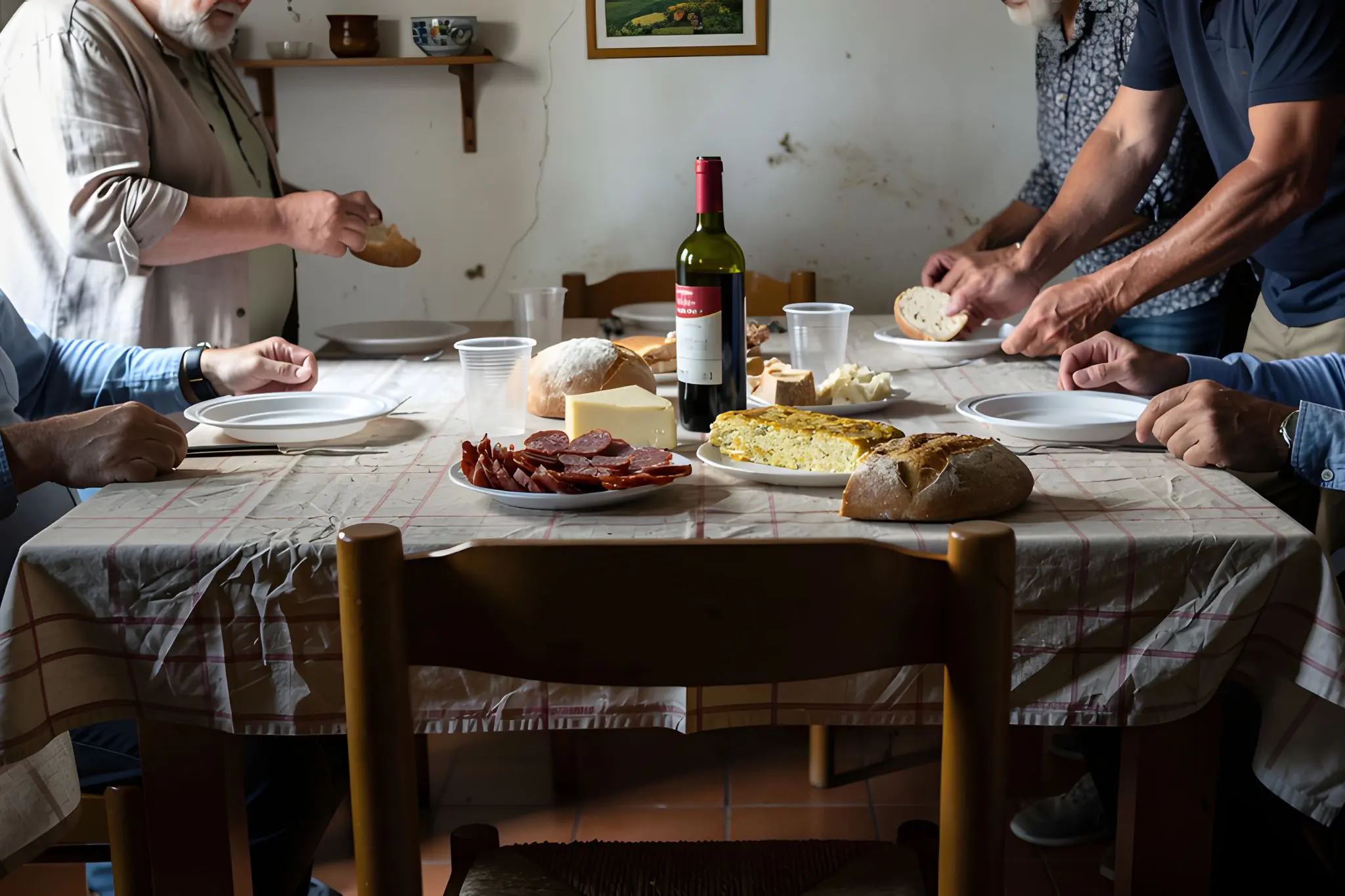
In legal terms, a furancho is a temporary licensed establishment, regulated by the Xunta de Galicia, authorised to sell surplus homemade wine for a limited period — typically running from late autumn through spring, and closing when the wine runs out. The food offering, where there is one, follows a fixed logic: empanada, chorizo, cheese, maybe a tortilla. Nothing plated. Nothing described. The point is not the menu.
In Galicia more broadly, furanchos exist along a spectrum. In the Rías Baixas, particularly around the Condado do Tea and O Salnés, they have become something semi-formalised — mapped, seasonal, increasingly known to visitors, occasionally Instagram-adjacent. They are not a secret. Some have websites.
The version closer to Ribeira Sacra is different. Not categorically — the legal structure is the same — but in register. It operates at a lower temperature. Quieter. Less eager to be found.
Where to Look (and Where Not To)
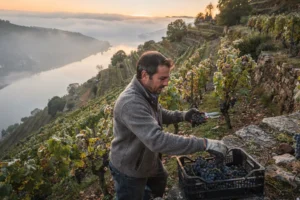
Furanchos do not appear uniformly across Ribeira Sacra, and anyone suggesting otherwise hasn’t been paying attention. The canyon areas — the steep Sil gorges, the Amandi terraces, the plots worked by the producers whose names appear on labels — are commercially oriented in a way that makes the furancho logic mostly irrelevant. When your yield is small and your wine has somewhere to go, you don’t sell it by the ceramic cup from your kitchen.
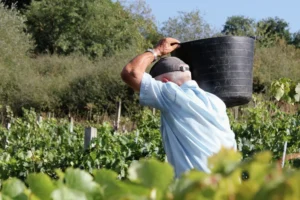
What you’re more likely to find, if you find anything, is in the transitional zones: the flatter agricultural areas toward Chantada, the lower Miño margins, the parts of Ribeira Sacra that blend into the surrounding rural landscape without sharp edges. Here, small-scale production persists alongside subsistence patterns. Here, the furancho still makes a kind of sense — economically, socially, structurally.
Even then: word of mouth, not signage. Timing, not planning.
The Wine Itself
It won’t have a label. It may not have a name beyond the family’s. It will be young — from the most recent harvest — and it will be variable in ways that a DO wine is specifically engineered not to be. That variability is not a flaw. It’s the whole argument.
What you’re drinking is viño da casa: wine made to be consumed within its own geography, by the people nearest to it, in the year it was produced. It predates the DO Ribeira Sacra (formalised in 1996) not as a heritage to preserve, but as a behaviour that the appellation system simply wasn’t designed to accommodate.
The furancho wine exists outside quality categories because it never applied for entry.
The Social Contract
You are not quite a customer. The transaction is real — you pay — but the logic governing the interaction isn’t commercial in any ordinary sense. There’s no menu to consult, no service to evaluate, no experience being curated for your benefit. What’s happening is closer to a temporary suspension of private space: the family opens a room, and you are permitted inside it.
Which means you behave accordingly. Patience. Attention. A certain willingness to sit with uncertainty. If the wine is rough, you drink it with respect, because the roughness is honest. If there’s empanada, you take what’s offered. You don’t ask for alternatives.
This is not customer hospitality. It’s something older — proximity to production as a form of social relation, where the transaction is the least interesting thing happening.
On Disappearance
The furancho, like most things that resist scaling, is under pressure. Regulation tightens. The generation that made this wine and opened these doors is ageing. Younger family members have other options — or no interest in the labour involved. Small-scale production declines when it’s no longer economically rational to maintain.
In Ribeira Sacra specifically, where the viticultural story has shifted decisively toward premium production and international markets, the conditions that sustained the furancho are narrowing. The appellation grows in prestige while the domestic wine culture that preceded it quietly contracts.
The handwritten sign on the roadside doesn’t announce this. It just tells you the door is open today. Whether it will be next year is a different question entirely.