Every system reveals itself most clearly at its edges.
In Ribeira Sacra, those edges do not appear as boundaries. There is no line where the monastic territory ends. Instead, it loosens — gradually, unevenly — into places where structure no longer fully holds.
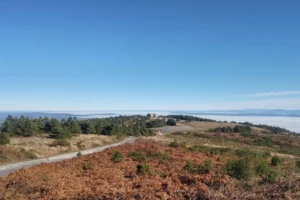
Around Monasterio de Santa María de Montederramo, the ruins of San Paio de Abeleda, and the hill town of Castro Caldelas, the landscape shifts again. The canyon recedes. The river is no longer the organising axis. The territory opens into a plateau that feels less defined, less legible as part of a system.
This is not where the monastic network begins.
It is where it thins — and where, in some cases, it disappears.
Beyond the River Logic
Up to this point, Ribeira Sacra has been read through its rivers.
Here, that logic fades.
Distance replaces proximity. The relationship to the Sil becomes indirect, almost abstract. Without that geographic anchor, the system loses coherence.
What remains is uneven — part structure, part residue, part absence.
Montederramo: Order Without Constraint
At Montederramo, the scale of the system is still visible.
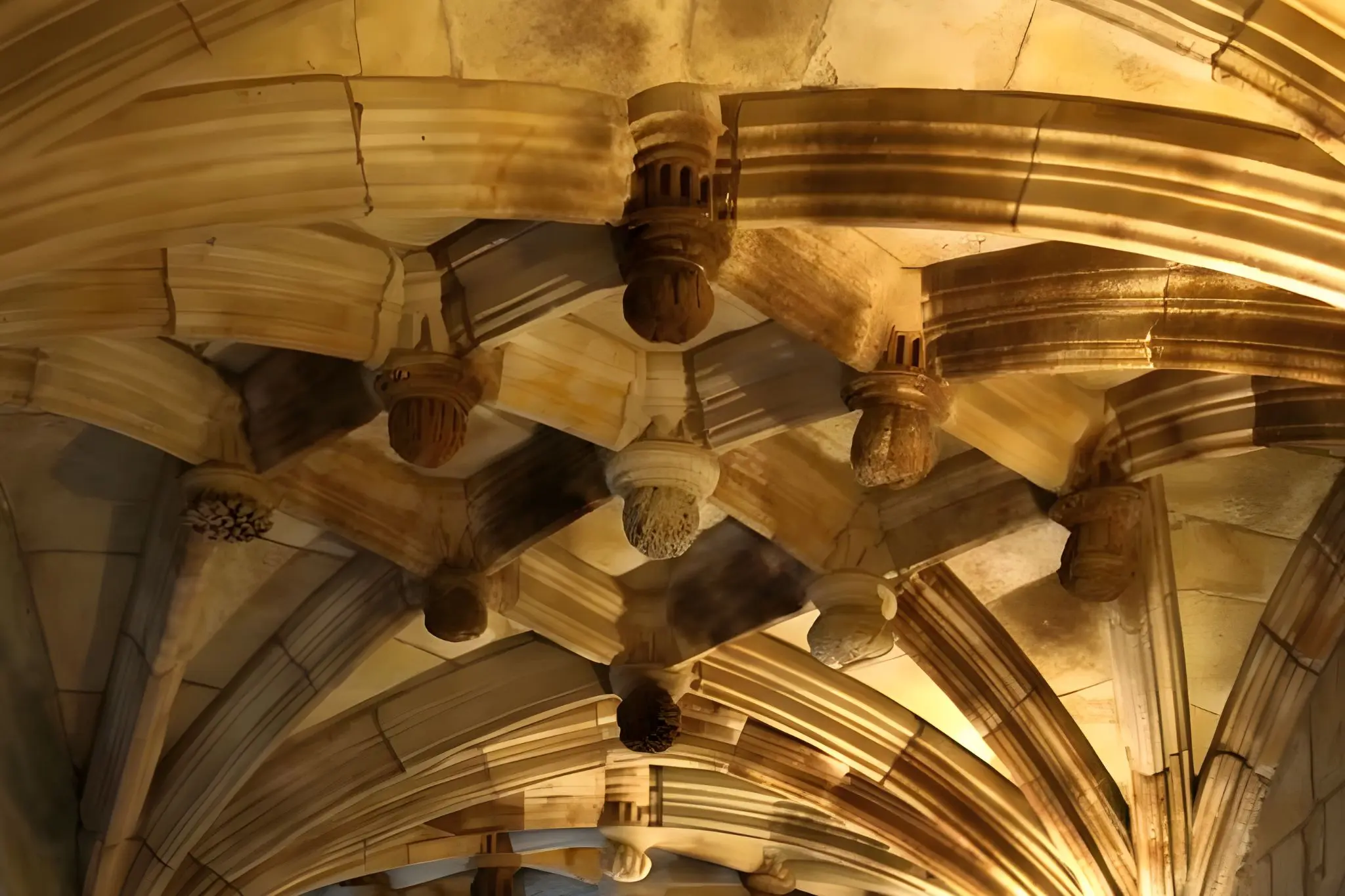
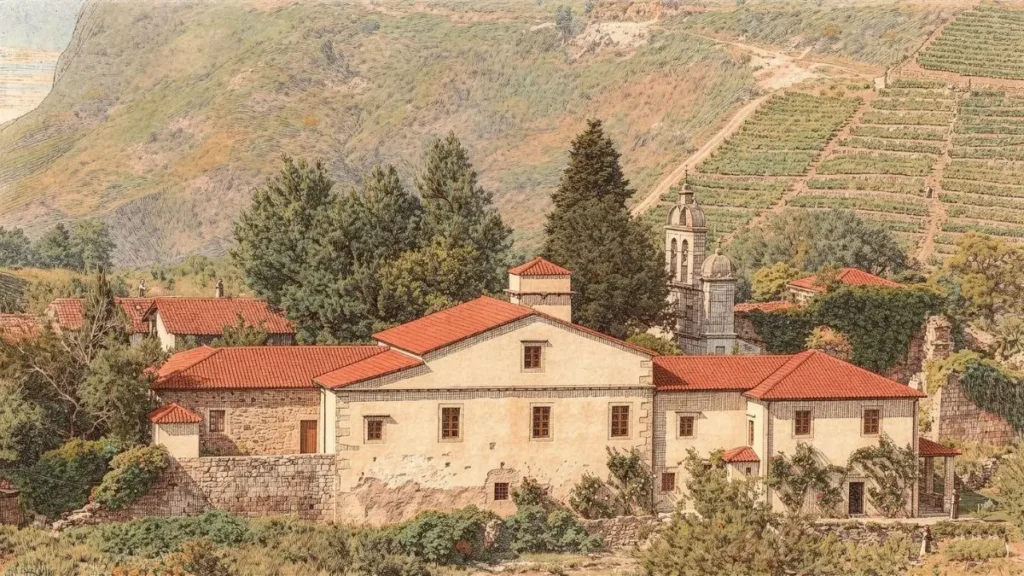
Founded in the 12th century and later integrated into the Cistercian network, it became one of the most powerful monastic centres in Galicia. Its architecture reflects that authority: expansive, formal, internally coherent.
But here, something shifts.
Unlike the monasteries along the Miño or the Sil, Montederramo is not shaped by a difficult landscape. It sits within an open, agricultural plateau — a territory that does not resist it.
The building retains the logic of the system.
The landscape no longer tests it.
Silence, in this case, is contained — architectural rather than territorial.
San Paio de Abeleda: Where Structure Fails
A few kilometres away, San Paio de Abeleda introduces a different condition.
Here, the system does not thin.
It breaks.
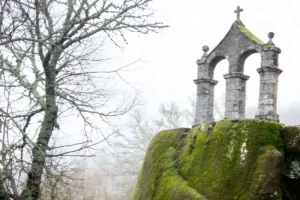
Once part of the same monastic network, the site now survives in a state of near-collapse — walls partially standing, volumes barely legible, structure reduced to fragments.
This is not curated heritage. Not adaptive reuse. Not even stable preservation.
It is exposure to time.
The architecture no longer contains silence. It cannot.
Instead, silence passes through it — uninterrupted, indifferent to form. What remains is not a functioning structure, nor a clearly readable one, but a trace.
And that trace matters.
Because it reveals something the rest of Ribeira Sacra often conceals: that the system was never guaranteed to endure.
Castro Caldelas: Residual Order
Nearby, Castro Caldelas offers another form of survival.
Its castle still stands. Its streets still hold. The structure persists.
But the network that once gave it meaning has faded.
This is not ruin, but residue — a place that remains legible even as its original function dissolves.
From System to Absence
Read together, Montederramo, Abeleda, and Castro Caldelas complete the arc.
Order. Fragment. Residue.
Not a single condition, but a gradient.
Here, Ribeira Sacra stops behaving like a system. It becomes uneven, discontinuous, partially erased.
And silence changes one last time.
It is no longer regulated, nor dispersed, nor encountered in its raw form.
It becomes ambient — and in places like Abeleda, almost absolute.
Staying With What Disappears
What defines this edge is not intensity, but loss of clarity.
There is no clear ending. Only a gradual weakening — and occasionally, a collapse.
And yet, this is where the territory becomes most honest.
Because the monastic system is no longer presented as heritage.
It is revealed as something that could persist, adapt — or vanish.
Ribeira Sacra does not end here.
But it becomes uncertain.
And in that uncertainty, the final form of silence emerges:
Not structured.
Not preserved.
But left.
Also in Stone and Silence
– Silence That Still Has Rules
– Where Silence Breaks Into Space
– Before the Rule