Before the monasteries organised Ribeira Sacra, before the terraces aligned with the rivers and the bells structured time, there was a different kind of presence here.
Less visible. Less stable.
Above the Sil canyon, away from its cliffs and viewpoints, the land opens into a quieter plateau — the interior around Mosteiro de San Pedro de Rocas and Monasterio de Santa María de Xunqueira de Espadanedo. It is easy to overlook. There are no dramatic drops, no immediate spectacle.
But this is where the system begins to unravel — and where something older becomes legible.
Not the Canyon, but Above It
This is not canyon-edge Ribeira Sacra.
Here, the terrain loosens. The forest thickens, the slopes flatten, and the sense of vertical exposure gives way to something more enclosed, more interior. Movement is less about descent and more about immersion.
This shift matters.
Because what emerges here predates the monastic system that would later define the region. It belongs to a time before orders, before rules, before architecture as we recognise it.
San Pedro de Rocas: Excavation as Shelter
At San Pedro de Rocas, the monastery is not built.
It is carved.
Traditionally dated to the 6th century — with possible earlier hermitic occupation — it is one of the oldest monastic sites in Galicia. But even that framing can be misleading. Rocas does not read as a monastery in the conventional sense.
It reads as an intervention in rock.
The chapels are excavated directly into the stone, their forms irregular, adapted rather than imposed. Columns emerge from the same mass that surrounds them. Walls are not constructed, but revealed.
This is not architecture asserting itself over landscape.
It is shelter extracted from it.
And that distinction shifts everything.
Because the silence here is not structured by rule or enclosure. It is immediate — dense, mineral, inseparable from the material that contains it.
Less produced than encountered.
Xunqueira de Espadanedo: The First Layer of Order
A short distance away, Xunqueira de Espadanedo marks a different moment.
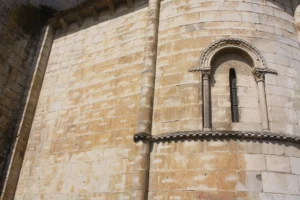
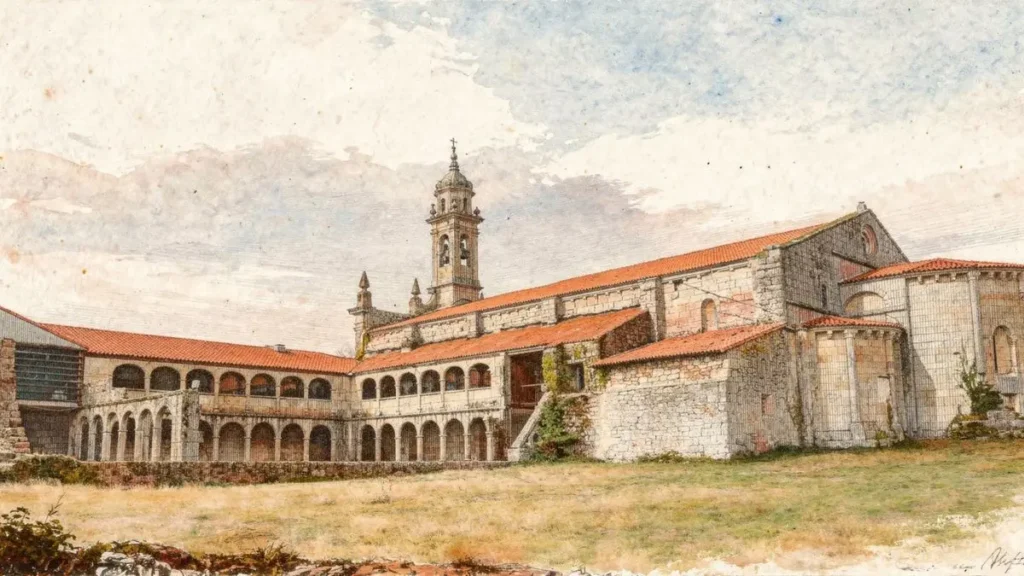
Founded in the 12th century and later shaped by Augustinian canons, it belongs to the early phase of institutional consolidation. Not yet the large Benedictine systems seen elsewhere, but already moving toward structure.
Here, architecture reappears.
Walls define space. The cloister organises movement. The church aligns with a recognisable liturgical logic. The building is no longer extracted from the ground, but placed upon it.
And yet, something of the earlier condition remains.
The scale is restrained. The presence is quieter. Even in its partial preservation today — parish use, limited visibility — Xunqueira feels transitional.
Not fully systematised. Not entirely raw.
Before and After the Rule
Read together, Rocas and Xunqueira do not describe a contrast, but a sequence.
From excavation to construction.
From individual withdrawal to collective organisation.
From silence encountered to silence regulated.
This is the pre-institutional layer of Ribeira Sacra — the moment before the monastic system stabilises into the forms we now recognise as Romanesque heritage.
And it complicates the narrative.
Because it reveals that Ribeira Sacra was not born as a network of monasteries, but as a landscape of gestures — small, dispersed, often temporary — that only later became structure.
Staying With the Origin
What makes this interior plateau difficult to read is precisely its lack of spectacle.
There is no immediate visual reward, no single viewpoint that explains the territory. The significance is slower, more conceptual, less visible.
You have to adjust your attention.
At Rocas, that means noticing the continuity between rock and space — how little separates inside from outside. At Xunqueira, it means recognising the first attempts at order without projecting the full system onto it.
Because this is not yet the Ribeira Sacra of monasteries.
It is the Ribeira Sacra before them.
A place where silence is not organised, not even fully understood — only inhabited.
And once you see that layer, everything that comes after — the great monasteries, the terraces, the system itself — reads differently.
Not as origin.
But as response.
Also in Stone and Silence
– Silence That Still Has Rules
– Where Silence Breaks Into Space
– At the Edges of the System