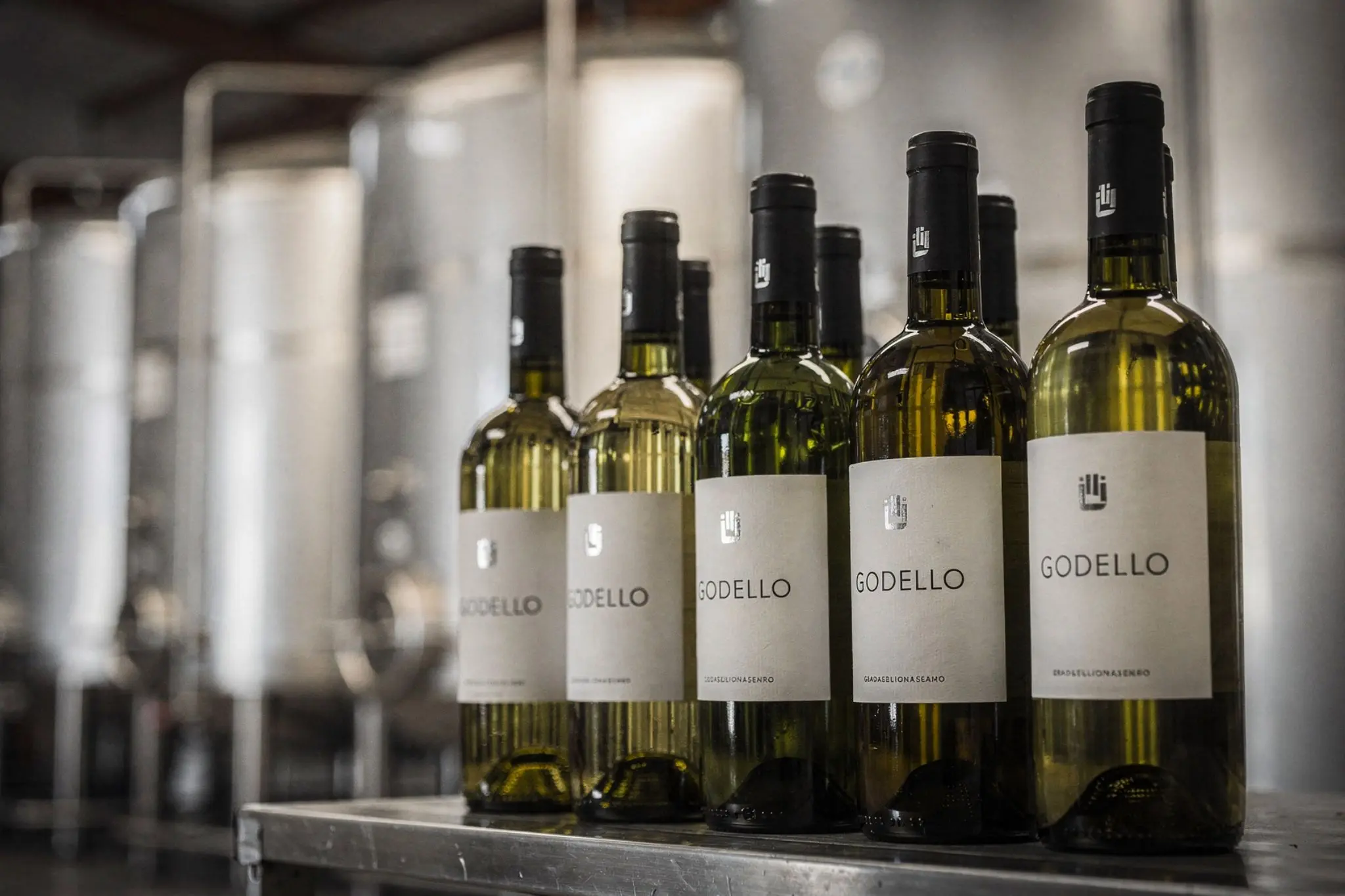
Start indoors. The stainless steel tank, the cool air, the faint scent of lees: this is where godello’s story crystallises, and it is a different kind of story to the one told on the terrace. Where mencía is exposure and slope, godello is enclosure and restraint. It is a grape that suits the interior — of the cellar, of the glass, of the season.
What makes this doubly interesting is that godello nearly vanished. Through much of the twentieth century, the variety contracted to the point of near-extinction: too disease-sensitive, too low-yielding for a wine economy organised around volume. Its survival owes less to nostalgia than to technical precision — a quiet effort of reconstruction, most famously centred on Valdeorras, upstream along the Sil, before gradually returning to the terraces of Ribeira Sacra, where the 2026 harvest passed a million kilos for the first time, close to a fifth of the appellation’s grapes. What we call tradition here is, in many cases, a careful recent re-invention.
A Reconstruction, Not a Relic
That detail matters. Godello’s current identity is built on fragments of the past, reassembled with full awareness of the contemporary palate. The white wines the region historically consumed were secondary — Ribeira Sacra was always a red wine territory in local culture and trade — so there was no unbroken living memory to draw on. Producers arrived at godello with freedom as well as responsibility: a blank page with archaeological notes in the margin.
What they have found is a variety of quietly architectural character. Stone fruit, fennel, a mineral or saline backbone that the granite and schist soils of the region confer without needing to announce itself. Godello does not perform. It accumulates. One of its defining and still under-appreciated qualities is its ability to age: given time, these whites develop a density and complexity that the freshest expressions only hint at.
Two Schools
The current conversation among producers is essentially about speed. One direction — stainless steel, early bottling, freshness as the priority — produces wines that are approachable, precise, gastronomically versatile. The other, more ambitious and not without controversy, involves barrel ageing or extended time on lees: a more complex, richer register that works well at the table but divides opinion among purists.
Neither is wrong. They reflect genuinely different ideas about what godello is for. And the terroir does not settle the argument — altitude and soil type (granite versus schist, again decisive) produce different base material regardless of what happens in the cellar. The variety is still in the process of defining itself, and the territory is still learning to read it.
That openness is, ultimately, godello’s most honest quality.