Paradela keeps its business in the middle and its sights at the edges. The pilgrims never see the middle. The Camino Francés stays out in the rural parishes, through Ferreiros, Mirallos, Mercadoiro, Laxe and Rozas, and leaves the village to the people who live in it and the farms it serves.
What the Village Is For
Paradela has what a working municipality needs: a health centre, a library, municipal pools and room for the feira on the 15th of every month. Livestock is sold beside stalls of plants, clothes and tools, with the pulpeiras cooking alongside. The 15 May fair is the big one of the year, with a parade of cow-carts and Rubia Galega bulls brought in for show.
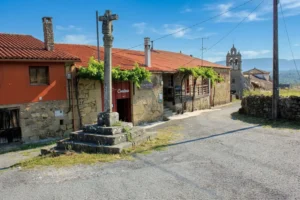
The one thing to stop for is the cruceiro of San Miguel, at the foot of the parish church. Its monolithic shaft is carved with motifs of the passion, and that modelled shaft is what puts it among the most original crosses in Galicia in the guides to the Camino.
Everything else lies six to eight kilometres out, nine to twelve minutes by car, each in a different direction. Treat each one as a short drive out and back from the centre.
East: A Portal on the Camino
Santa María de Ferreiros stands at Mirallos, right beside the Camino. It was a priory of the Encomienda de Portomarín, with a hospital for pilgrims, and in the eighteenth century the church was moved stone by stone from Eirexe. Only the main portal is still Romanesque. It has three round archivolts with a chequered chamfer, capitals of leaves, human faces and fantastic animals, and a bilobed tympanum resting on two corbels carved as lion heads. The rest was altered: a single nave and a straight apse under a Baroque bellcote. By the entrance stands a font cut with symbols.
South: What Is Left of the Abbey
Santa María de Castro de Rei de Lemos sits at Mosteirovello, south of Paradela on the LU-P-4201. A Benedictine monastery stood here before the twelfth century, and Alfonso VII handed it to the Cistercians. Of the early church, only the epistle apse and part of the walls survive. Inside are paintings from the fifteenth and early sixteenth centuries and a pre-Romanesque capital.
Both interiors open only on a guided visit. Call the Consorcio de Turismo Ribeira Sacra on 638 823 592 before you set out.
West: The Edge of Belesar
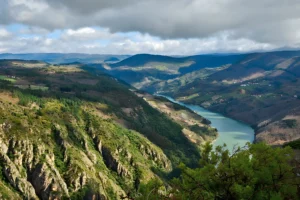
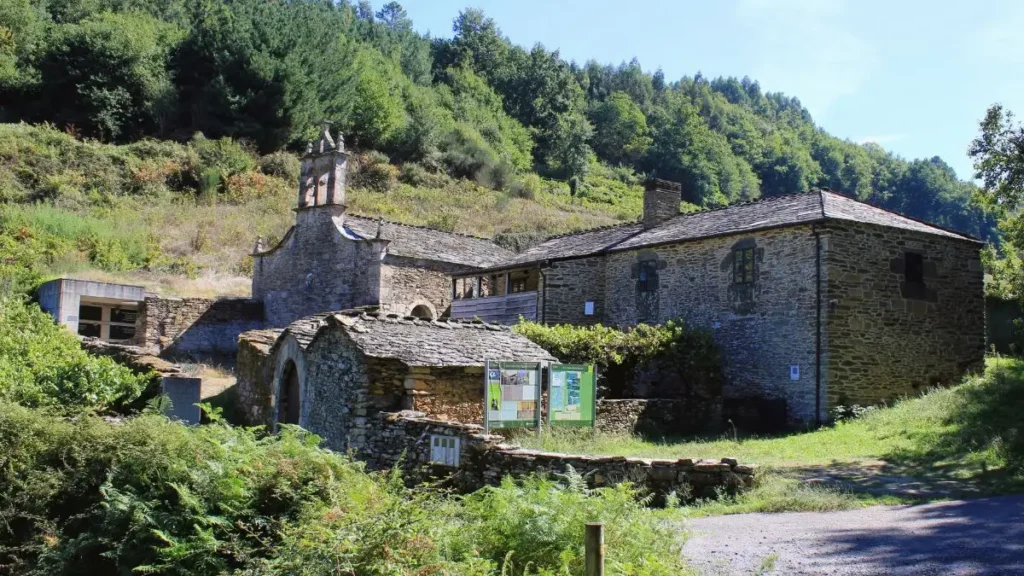
To the west the land drops to the Miño. The Mirador de Cabodevila e Penedo do Bico stands at the end of a headland between the Miño and the arm of the reservoir that runs up into the Loio. The name comes from the Latin caput villae, the head or the end of the settlement, and older residents remember it as the place where stone was cut for millstones. San Facundo de Ribas de Miño is 3.4 km on. It is a church and rectory where pilgrims crossed the river by boat rather than pay the toll at Portomarín. The Camiño Vello de Aldosende follows this shore on foot from Aldosende to the same viewpoint.
The Valley Path
The Ruta do Loio (PR-G 14) starts at the municipal pools in Paradela and follows the river down to Belesar. It has been closed since February 2024. Two of its bridges, the Ponte da Retorta and the Ponte de Portocaneiro, are down. In October 2026 the banks on both sides had been cleared and staked out, with nothing yet built between them.
The route’s highlight, the Muíño da Retorta, can still be reached by road. It is signposted from Paradela, 5.9 km away.
The Mill Nobody Touched
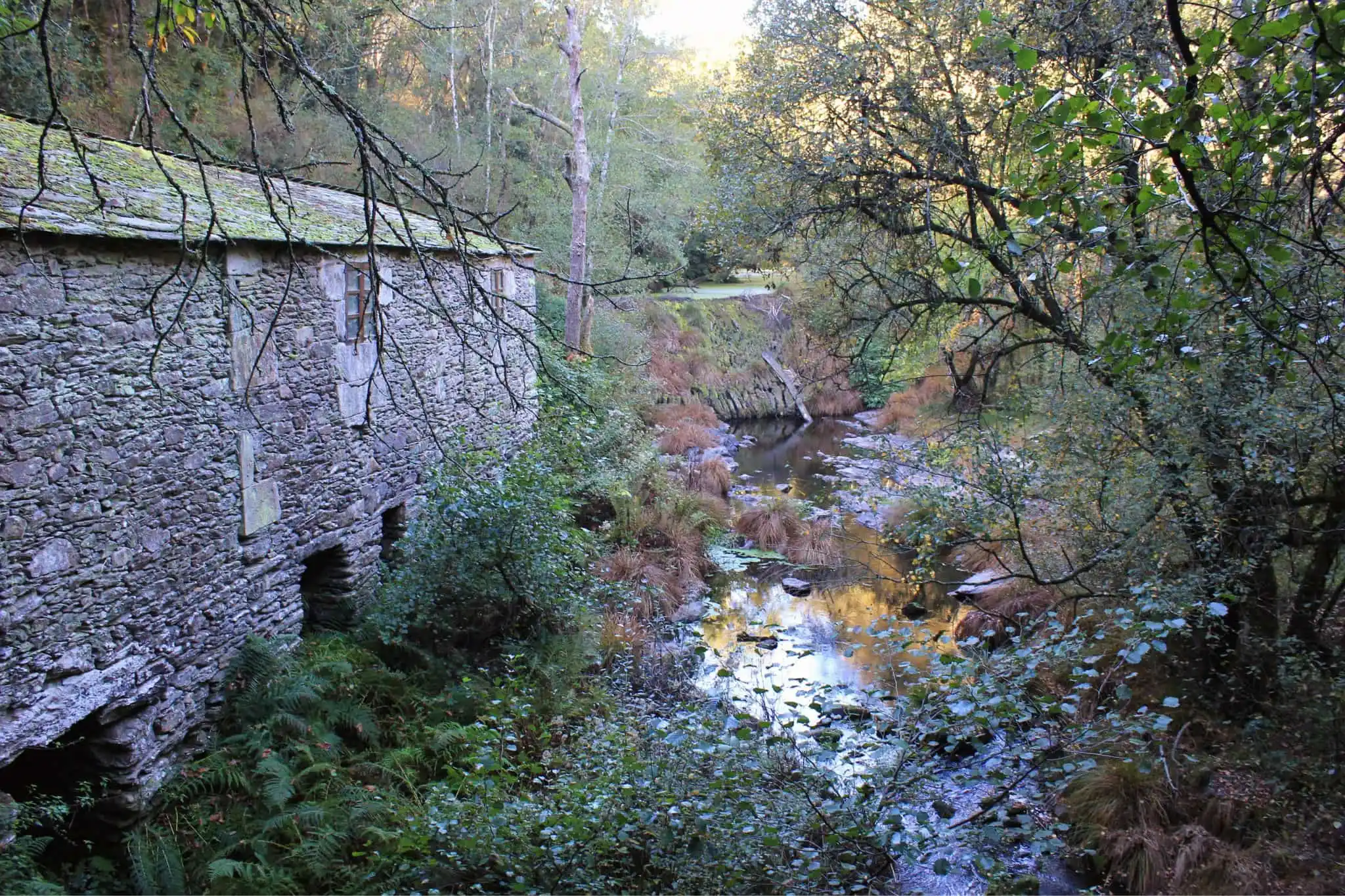
The Muíño da Retorta is one of the largest mills in the area, with four millstones, and it stands in a native wood of oak and chestnut. The panel at the entrance still calls it recently restored, and the plaque on its wall names the 2011–2012 funding call that paid for the work. The slate roof is sound, the windows are glazed and the doors are shut. Nobody seems to have touched it since. The leat that fed it is overgrown, the pond above it lies under duckweed, and its own footbridge, the Ponte do Muíño da Retorta, still stands beside it.
A bat survey along the Loio recorded pipistrelles flying outside the mill, and the report printed its photograph with a caption: Muíño da Retorta. Ideal como refuxio.
Muíño da Retorta on the Loio; Church and rectory at San Facundo — photos by P. Vanossi.