In the autumn of 1717, a Franciscan from a convent near Bologna walked east out of Santiago on his way home. Gian Lorenzo Buonafede Vanti had arrived by the Portuguese route, gone out to Fisterra to look at the end of Europe, and was now returning through Galicia in a Holy Year, writing letters as he went — twelve of them, long and specific.
He did not go through Arzúa, Melide and Palas de Rei, the villages the Codex Calixtinus had fixed in place five centuries earlier. He turned south, followed the Miño, then the Sil, and passed through a hundred kilometres of what nobody yet called Ribeira Sacra. In his letters he gives this route a name. He calls it il Cammino dritto di San Giacomo — the direct road to Santiago.
Not the alternative. Not the winter variant. The direct one.
The name it carries now — the Winter Way, Camiño de Inverno to the parishes it crosses — describes a season and implies a reason: that pilgrims came this way when snow shut the high pass at O Cebreiro, and that the route therefore exists as a workaround. That is broadly true and endlessly repeated, including by the Xunta’s own route pages, which hedge it carefully — se piensa que pudo surgir, it is thought it may have arisen. Vanti’s timing supports it: he walked during the Little Ice Age, when the cooling was severe enough to make the León and Lugo mountain passes genuinely impassable for months at a time, and a detour became a necessity rather than a preference.
But avoidance explains why pilgrims left the Francés. It does not explain why they came here specifically, and the answer to that is older than the pilgrimage by a thousand years.
The road was already built. From Las Médulas, where Rome tore a mountain apart with water to get at the gold inside it, an engineered network ran west along the Sil to move that gold out of the peninsula. It is the same corridor that later carried the winter pilgrims: down past Montefurado, where a second-century tunnel diverted an entire river through a quartzite ridge; through Quiroga and the Lor valley; across the flat of Val de Lemos to Monforte; and up the Miño bank to Chantada. A Camino needs a surface, a gradient a loaded body can manage, and settlements at intervals a day apart. The gold road supplied all three, and had been supplying them since before there was anyone to walk to.
This reverses the usual telling. The snow is the trigger, not the reason. Pilgrims did not carve a new path through unfamiliar country in bad weather — they used the low, warm, well-made road that had been running through this territory for twelve centuries and happened to arrive at the right place. The monasteries were already strung along it. So were the vines.
Which makes the modern administrative history quietly comic. The route was walked for centuries and was recognised as an official Jacobean way by the Lei do Patrimonio Cultural de Galicia in April 2016. And the recognition covers the Galician stretch only — the León kilometres, including Las Médulas where the whole thing starts, sat outside it.
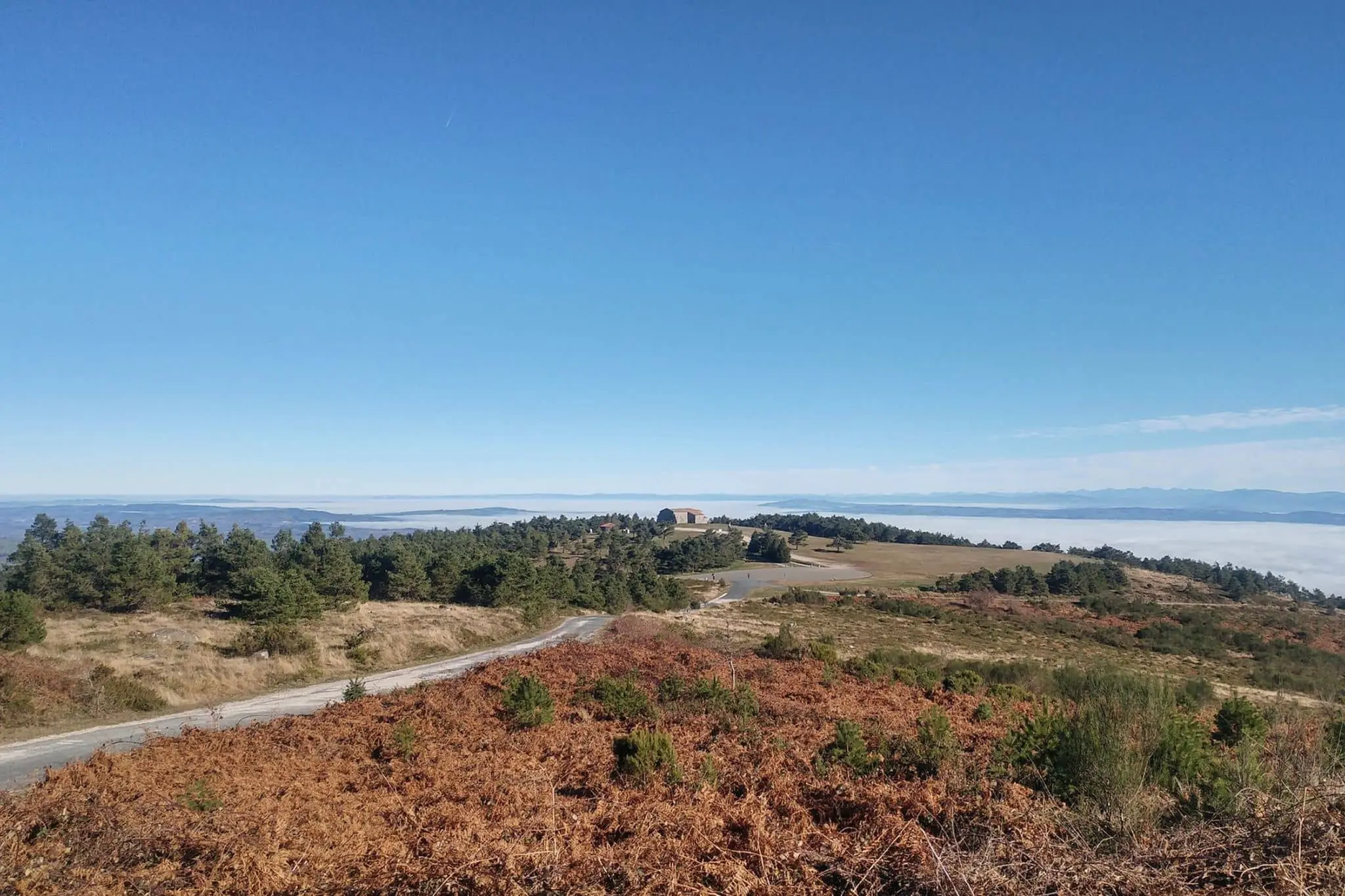
A hundred kilometres of the route run through the twenty-six concellos of Ribeira Sacra, which is more than a third of the total and includes the hardest climbing on it. The Camino enters at Albaredos, on the Sil in Quiroga, and leaves at eleven hundred and fifty metres, at a chapel on the Faro ridge above Chantada — a seventeenth-century sanctuary built over Romanesque remains, where every 8 September devotees still converge from all four Galician provinces.
What the Winter Way preserves, and what the summer routes have largely lost, is the ordinary condition of medieval movement: you travelled on infrastructure someone else had built for an entirely different purpose, and you stopped where the previous traffic had already put a roof. This is not a spiritual alternative to the Francés. It is the older engineering underneath the devotion, still legible, still walkable, still — as Vanti had it — the direct road.
Ermida de Nosa Señora do Faro, Chantada — The Winter Way — photo by A. Atterdag.