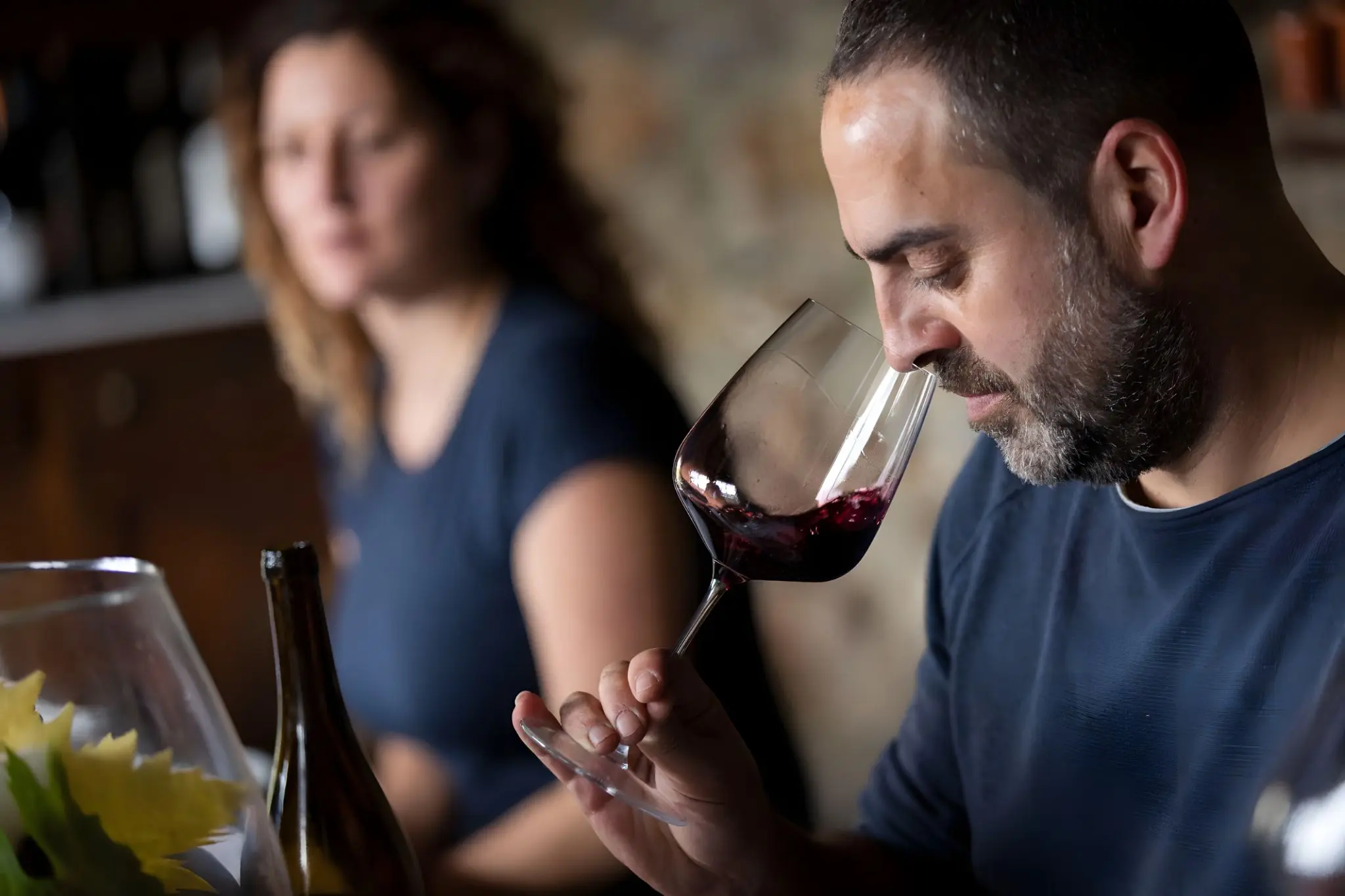
Enonatur sits in Chantada, on the Miño bank of the Ribeira Sacra, and its proposition is unusual enough to sound like a gimmick until you meet the man behind it. You sponsor a vineyard that would otherwise be abandoned, and you make a wine that carries your own name on the label — cultivating, pruning and harvesting as much or as little as you want. Roberto Regal, its founder and winemaker, is the grandson of four ribeiraos, and he talks about the vineyard less as a product than as a bridge between people.
Q. You call yourself the grandson of four winegrowers. What did they leave you?
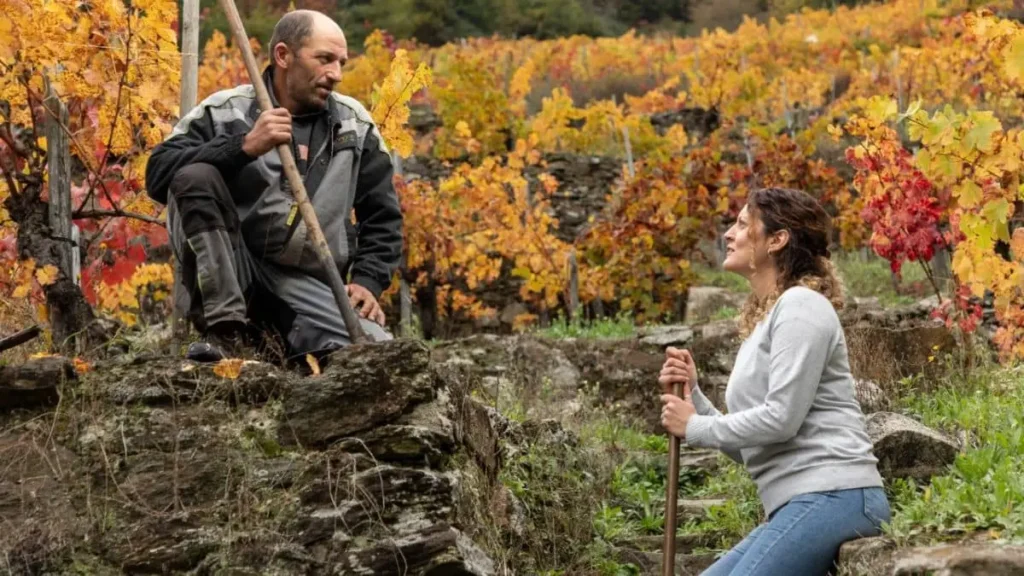
I was born and raised here. Four of my grandparents worked the vines — son neto de ribeiraos, as we say in my land. They kept a whole inheritance alive: fruit, vegetables, the river, food, wine, a landscape. And they were overlooked. Small farmers who were never really acknowledged for any of it. In my adolescence I had no vocation, but I understood quite soon that my future was in front of me, in a rich land full of possibilities.
Q. Two of them are still living. If you sat down with one in the vineyard today, what would you talk about?
The present, more than the future. I’d ask what he makes of what’s happening — whether the essence of the Ribeira Sacra is being lost, what he thinks about the speculation. And how he’d go about it: how you get people from here, or people who come from outside with the same sensibility, to build a network that brings life back to the villages, and to the vineyards as a consequence. How you recover, or at least preserve, a wine culture that runs through everything. Because wine means many things. My grandparents taught me that a wine is a link — a bridge between humans.
Q. Is there a gesture you still repeat exactly as they did?
Several. In the vineyard, going back over a task once it’s done, refining it, never leaving it half-finished. But the one I’m most aware of isn’t technical. It’s the whole ceremony of receiving people in the cellar — pouring another glass, making sure nobody’s in a hurry to leave, keeping the conversation going. Open spaces for company and talk. I inherited that from them.
Q. You’ve said there was a moment you felt the Ribeira Sacra could lose its identity. When?
Over the last ten years, mostly, watching a certain speculation with the territory. There are people who arrive with sensibility, wanting to add something, wanting to respect the place. And there are people who arrive only to speculate — buy a cellar, put it on Airbnb, and don’t mind abandoning everything around it. For them the wine culture is the least of it, the environment is the least of it, the vine is the least of it. They focus on exploiting the river, exploiting the lodging. For years now I’ve felt not just fear but sadness that nobody’s putting a stop to it. I fight it every day, civically. I try to understand these people, and I try to convince them that making good wine is what matters — and that to do it you have to look after the vineyard, with care, for hours. Lose the landscape and the wine culture, and you’ll lose the other income streams too.
Q. You’re pointed about the administration, too.
They only clean the roads and the accesses when there’s an event for people from outside. Nobody works politically on the day-to-day of the winegrower — clearing a path, keeping a common space usable. It gives me a kind of impotence. On the road itself, tourists change lanes so as not to get close, they don’t know how to drive near you, and sometimes, when you’re working, the winegrower looks like a piece in a museum — as if people were at a zoo. And the administration doesn’t respect the common ground either: the old paths, the village uses, the little that’s left. In a way the policies being made are expelling them. It’s a kind of unprotection. We don’t look after the real treasure, which is the people, and the whole around them. It should work like an organic network.
When you’re working, the winegrower looks like a piece in a museum — as if people were at a zoo.
Q. At Enonatur, each person makes their own wine. Where’s the line you don’t cross?
Every client decides as much as they know and want to — that turns the whole team into tutors, more or less, on demand. Some people want a singular, healthy, exclusive wine and nothing more. Others want to take part in a stage of it, to prune, to harvest. What they share is sensibility, and an awareness that wine here is transversal. They know they’re not just making a wine. They’re bottling life — dignity, a cultural and environmental landscape, legacy, and above all a kind of love.
Q. Do people arrive expecting one thing and leave with another?
Many. Some came already knowing they’d be moved. Others arrived wanting to make a wine, saw what it costs — our effort — and ended up valuing the project far more. The idea you build in your head changes completely once you’re standing here. Where it hasn’t worked is with the people who came to do great business, to make a product — these aren’t wines to get rich on. But then there’s the other kind. I’ve had clients who were winegrowers themselves, who came because they had no continuity for a plot they’d cared for their whole life, as a life’s work. I’ve seen them cry, in front of other clients, because there was no one to carry it on.
Q. You tie Enonatur to the World Heritage bid. With ICOMOS having advised against inscription and the Busan decision at the door, what changes for you either way?
If the Ribeira Sacra were chosen, it would be a great window onto the world for our land, as a territory of real cultural and natural value. It would mark a turn toward a more hopeful future — preservation, respect for our ancestors, a better quality of life, a path toward beauty that avoids speculation. It would strengthen exactly the philosophy Enonatur was built on: preserving and adding value through positive impact, protecting the place from mass tourism while weaving a fairer, more sustainable economy. And if it doesn’t come? The work is the same. The vineyard still needs looking after tomorrow morning.
Q. If a traveller wanted to understand this place, who should they go and see?
No one in particular. I’d tell them to listen. To sit in the cellars of the old people, the ones truly from here, and visit as many as they can — old winegrowers, not scholars. That’s where it is. Don’t lose the chance, because they won’t be here forever.
Fire Round
A place
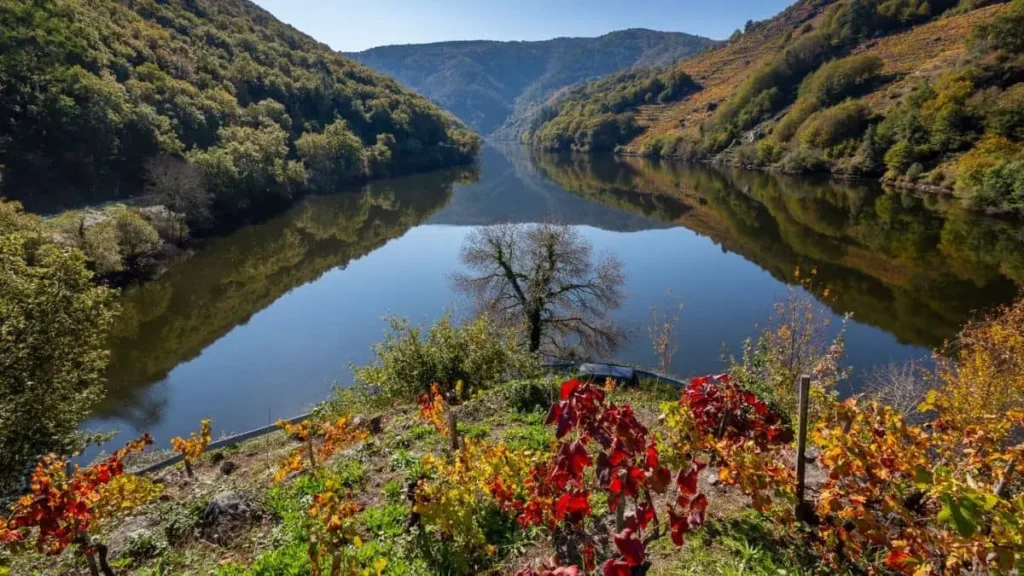
The Ribeira Sacra in autumn.
A dish or a wine
Any of them, with my loved ones.
A route
Any with plenty of trees and dirt paths.
A word
Seixo — my son’s name.
A misconception
Wanting to change the world without perfecting your own inner one.
All photos by Abel Valdenebro, courtesy of Enonatur. Not for reproduction without written permission.