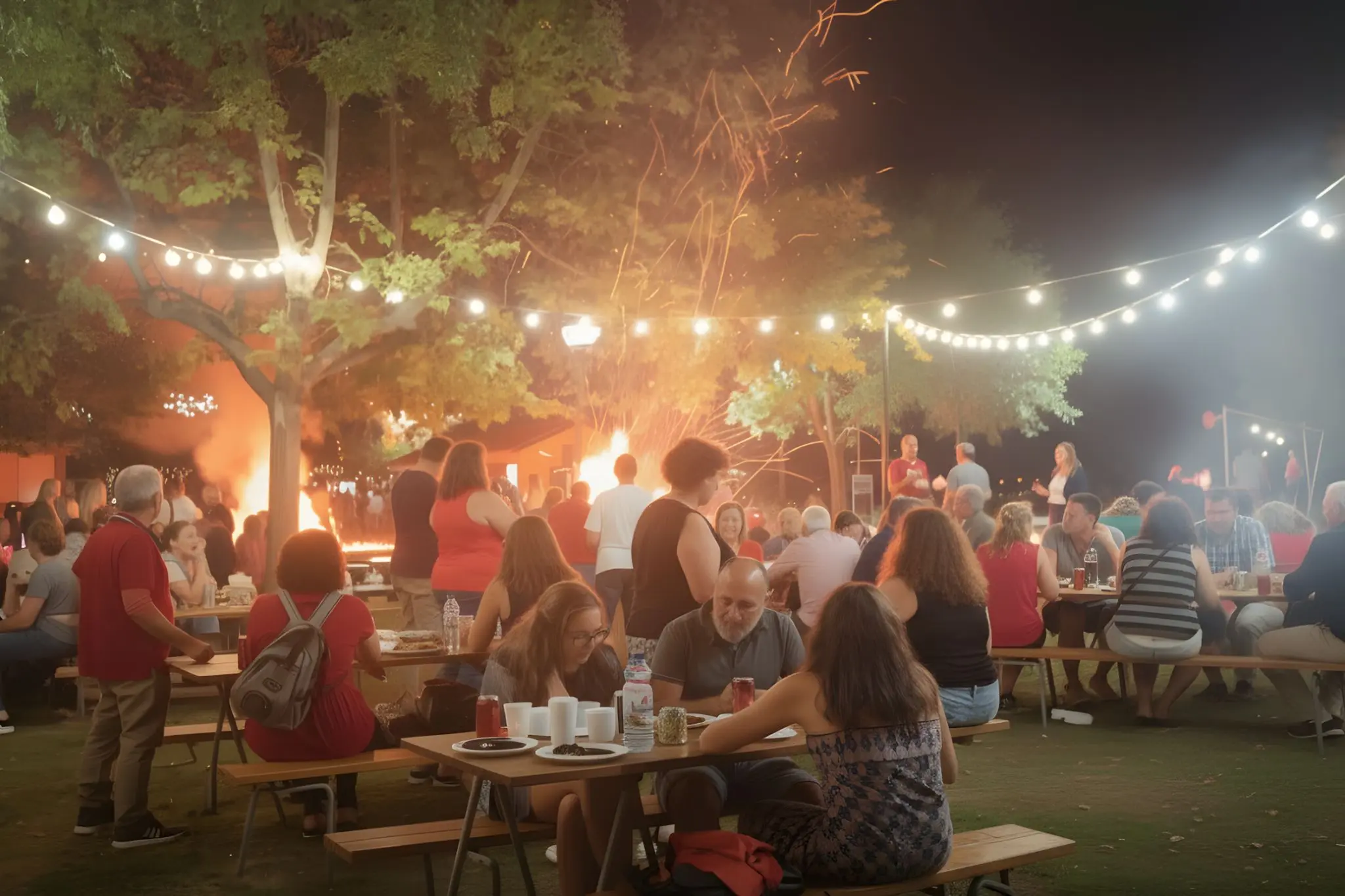
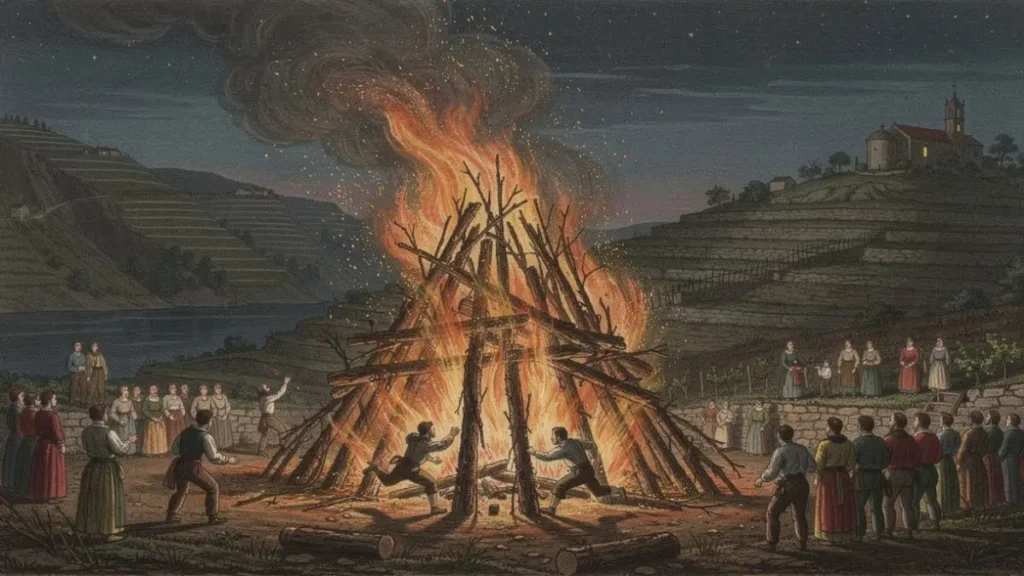
If you are anywhere in the Ribeira Sacra on the evening of the twenty-third of June, you will smell it before you find it: woodsmoke, and under it the oilier note of sardines on a grill. Follow either one. They will lead you to the same place — a square, a crossroads, a patch of riverbank — where a fire is burning and people are standing around it with plastic cups, in no hurry to do anything but stay near the heat on the shortest night of the year.
This is San Xoán, and it belongs to all of Galicia rather than to this territory in particular. But it arrives here with a quieter character than it has on the coast, where the city beaches turn into festival grounds. Inland, on the canyons and the plateaux, it stays closer to what it has always been: a neighbourhood lighting a fire it built itself, and feeding whoever turns up.
The Fire and the Saint
The bonfire long predates the saint whose feast it now keeps. Midsummer fire is one of the oldest customs in Europe, and the Church, unable to put it out, did the sensible thing and gave it an owner. The twenty-fourth of June is the nativity of John the Baptist, set six months before Christmas by the arithmetic of the Gospel of Luke — one of only three birthdays the liturgical calendar marks at all. The solstice itself falls a few days earlier, around the twenty-first; the fire keeps the saint’s date now, not the sun’s. It is a small thing, easy to miss, and characteristic of a region where Benedictine rule was laid so thoroughly over older ground that the two are no longer easy to separate.
What the fire was originally for is purgation. In Galician it is a cacharela — not the Castilian hoguera — and it was lit to drive off the meigas and the evil eye, the things believed to move most freely on the year’s shortest darkness. People still leap the embers, an odd number of times for luck, mostly without remembering why. The gesture has outlived its explanation, which is the usual fate of a good ritual.
What You’ll Eat and Drink
The food is unceremonious and the better for it. The sardiñada is the heart of it: fresh sardines laid straight on the grill, eaten with bread and a glass of the local red. There is usually a plastic plate but rarely a knife, so unless you have come prepared you eat them with your fingers, which is the right way anyway. They are at their best now, fat before the summer, and a San Xoán fire without them would feel like a sentence missing its verb. In Monforte the neighbourhood festivities — the San Xoán dos Chaos — turn whole plazas over to grills and music; smaller parishes around Pantón do the same at a lower volume, sometimes adding a pancetada, pork belly over the coals. At these parish fires the food and the music are free and the drinks cost only a few coins — this is a neighbourhood feeding itself and its guests, not a stall doing business.
Then, later, the queimada: augardente set alight in a clay bowl with sugar, coffee beans and lemon peel, stirred with a long ladle while someone reads the conxuro, the spell that banishes witches by name. Done well it is genuinely a little eerie — blue flame, a voice in the dark, the smell of burnt spirit. Done for tourists it is theatre. Inland you are more likely to get the first kind, offered rather than performed, because the person making it is doing it the way their family always has.
The Herbs at Dawn
The gentlest part of the night belongs to the following morning. On the eve, people gather the herbas de San Xoán — a small bouquet of herba de San Xoán (St John’s wort, which obligingly flowers exactly now), fiuncho (fennel), fento (fern), malva (mallow), romeu (rosemary), sabugueiro (elder), and a rose — and leave them in a basin of water out overnight. By morning the water has taken the dew and the cool of the dark, and you wash your face in it for the year’s health and protection. It is a pharmacopoeia disguised as a posy, and the one piece of the night that asks nothing of you but to be awake early.
One practical note, against the grain of how festivals are usually found: do not chase the biggest fire. The municipal nights are warm and easy to locate, but the version worth happening upon is the parish one — a fire at a village crossroads, a few grills going at once, a local band with a singer, and a hundred-odd people who all, more or less, know each other. You will not be a guest there and you will not be a customer. You will simply be someone the fire happens to be lighting, which on this particular night is welcome enough. Someone will likely remark that the woodpile is smaller than last year’s — they say it most years, and in the small parishes they are not always wrong — but the fire is lit and the sardines are on, and that is the part that matters tonight. Bring an appetite, accept the cup that is offered, and do not plan to be in bed early.