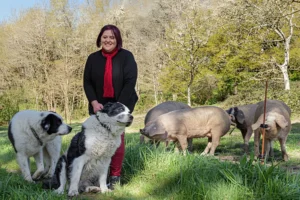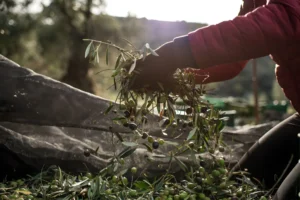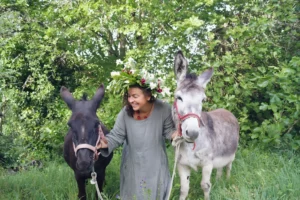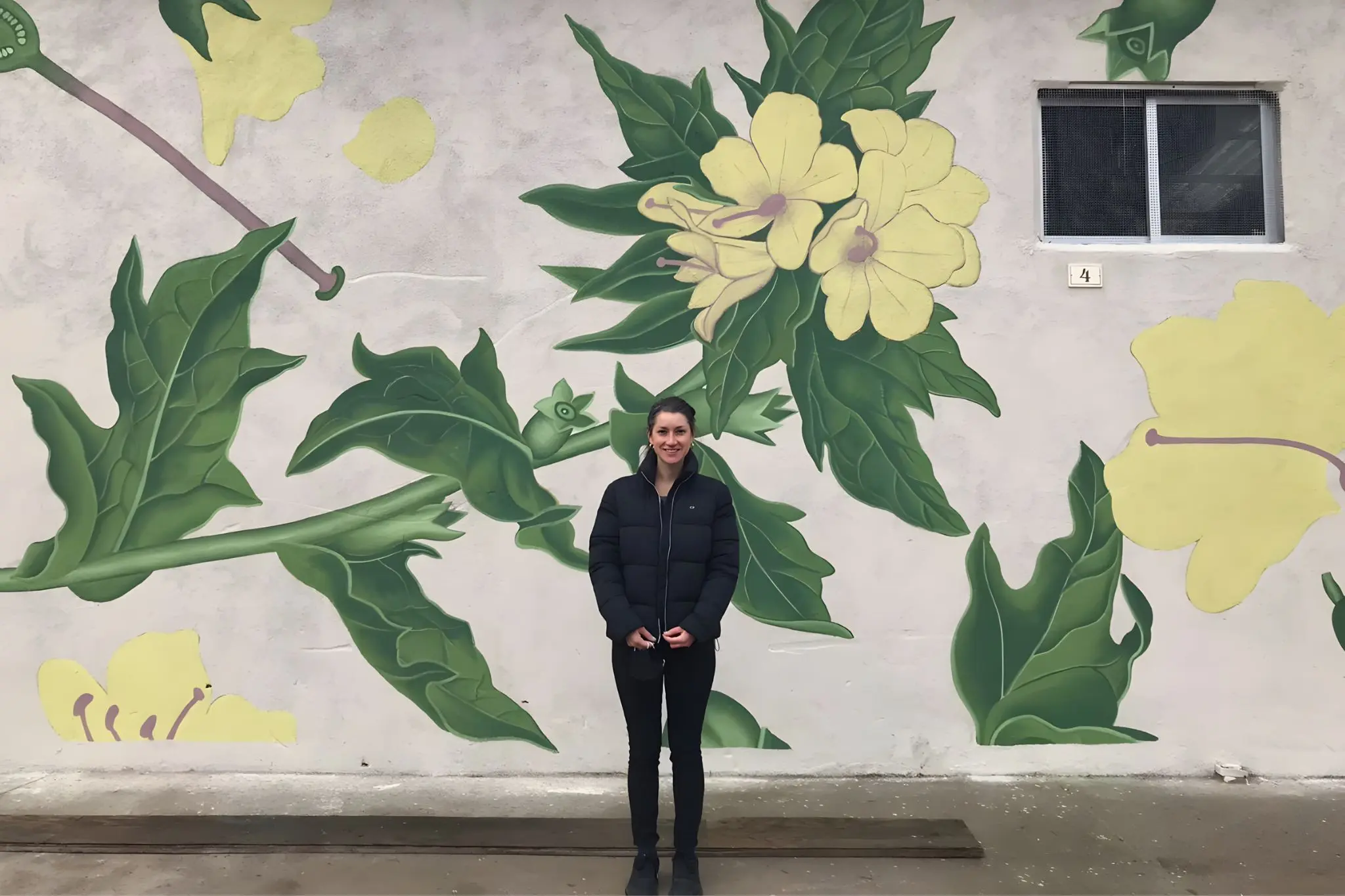
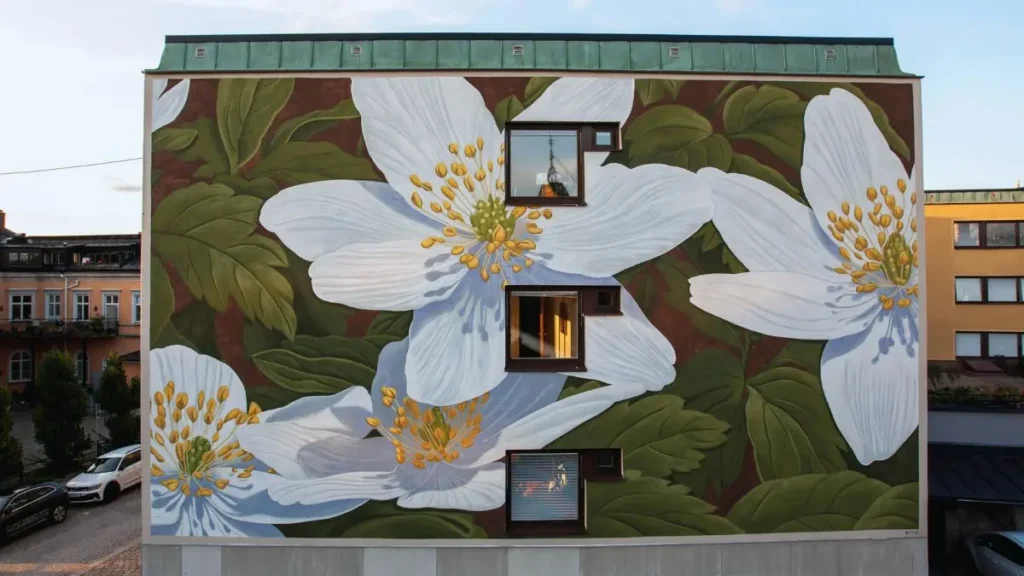
Doa Ocampo paints things most people walk past. Born on the banks of the Cabe and raised across the rural fringes of Sober, Pantón and beyond, she trained in fine art in Galicia, Mexico and Portugal before realising that what she wanted to put on walls was not human at all. Since 2014 her project Reforestando has spread across Europe, the United States and Africa as a kind of mural herbarium — site-specific paintings of the wild plants native to each place she works, scaled up to the size of monuments. In the Sober she calls her base camp, the studio is where the ideas form; the world is where the walls are. We spoke about botanical activism, the eremitic air of the territory, and a river that is no longer safe to swim in.
Q. Start with who you are — in your own words, not your CV.
I’m Doa Ocampo Álvarez — visual artist, painter, muralist, botanical activist. I make art because the world of creation has interested me for as long as I can remember; I rarely pictured myself doing anything else. My family were craftspeople, so making things by hand, managing your own work — that was always the air I breathed. The plant kingdom fascinates me, and I think being raised close to nature, using wild plants for different purposes, shaped that — knowing something makes you more sensitive to it. My main artistic mission now is botanical activism disguised as mural painting. I’m also drawn to the spiritual, and to exploring beauty, because I believe observing what is beautiful is a path to self-knowledge and a door into understanding the universe.
Q. And how did you arrive here?
I was born here, on the banks of the river Cabe, and raised in several places — mostly rural — between Sober, Pantón, Rinlo and Las Alpujarras. I’ve lived away for stretches and always come back to reconnect. I feel this place as my base camp. Right now I’m here; I might not be for a while, but I think I’ll always end up returning.
Q. How would you describe your relationship with Ribeira Sacra to someone who has never been?
For me it’s home, a refuge, a place to be calm and let time expand a little. Having a place with those qualities matters enormously to me — to think, to create, to paint, but also to walk, cycle, climb, be in the beautiful forests. So I’d say my relationship with this place is fairly total. You can live a bit like you’re in a convent here, and step out when you need to. I do the studio part of my work here — developing ideas and pieces — but I have to leave often for the other part: exhibitions, mural projects, residencies. Being able to combine those two worlds is a good balance for me. I like to think this place keeps the essence of the Ribeira Sacra of the monasteries, the ideal terrain for anchorites. There’s an eremitic air to the area. It isn’t everyone’s reality, but I don’t think I’m the only one who lives it this way.
Q. What does it have that you haven’t found elsewhere — and what does it still lack?
I love this place, but I’m an optimist when I get to know somewhere; I feel I could live almost anywhere. So I’m not sure I could name something I haven’t found elsewhere. What did bring me back, more than once, was being near certain people — I think places are made by their people too. So I’d say some people are what I’ve found here and nowhere else. And what it lacks, maybe, is a few more people inhabiting the many empty houses, walking the paths so they stay clear. And brush-cutters as a public service.
Q. Tell us what you’re working on now.
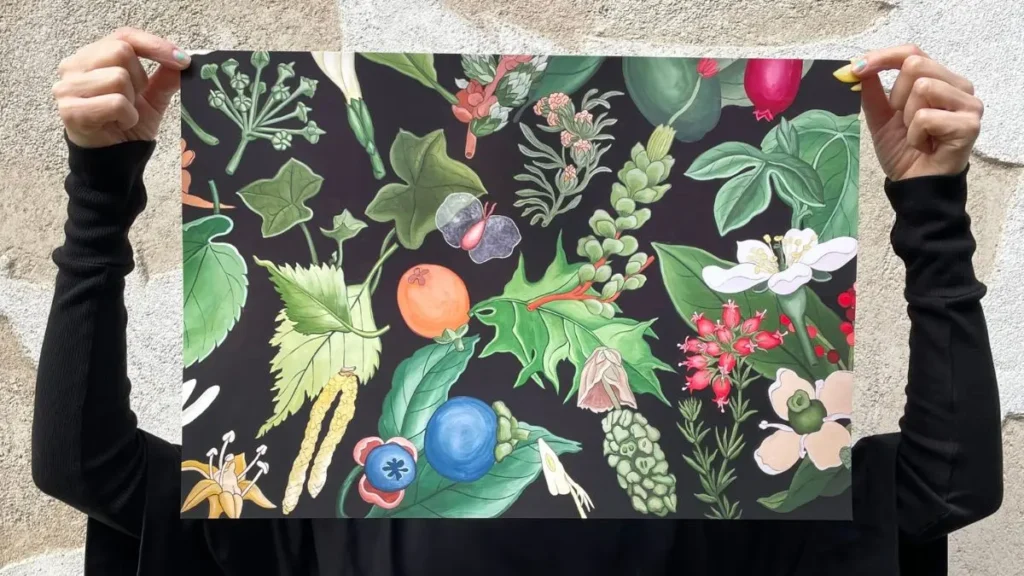
Most of my energy goes into the mural herbarium I’ve been building across the territory since 2014, under the title-concept “Reforestando” — a series of site-specific murals, interventions somewhere between activism and botanical outreach. They put the memory of knowledge about wild botany into dialogue with the observation and visibility of the plants actually present in a place. The constant across every piece has been the will to return the gaze to those individual plants that have a proper name, though it isn’t always known to the people looking at them.
I like to think of it as a large-scale portrait of beings who aren’t usually the centre of the human story. A small act of offering, of plant justice.
Q. What’s the hardest part of doing this here, in this particular place?
Communications, in general. The internet, for one. I know some places don’t have this problem, but the connection where I live doesn’t let me do my work without getting creative — which sounds fun, but day to day it isn’t always practical. I accept it as a price for living where I live, more than offset by everything this place gives, but I hope it improves. And public transport: I love that I have easy access to the train, but try to use it regularly and you find the frequency isn’t there. Sometimes it takes longer to reach Vigo or A Coruña than to reach Madrid. I’d love to skip the car more often on these regional trips, but it isn’t always viable.
Q. You mentioned environmental practices, too.
It’s hard to live alongside certain practices that don’t respect the environment — not unique to this territory, of course, but more frequent than they should be, talked about little in the media and addressed even less. The way the forest is managed in many places is disrespectful: they fell wooded areas, leave the tracks destroyed, don’t collect all the debris, and that becomes a fire risk. There’s water contamination — the river Cabe, for one, though there are others, is unfit for swimming from Monforte downstream, which means it’s polluted, and it’s sad that nothing is being done to reverse it when water is a vital element. And there’s hunting, practised without enough control — coming closer to houses than is allowed, with no real census of the wildlife, so it’s being wiped out without oversight, throwing the ecosystems out of balance.
Q. What’s coming up that readers should know about?
This summer I’ll hold an “open studio” day, to show part of my work to the community. I like the idea of sharing a bit of what I do with whoever lives in or passes through this area. There’s no date yet — I’ll announce it on my channels.
Q. If you could change one thing about how Ribeira Sacra is perceived, what would it be?
I’d like it to be seen not only as a place where tourism is what matters, but as a territory cared for with its resident population in mind.
Fire Round
A place
Where the Cabe meets the Sil — there’s something in confluences, in waters that mix.
A dish
The chestnut, no question.
A route
By water, in a rowing boat — the silence matters — down the Sil between Os Chancís and the Monastery of Santa Cristina.
A word
Silence.
A misconception
That it’s perceived only as a place of touristic interest.
All photos courtesy of Doa Ocampo. Not for reproduction without written permission.