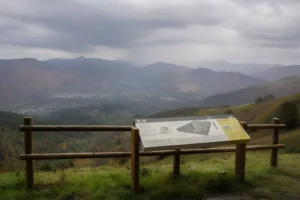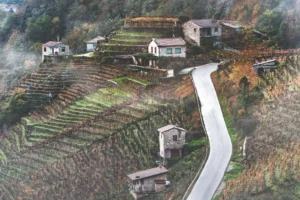
The festival lives in a place built to be forgotten. Between 1949 and 1955, as the dams went up along the Miño and the Sil, the electricity company Fenosa raised a stepped village on the hillside at Os Peares to house the workers who built and ran them — houses, a church, a swimming pool, a small functional town that owed nothing to Galician vernacular. When the dams no longer needed it, the village emptied and stood quiet for decades. In 2009 it was restored as a language-immersion centre. For one week each August, it fills with strings.
That layering is what makes the address worth pausing on. Os Peares belongs to nobody cleanly: the Miño meets the Sil here, and four municipalities across two provinces — Nogueira de Ramuín and A Peroxa in Ourense, Carballedo and Pantón in Lugo — meet with them. A house on one side of a street can sit in a different province from the one opposite. For a festival whose stated ambition is to reach the whole of Ribeira Sacra regardless of which administration owns which slope, a base that refuses to pick a province is less convenience than manifesto. And the immersion centre supplies what no concert hall could: lodging, classrooms, rehearsal rooms — a campus where musicians live together for a week rather than arriving for a soundcheck and leaving after the bows.
The Half Nobody Sees
The week the public attends is the smaller half. Running alongside it is the Academy: twenty young musicians sharing meals, walks, ping-pong tournaments and stages with the resident artists who, in any other setting, they would only watch from a seat. The intake is deliberately uneven — instrumentalists finishing their studies beside others just beginning to make a profession of it — and the organisers are candid that the common denominator is appetite rather than age or pedigree. The intensity of living together for seven days flattens the hierarchy faster than any masterclass timetable would. The students compete for the Galimusic–Fest Clásico prize and an Audience Award; the Galimusic winner returns to open the following year’s festival as a soloist, which turns the prize from a line on a CV into an actual invitation back.
The resident roster rotates each summer and reads internationally — recent editions have brought players from Spain, Portugal, Switzerland and Japan, anchored by the cellist Beatriz Blanco, who directs the festival. These five or so musicians carry most of the programme as a chamber ensemble convened for the week rather than a touring group.
Why Classical Music Here at All
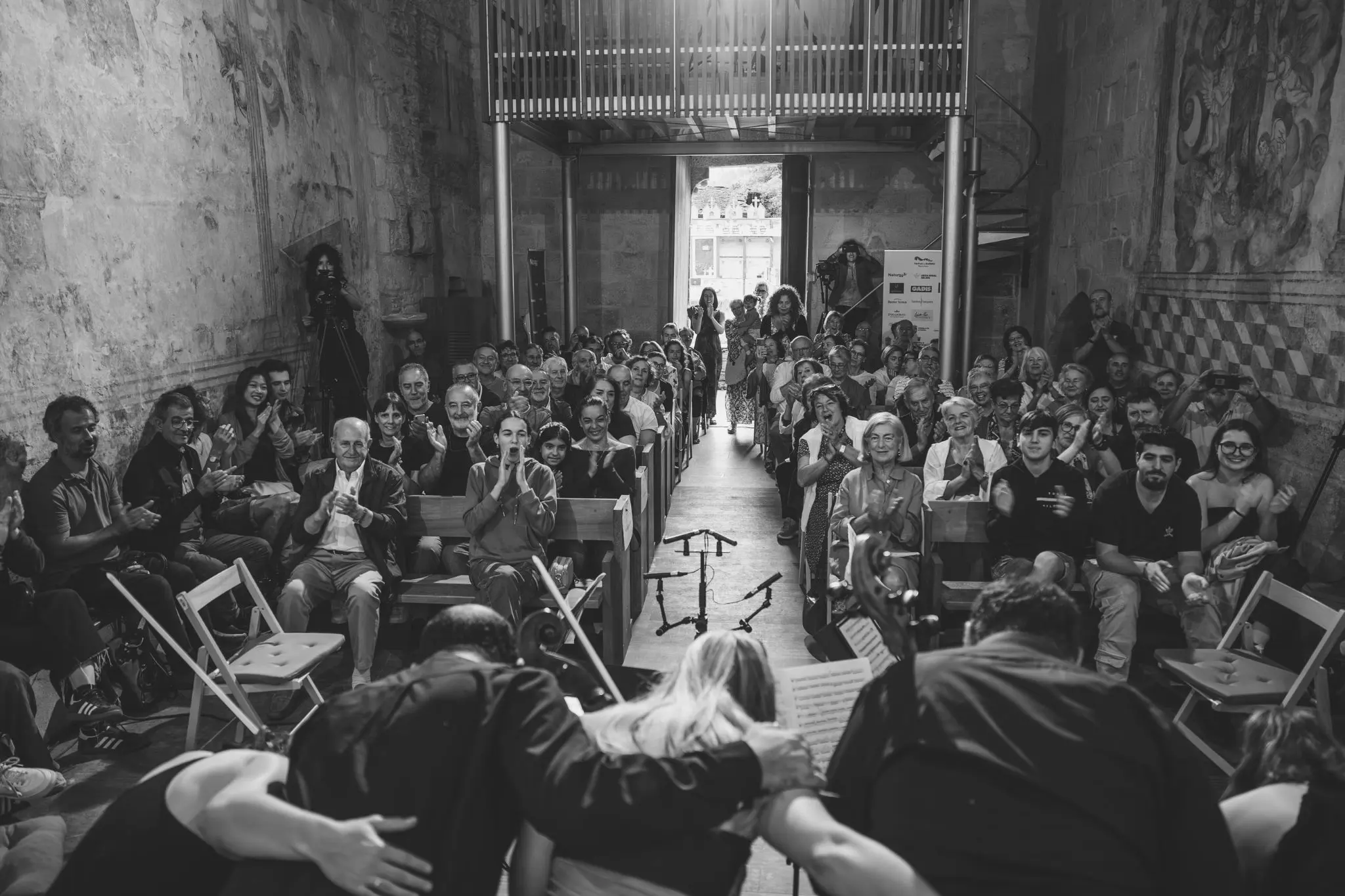
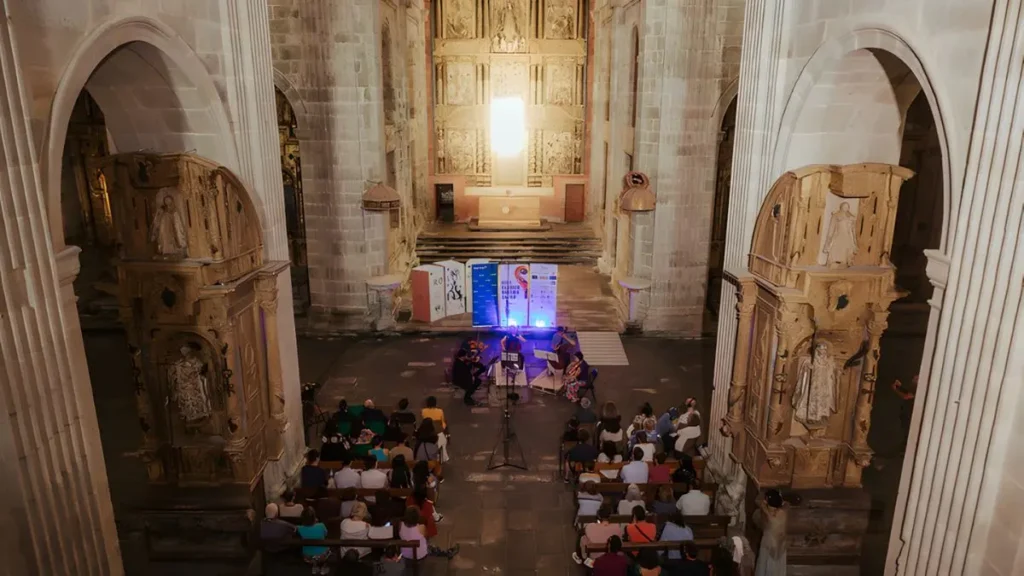
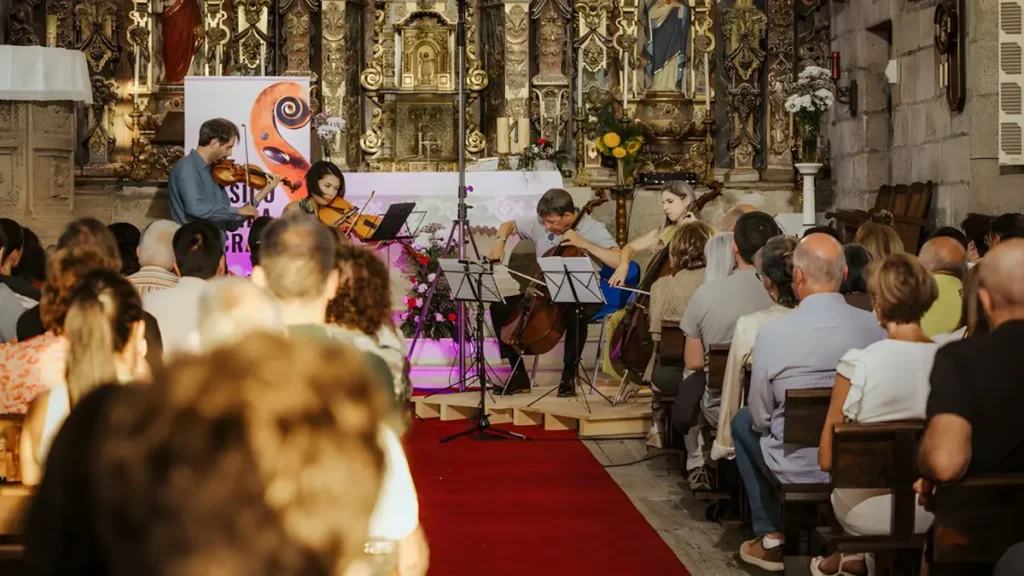
Chamber music is not what brings most people to Ribeira Sacra — the canyon viewpoints, the heroic vineyards and the Romanesque churches do that work. The festival has never tried to compete with that; it has simply moved into the buildings. Concerts happen in the rural churches that are the territory’s defining architecture — recent editions have used San Martiño de Nogueira, San Cristovo at Castro de Carballedo, the monastery church of Santa María de Montederramo — and in the immersion centre, where open rehearsals let an audience watch the work before the polish. Blanco describes spotting an opportunity early on “to bring high-level classical music to corners where perhaps it had never sounded before,” and talks about the small churches in terms that elude her: “the inspiration we find in each of them can’t be described in words.” A stone nave built for plainchant does something to a string quartet that a purpose-built auditorium cannot. The programming follows suit: not aggressively avant-garde, but willing each year to slip something less expected — a piece of Martinů, a Kurtág miniature — between the Brahms and the Schubert, on the theory that an audience that came for free will stay for anything that holds together.
Free is the operative word. Every concert is free to attend, reservation only — “the audience is anyone who wants to come,” in Blanco’s words — and that single decision shapes the room: neighbours beside second-home owners beside the small but loyal contingent of classical-music travellers who now time their summer to the festival. Over its run it has drawn participants and audiences from seventeen countries and fourteen of Spain’s autonomous communities, on a publicity budget of essentially nothing.
What Would Close It
The organisers are unsentimental about the fragility. The threat is not a bad review or an empty pew; it is the slow attrition of a project carried by volunteers. The festival week looks like magic precisely because the year-round labour behind it — the website, the social media, the production, the logistics — is invisible and largely unpaid. “The week of the festival is a magical moment,” Blanco says, “but the work behind it isn’t visible — it’s constant, it never stops.” With minimal funding there is no staff to absorb that work, and the honest answer to what would end the festival is the day the effort it demands outgrows the will of the people doing it for free. It is the structural condition of nearly everything worth doing in the emptied interior, and the festival names it plainly rather than dressing it as resilience.
There is a neat coincidence in the timing. Ribeira Sacra’s World Heritage candidature — built around the theme of water — reaches its decision at Busan in the summer of 2026, roughly as the festival opens its eighth edition. The festival has answered the moment in the only currency it has, devoting concert programmes to water and to the territory’s bid without waiting to see how the vote lands. Whatever Busan decides, the music will be in the churches in August. The eighth edition runs 23–30 August 2026. Concert reservations and the Friends of the Festival scheme are both handled through Vivetix. Full programme and updates on the festival’s website and Instagram; the village at the confluence does the rest.
All photos courtesy of Asociación Ribeira Sacra Cultural. Not for reproduction without written permission.