You arrive by train, into a town that has never organised itself around being looked at. There are roundabouts, apartment blocks, a hospital, a couple of supermarkets, schools letting out at half past one. The first impression is faintly disappointing if you came looking for the canyon, and that disappointment is the most useful thing the town can teach you. The canyons sell Ribeira Sacra. Monforte de Lemos keeps it operational.
The geography explains the rest. Most of the territory is vertical — slopes, terraces, fragmentation, the logic of the gorge. The Val de Lemos is the anomaly: a broad, fertile basin where movement is easy, ringed by hills and threaded by the river Cabe. Where the rest of Ribeira Sacra produces isolation, this flatness produced concentration — markets, administration, commerce, and eventually a railway. The town exists because this is one of the few places in the territory where infrastructure was never a fight against the slope.
The House on the Hill
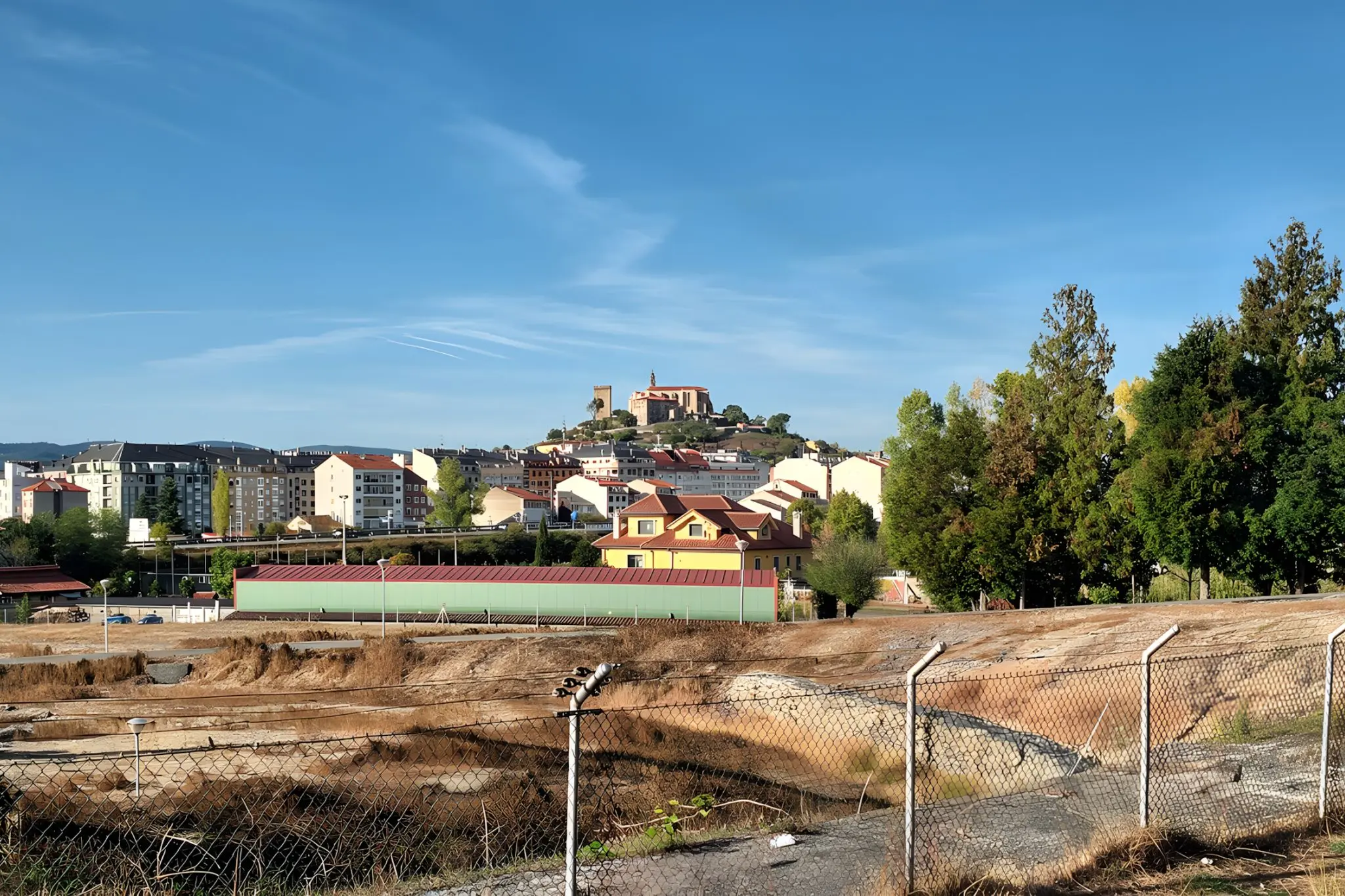
Above the modern town rises the Monte de San Vicente, and on it the medieval keep of the Counts of Lemos — the Torre da Homenaxe, thirty metres of granite with walls three metres thick, visible from most of the valley. For locals it functions less as a monument than as a horizon line: when you can see it, you are nearly home. Beside it stand the Benedictine monastery of San Vicente do Pino and the seventeenth-century Pazo Condal, the counts’ residence, both now folded into a parador.
The detail that matters is not the architecture but the arrangement of power it records. Elsewhere in Ribeira Sacra, monasteries organised the territory — they cleared the terraces, planted the vines, ran the economy. Here a noble house did the political work, the Casa de Lemos governing inland Galicia from this hill and counting some of the most powerful figures in seventeenth-century Spain among its lords. Monforte was the place that controlled the territory while monasteries structured it. The two logics ran in parallel, and they met on this hill.
The slope itself carries a quieter history. The oldest Monforte sat at the top, beside the castle, and over centuries it slid downhill toward the Cabe, leaving its layers behind it. One of those layers is the medieval Jewish quarter — Monforte gave shelter to refugees fleeing persecution from the twelfth century onward, and its community was among the most important in Galicia, never confined to a ghetto, woven through streets that still carry the old trades in their names. On the keep’s ashlars, if you know to look, are engraved stars of Solomon. The town has been carrying more than one tradition for a long time.
The Galician Escorial
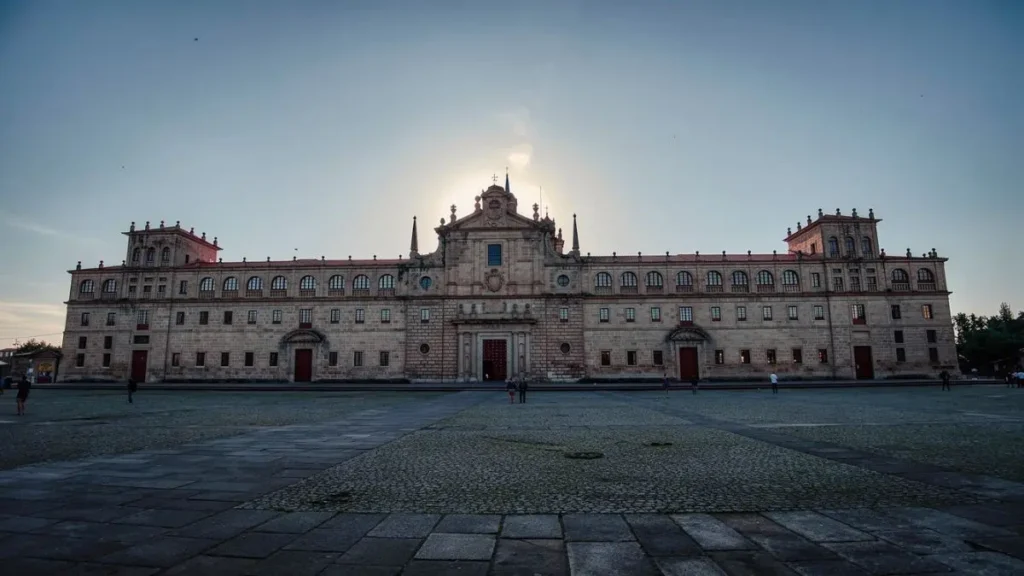
Down in the town, the Colegio de Nuestra Señora de la Antigua is the building that gives the game away. Begun in 1593 and finished only in 1913, it is a hundred-metre Jesuit complex so disproportionate to the town around it that it earned the nickname O Escorial Galego. It holds El Greco and Andrea del Sarto inside, and it still works as a school. That combination — elite institutional ambition, still in daily use — says more about Monforte’s historical weight than its current population ever could. This is not picturesque parish Romanesque. It is architecture built to announce that something of consequence happened here, and never quite stopped.
The Railway That Made It Modern
The least romanticised chapter is the most defining. In 1883 Alfonso XII inaugurated the Madrid–A Coruña line, and because it forked here toward Vigo and the Atlantic ports, Monforte became the most important railway junction in Galicia. The town was wired into the rest of Spain decades before anyone thought to market the canyon as scenery. A whole social world grew up around the station — railway workers, wide avenues, an industrial identity entirely absent from the tourist story. When the system was later reorganised and the control centre went to Ourense and the workshops to León, the decline was real and is still legible in streets built for a busier town. The old roundhouse survives as the Galician Railway Museum, its thirty-eight radiating tracks unique in Spain.
Where Things Get Solved
This is the part visitors miss because it does not photograph. For most of southern Lugo and a slice of inland Ourense, Monforte is where the hospital is, where the secondary schools are, where you go for the bank, the mechanic, the agricultural supplier, the paperwork, the part you need by Thursday. Young people from the surrounding villages grow up oriented toward it socially; the weekend gravity of the whole territory pulls here. The wine economy participates differently too — many bodegas sit out in Amandi or Chantada, but the Consello Regulador, the logistics, the regulation and the commerce often run through here. Less vineyard, more infrastructure.
Come on a market morning, or stay for the evening transition, when the bars empty of the lunchtime trade and fill again with students, workers and older residents. The town is doing what it does, without an audience in mind. Monforte sits, by accident of geography and history, slightly outside the official Ribeira Sacra narrative, and feels more inland Galician than branded. That distinction is the whole point. It is also a working town on the Camiño de Inverno to Santiago, which means it has always known how to absorb people passing through. Without it, the surrounding territory becomes harder to inhabit — not simply harder to visit.
The San Vicente do Pino complex seen from the railway yard — photo by P. Vanossi, edited with AI.
Colegio de Nuestra Señora de la Antigua, Monforte de Lemos — photo by Pabernosmatao, edited with AI.