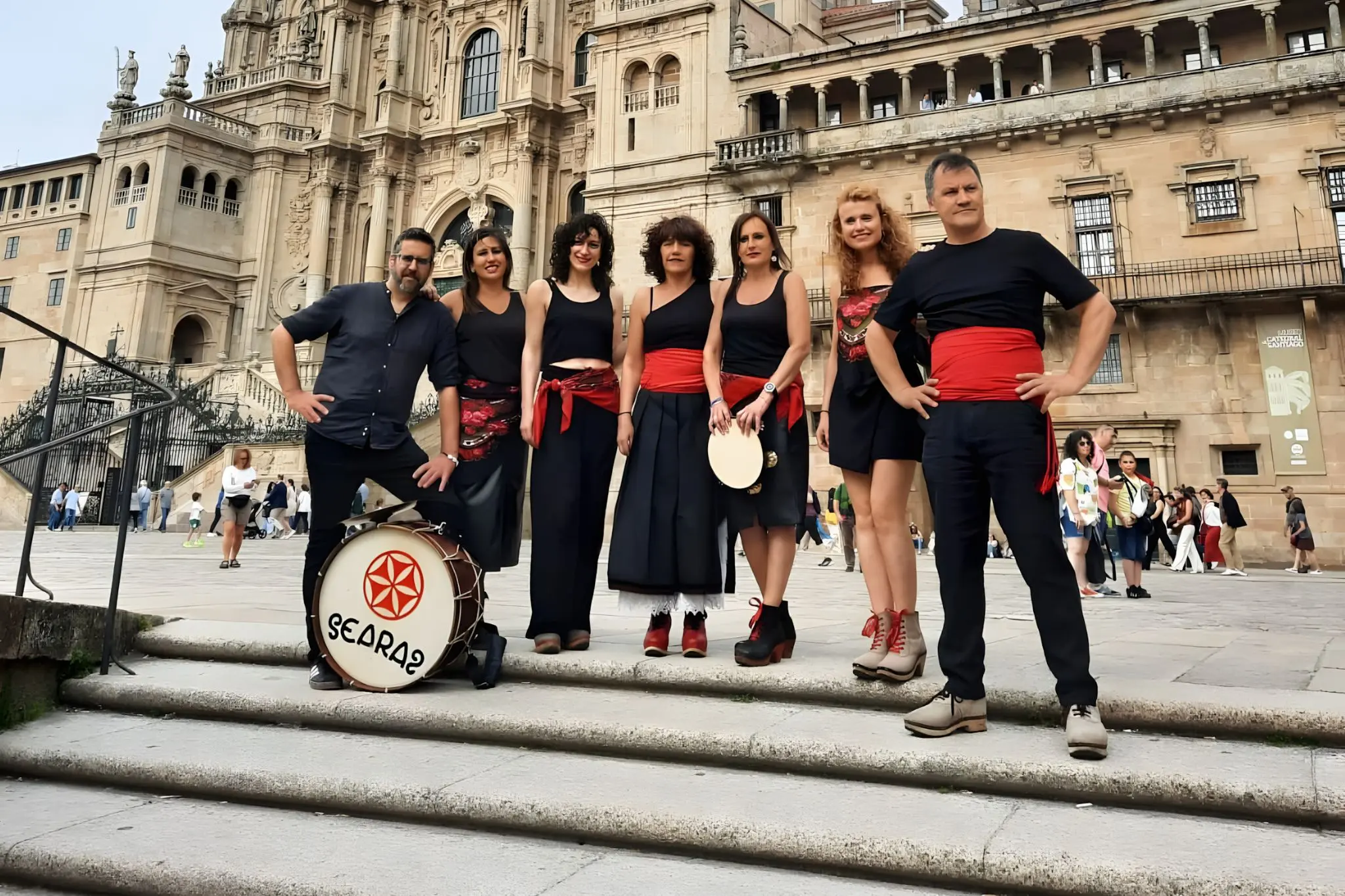
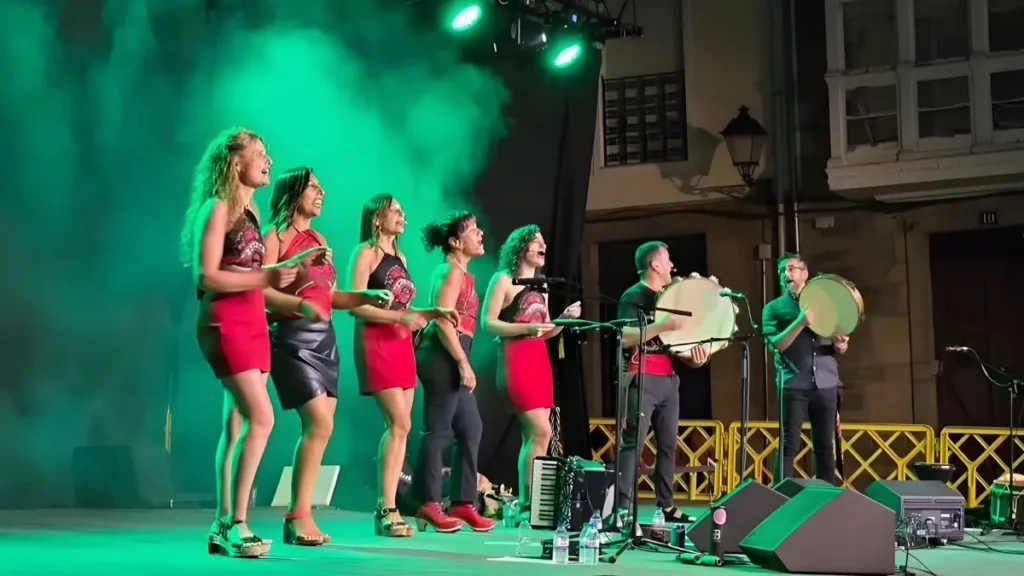
Most things called traditional in Ribeira Sacra are reconstructions — recovered, codified, returned to view after a gap. Searas is not one of them. Seven friends, family members and neighbours from Chantada — Maira, Ana, Ruth, Roberto, Belén, Moncho, and Miriam — have been playing together for a dozen years, with a repertoire rooted in Galician tradition and a steady drift toward original compositions. They came of age in the vineyards their parents and grandparents still tend, learned the work of vine and augardente before anyone needed a brochure to explain it, and started playing because, in their phrase, the body asked. None of them are professionals. None aspire to be. That refusal is what gives the rest of the conversation its weight: when they speak about the territory, it isn’t a position taken — it’s a life already lived.
Q. You’ve described yourselves as a group of friends who play, not a band with ambitions. Can you place that in context?
We are Searas, a music group with a Galician traditional base but with many original compositions and fusion with other traditions. We’ve been at this project for around a dozen years. The current line-up is Maira, Ana (sisters), Ruth (cousin to Ana and Maira), Roberto (Ana’s partner), Belén and Moncho (siblings) and Miriam. Friends and neighbours all our lives, and we’d already crossed paths in earlier musical projects. We make music because our bodies ask for it and because we genuinely enjoy what we do. Ours is a project of friendship and music. We are not professionals and have no aspiration to be — we just enjoy ourselves and try, as far as possible, to keep getting better at what we like.
Q. Where in Chantada are you actually rooted?
We are all from Chantada, although Ana, Maira and Ruth were born in Barcelona, where their parents had emigrated. Today Ruth lives in Ourense, Belén in A Coruña, and the rest of us are in Chantada: Maira and Miriam in the town itself, Roberto and Ana in Alemparte (parish of Mariz), and Moncho in Cartemil (parish of Nogueira).
Q. How do you describe your relationship with this territory?
First, it has to be said: we were here before Ribeira Sacra was. We grew up here as children before the label “Ribeira Sacra” existed. Our parents and grandparents had — and some still have — ribeiras, small family vineyards. Practically all of us know and have done the work of the vine, of wine and augardente production. The ribeira is part of our physical landscape, our cultural and emotional patrimony. Maira and Ana’s parents still tend their vineyard, and Maira works as a wine technician with several Ribeira Sacra wineries. Moncho lives literally between vines at Cabodomundo.
The creation of the Ribeira Sacra denominación de orixe and the new image of the territory that came with it gave many people here a push of self-esteem. We learned to value our cultural and landscape patrimony. The tourism success that followed brought everything — good things and not-so-good ones.
For those who don’t know the area, you could describe it as an exceptional landscape where mountains humanised by stone walls for vine cultivation meet forests of chestnut, oak and pine. Two rivers, the Miño and the Sil, with their immense dammed water masses pressed between mountains, create an idyllic environment. Between the chestnut groves and the forests an enormous artistic richness is hidden: the Romanesque monasteries and churches. And on top of that, the ribeira has its own ancestral traditional culture.
Not everything is positive. Unfortunately, the Ribeira Sacra label is not stopping rural depopulation. The people who have always inhabited the ribeira are disappearing, and with them, a large part of our intangible heritage. New ways of inhabiting the ribeira are arriving, but we are not really managing to safeguard the patrimony.
We were here before Ribeira Sacra was.
Q. What does this place have that you haven’t found elsewhere — and what is it still missing?
After everything we’ve said, it’s clear: what we find here is our home, in the broadest sense. We enjoy our culture, we participate in it through our way of life and of course through our music. We have that healthy, intense emotional bond with our land that lets us appreciate what we have enough to know how to value other lands and other cultures too. What is missing, as we said earlier, is that the recuperation of Ribeira Sacra be more careful with the new ways of inhabiting and occupying it — so that the chain of transmission of the enormous material and intangible patrimony we possess does not keep breaking.
Q. What are you working on now?
As a group, our main project is to stay together and keep making the music we like, the way we like it. We maintain a clearly traditional line with many original compositions — some pointed, some playful. At the moment we are trying to introduce a sound system to get our open-air and large-venue performances out to more people. Beyond that, we have no greater ambition than to keep enjoying ourselves and keep improving, so that those who listen to us have as good a time as we do.
Q. What is hardest about doing what you do, here?
The hardest part is simply logistical. Some of us are based outside Chantada, and others have working-hour constraints, so it’s hard to get together to rehearse and we have to turn down some gigs. Beyond that, living here is a luxury and a privilege. We can complain occasionally about specific things, but on the whole, we lead a wonderful existence.
Q. What’s coming up?
Readers should know we’re committing to using the sound system — and they’ll have to be a little patient with us when they hear it, because the adaptation isn’t easy. One of our members is working hard to organise a session of cantos de taberna in Chantada, which will be announced shortly, so we’ll be there. And above all: we are ready to take the party wherever you call us. You won’t regret it.
Q. If you could change one thing about how Ribeira Sacra is perceived — by visitors, by institutions, by the outside world — what would it be?
For institutions: a real planning exercise for the future of which ribeira we want. Opening up to uncontrolled or badly managed tourism will bring nothing good and can end up destroying what we have. For visitors: stop and talk to people outside the tourist circuits. Get to know our reality first-hand. The experience will be much more intense.
Fire Round
A place
The Peneda do Graúllo, and the descent to the abandoned hamlet of Paradela where the Fondós drops into the Miño.
A dish and a wine
Cabra cocida — even cured into a kind of goat cecina — with a Ribeira Sacra red, and a glass of Xastré, the herbal augardente from the parish of Nogueira, to finish.
A route
The Camiño das Adegas de Remuíño in autumn.
A word
Silence.
A misconception
Perhaps the most dangerous thing is losing the authenticity of a place by trying to make it more attractive for those who come from outside.
All photos courtesy of Searas. Not for reproduction without written permission.