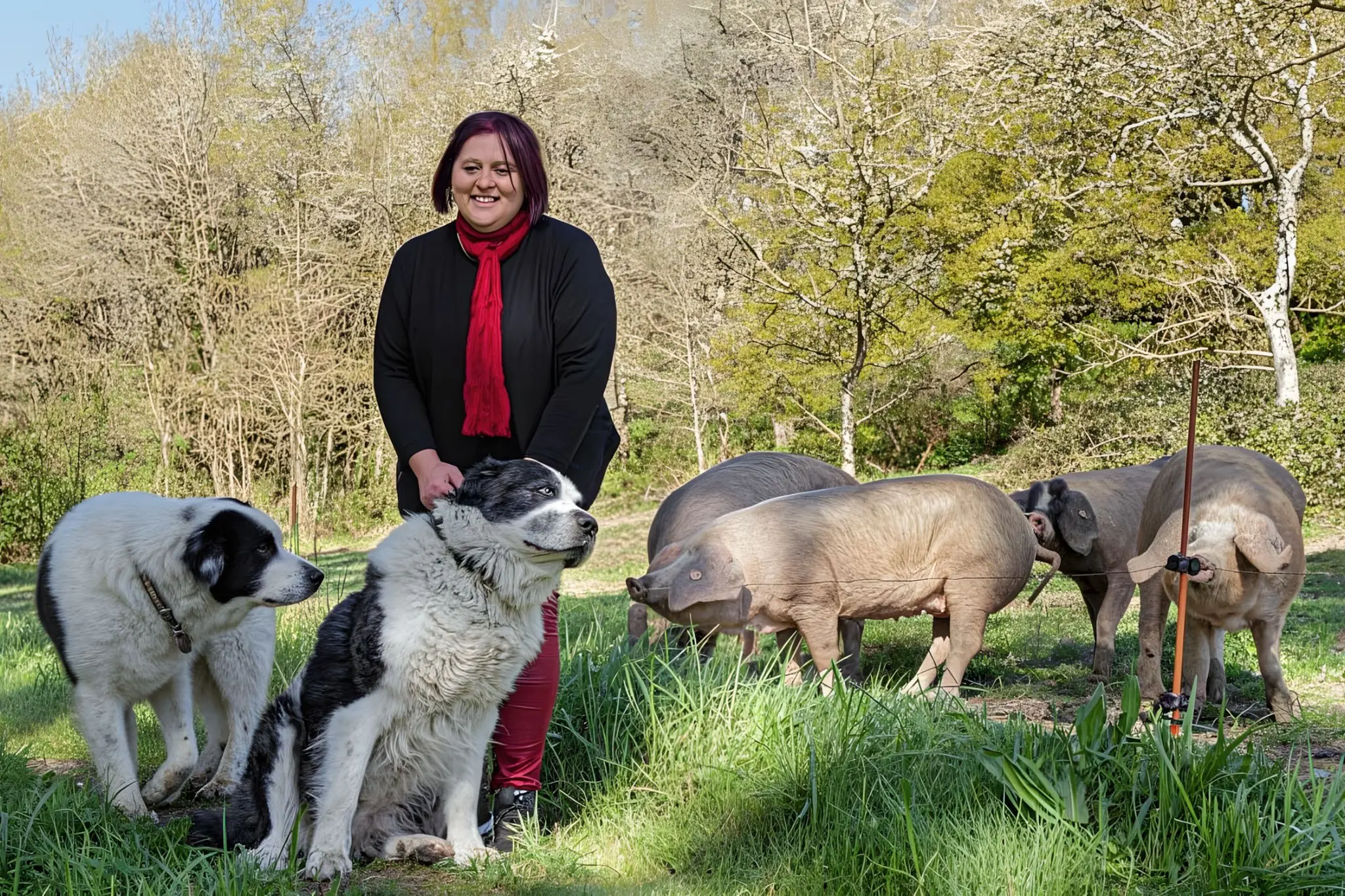
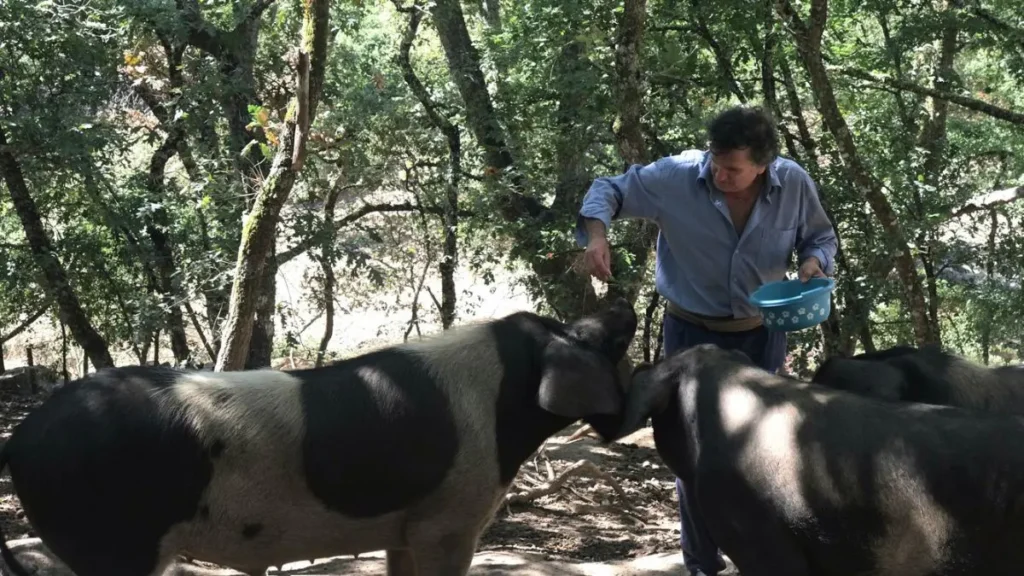
The cooperative is named after a pig. More precisely, after the way the old breeders along the Costa da Morte described the Galician Celtic pig: a porco celta drags its ears through the soil as it roots, and from the side it seems to grow three snouts — tres fuciños. The name carries the animal and the joke at once, which is roughly the register Isabel Costas works in. She runs the cooperative from Carballedo, on the Miño side of Ribeira Sacra, where eleven small breeders raise their pigs loose on the monte rather than penned in sheds. She arrived from a village outside Vigo eighteen years ago — her own summary is two words long: “por amor.” What kept her was harder to name, and most of this conversation is her trying.
Q. You describe yourself as a rural entrepreneur, but that’s not where you started. How did a bilingual executive secretary end up raising pigs on the mountain?
I’m from Valladares, a village near Vigo. I came to Carballedo for love, and I stayed because I found a way of living that made more sense to me than the one I left. I’d worked the land with my grandmother as a girl — but doing what you’re told is not the same as running the thing yourself. When the decisions are yours, the land stops being a chore and becomes a position. Tres Fuciños is built on the traditional rearing of porco celta in freedom. Beyond the meat, it’s a bet on the rural — on a more honest way of producing food and on putting people back in contact with what they eat.
Q. The pigs live very differently from the ones in industrial farms.
Completely. Ours live on the mountain, free, for twelve to fourteen months — in intensive farms the fattening period averages five. The movement builds muscle, which is why the meat is redder, almost like beef, and marbled the way good meat should be. We handle the whole chain ourselves, from the animal on the monte to the product in the customer’s hands, and we work to order rather than build up surplus, so what arrives is as fresh as possible. There’s a second thing the pigs do that nobody pays us for: they clear the scrub. A celtic pig is the best machine there is for keeping the monte clean — and a cleared mountain is a mountain that burns less.
Q. What does Ribeira Sacra give you that you hadn’t found anywhere else?
Something hard to explain unless you live it — a real connection between people and the territory. There are still human rhythms here, a direct relationship with nature, a sense of truth that most places lost a while ago. And it comes with a particular mix of harshness and beauty. Nothing here is easy: working the land, keeping a rural project alive, living in a small aldea takes enormous effort. But that’s exactly why everything has more value. Every tended plot, every terraced vineyard, every small producer still holding on tells a story of roots and resistance. I found a life here that’s more coherent with who I am.
Q. And what’s still missing?
Plenty. Real support for the rural, fewer obstacles for people who want to start something, less bureaucracy for small projects. Generational renewal. Better services, so young people can stay without feeling they’re giving up a future. And maybe, from the outside, an understanding that the rural isn’t only landscape or tourism — it’s work, economy, culture, people holding a territory up every single day.
If no one lives and works here, the territory ends up as nothing more than a postcard.
Q. Running this means being several people at once.
You can’t really separate the life from the project. The work never fully ends, and most days you’re the producer, the sales rep, the administrator, the communications team and the customer service line at the same time — on top of being yourself, the woman of the house, the one tending the vegetable garden. And then, just as important: training, training, training. I always believed that “living rural” doesn’t mean “living uninformed.” The hardest part is competing in a market that often only reads the price and not what stands behind a sustainable product. Raising animals in freedom, respecting natural timescales, doing things with coherence — it costs more time, more money, more effort, and that isn’t always understood from outside.
Q. What’s coming next for Tres Fuciños?
Important months. We’re consolidating what we have and opening lines that bring the project closer to people. One is the food truck — a way to carry the product and the philosophy to fairs and events where people can actually taste it and understand it. We’re also building experiences tied to the territory: visits, tastings, things organised around the monte, the vegetable garden, the porco celta and the way we work. The idea is that you don’t just buy a product, you get to know everything behind it. More than big launches, what’s coming is an evolution — to keep building a rural model that’s alive, sustainable and connected to where it stands.
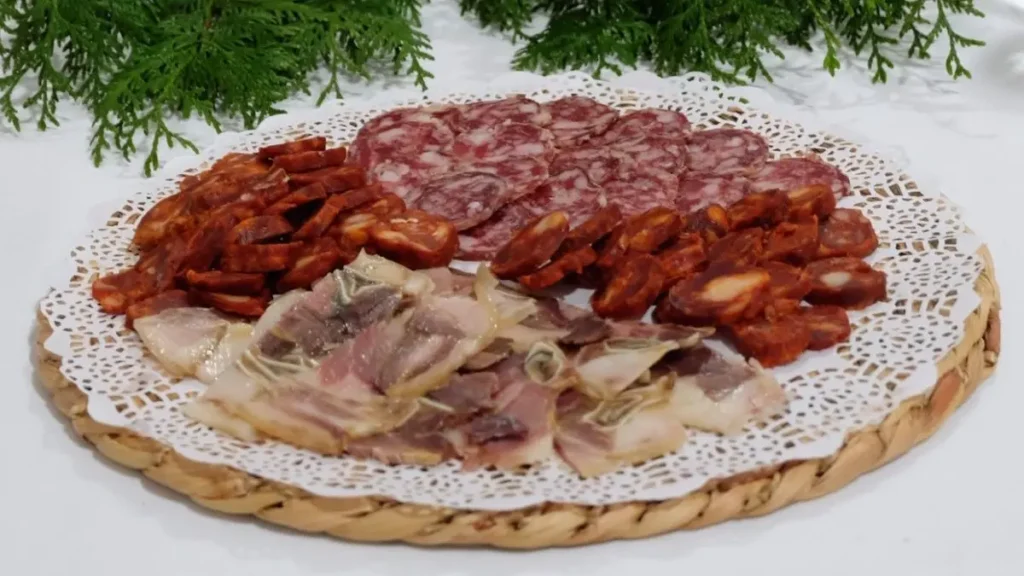
Tres Fuciños operates from Carballedo (Lugo). Pork is sold to order, fresh and cured, and the food truck appears at fairs across the region through the year — the Festa do Cocido do Porco Celta in Carballedo every April is the surest place to find them.
Fire Round
A place
The Cabo do Mundo bend of the Miño — a fantastic stretch.
A wine
A godello. There are several on my mind right now, but godello is my passion.
A route
The whole of Ribeira Sacra has that sense of discovery — but the Pincelo area is the one I love.
A word
Resistance.
A misconception
That Ribeira Sacra is just a pretty place to visit. It’s real life — keeping this territory alive every single day.
All photos courtesy of Tres Fuciños. Not for reproduction without written permission.