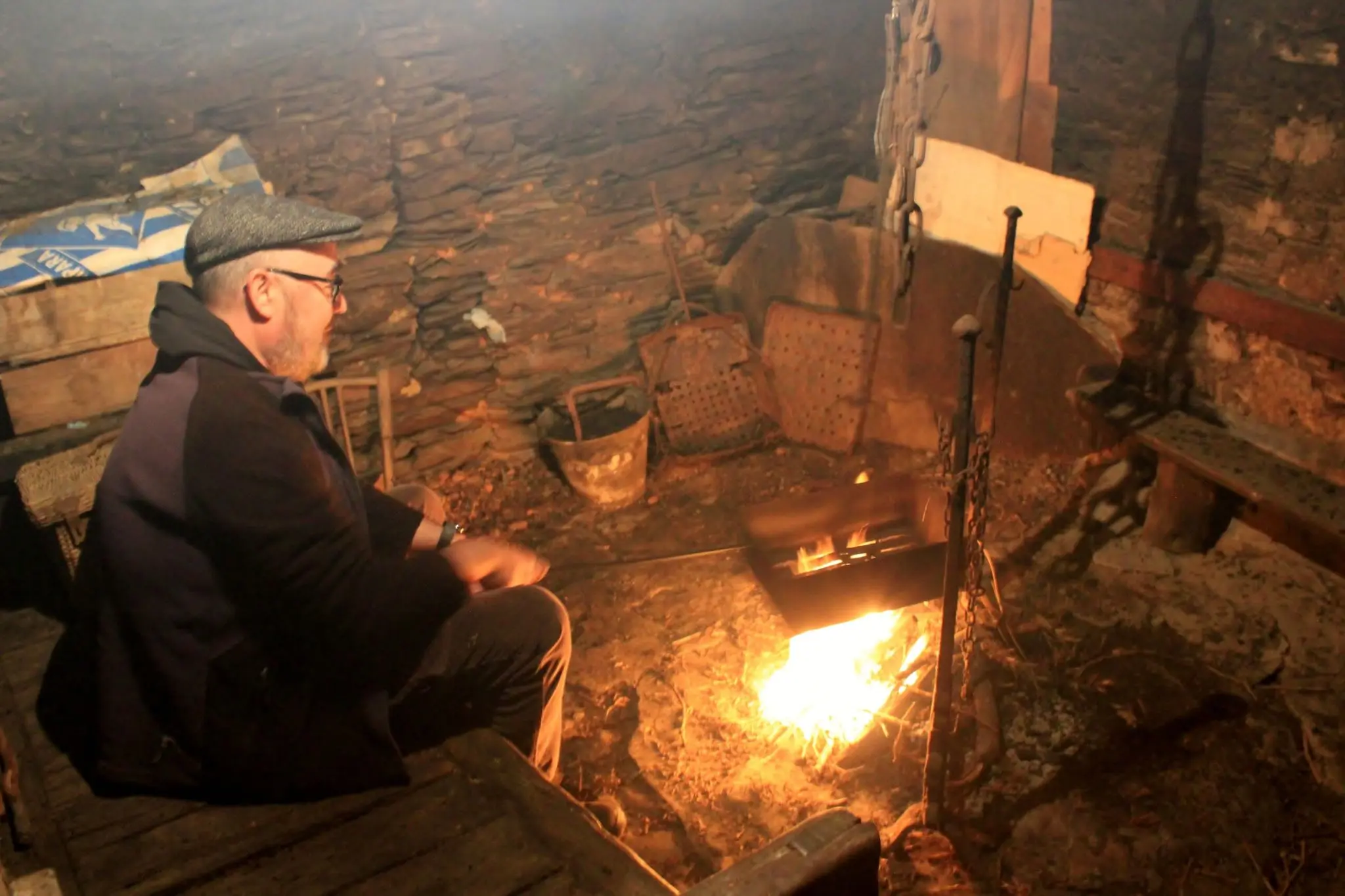
When Víctor took on his sequeiro, the floor couldn’t be seen for soot. He cleared it with a broom and a cloth, which took a week, and for that week he blew black out of his nose. Then he sanded the old wooden screw until it turned again, wired in a light, and stopped there. Everything else is as it was.
A sequeiro dries chestnuts, which was how they were kept through the year: fire below, chestnuts on the floor above, smoke and heat coming up through the boards in between. The ones that get written about stand on their own, two storeys of stone, mostly out in the soutos, the chestnut groves. There someone kept the fire going day and night for fifteen or twenty days, and often lived inside until the job was done. Víctor’s is inside his house, in Os Anguieiros, Quiroga.
The Kitchen Ceiling
His father was born here. Víctor still lives in Madrid, about five hours’ drive away, and comes up on long weekends and in summer; the plan is to retire to the house. “Espero,” he adds: I hope.
The fire in his sequeiro was made straight on the floor, under a pot hung from the wooden screw, which wound it up or down. Above it, in the caniceira, the chestnuts were spread out and turned every day while the smoke came up through the gaps between the beams. Older women used it “until 80-something, 85 maybe”. The caniceira is an attic of bare boards now.
Out in the souto, the chestnuts had a building of their own and someone to sit up with them. In Os Anguieiros they had the kitchen ceiling. The fire that dried them was the fire the meals were cooked on, and the household sat around it as low as it could get, under the smoke.
In another house, the sequeiro takes up a large part of the building, and the room with the fire sits close to the stable. Here someone solved the smoke differently: the caniceira floor is planks laid tight and drilled with rows of small round holes. It is as it was fifty years ago, and half of it is falling in. Having one in the house was normal. Several more survive in the village, most in worse shape, and none was ever shared. More or less, each house did its own.
The Pisa in Purdeus
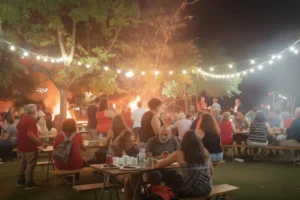
In Purdeus, Parada de Sil, the whole process is staged once a year, in November, at the Festa da Pisa da Castaña. The pisa is the step after the drying: the chestnuts are swung in a sack against a log until the shells give.
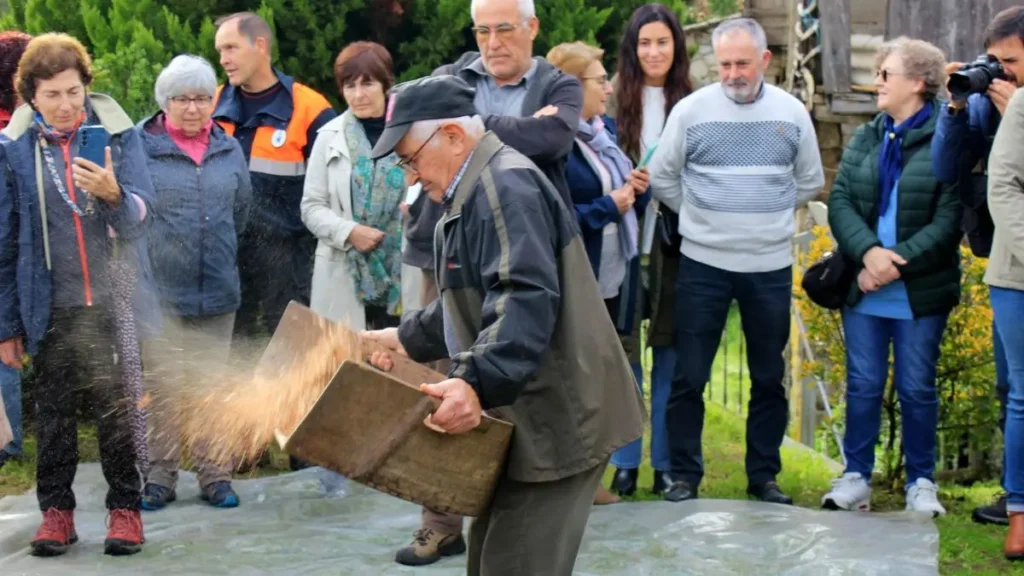
The sack comes out of an upstairs window, filled by the grandfather while his family turns the chestnuts behind him for the visitors. Below, a tarp has been thrown over a log and the crowd takes turns at it, swinging hard. Sack after sack splits open, and the veterans grumble that it isn’t being done properly.
Whatever stays inside ends up in a wide wooden tray, the most filmed part of the day, and a man jerks it until the husks lift off in a brown cloud and drift over the tarp. The chestnuts left behind are cold and hard. Nobody was ever going to eat them; the ones for the cocido at lunch were boiled somewhere else.
Under the trees, between the wine, the cheese and the cured meats, the stalls sell a jar of chestnut cream with orange from A Teixeira and a bica, the Galician sponge cake, from Nogueira de Ramuín, with more wheat flour in it than chestnut.
The Fire He Hasn’t Lit
Víctor would like to cook in his sequeiro again, with embers in the stone oven in the corner. He hasn’t dared. No heat has gone into it for so long that he is afraid the oven will crack. His friend Ramón reminds him that these things were made never to break. “Sí, pero estaban hechas para que se usaran también,” Víctor says. Yes, but they were made to be used, too.
Fire under the caniceira in Os Anguieiros; Shaking off the husks at the pisa in Purdeus — photos by P. Vanossi.