Lucas Vázquez was born in Switzerland, where his family had emigrated, and came to Pantón at eight. When he first went looking for it online, the search engine kept giving him a chair: the Panton, a famous piece of Danish design. About Pantón itself there was almost nothing, and what there was didn’t agree. So he started collecting, and the association he belongs to, Segredos de Pantón, now publishes what it finds with a bibliography attached. It writes for the people who live here, not for visitors.
One of the things it has found is a kind of building no list recognises. Lucas calls them bodegas monumentales, monumental cellars, because most of them are big, and some are huge. They are dug halfway into the slope, built in granite, with a wide door and no windows, only two small vents; hold a hand to one and the air coming out is cold. Most have an upper floor reached from the side, where the ground rises, for baskets and tools. The winemaking itself happened largely outside, so the owners kept large trees beside the door and pruned them year after year for shade and firewood. By his count there are around fifteen in Pantón, in Siós, Vilamelle, Vilar de Ortelle and Atán, and none of them is used.

Four Doors
They are not all alike. In Deade, the Adega de Casdocende rises two storeys under render, its slatted doors shut; inside, the floor is bare rock. In Armental, the Adega da Orde belonged, Lucas says, to the monastery of San Miguel de Eiré. It was built over a stream diverted to run beneath it, and vines are still planted right up to its walls. At the Pazo de Maside the water went the other way, channelled over the top of the cellar to keep it damp.
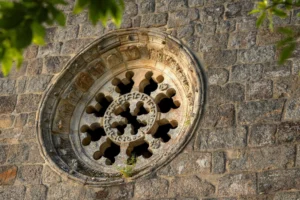
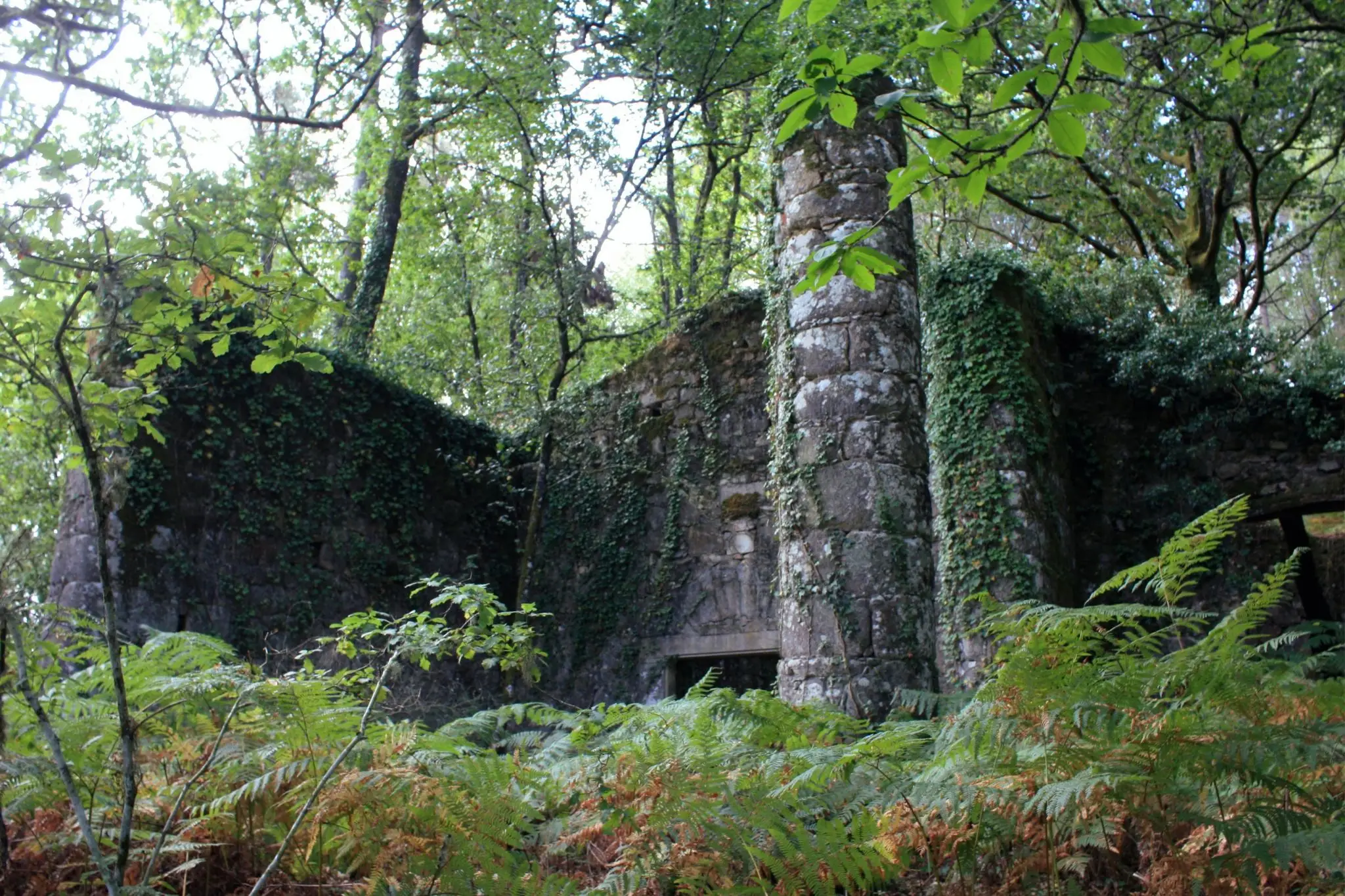
The Adega da Casa da Fonte, in Ferreira, was four times the size of an ordinary cellar and twice as tall, with a pendello, an open shed, as large as a cellar in its own right. The story is that its owner lost it at cards. Today it is a roofless shell among ferns and trees, with a carved oval set into the wall that reads AÑO; the rest has worn away. At Cima de Atán, the cellar is built in slate and dug so far into the hillside that its roof runs down to meet the ground. The aldea has two registered residents.
The largest cellars belonged to big houses and religious orders, and worked as the industries of their day. Siós, Lucas says, sent wine to Lugo, to Ourense and further.
Three Maps
Three different maps of wine cross Pantón, and they don’t agree. The first is the DO’s. The Consello Regulador lists the parishes whose vineyards qualify, and San Xulián de Eiré is not among them. Yet the capitals of San Miguel de Eiré are carved with grapes, and Lucas’s own family in Eiré has always kept vines.
The second is the heritage map. Lucas knows of one cellar, in Ferreira, that appears in the concello‘s planning catalogue, and he counts even that as progress. The rest are on no list he has found.
The third map belongs to the families, and it is the one that has held. Most of the cellars have stayed in the family, kept out of attachment long after the wine stopped. Lucas understands the reluctance to let them go, and knows its cost: everyone wants to preserve, he says, and the building ends in ruin anyway.
On the Map, Off the Map
Some of Pantón’s monumental cellars still make wine. Two of them are known well beyond the concello.
Casa Moreiras, in Siós, is semi-buried, built of local stone, and carries an inscription inside dated 1692, the year the winery gives for its first wine. It has bottled under the DO Ribeira Sacra since 1996, and its tasting room takes visitors by appointment.
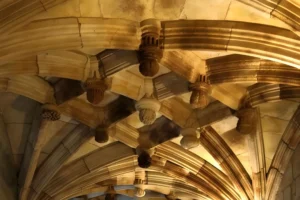
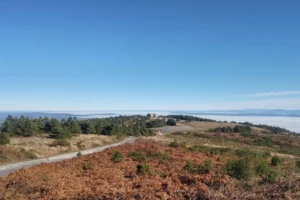
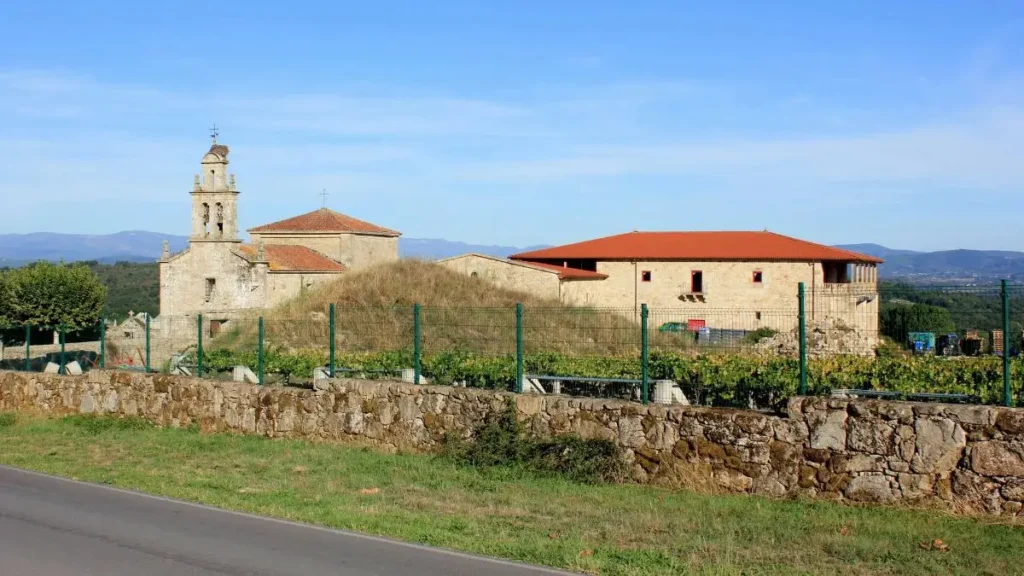
San Martiño de Pantón can’t be visited yet; work on the building is still going on. In 1569 the parish priest, Alonso Ares, gave his house to found a Dominican convent; the friars left for Monforte between 1617 and 1622, and what stayed behind was a barrel-vaulted cellar some fifty metres long and more than seven metres high. The oldest neighbours never saw it working. They remembered 500-litre casks inside, too small for the room. In 2018 Lorenzo López, a hotelier born in Deade who had left at seventeen and made his fortune in Gran Canaria, restored the old rectory for Adegas O Castro. The company holds more than two hundred hectares of its own vines and sells its wine as Alma Gaia, outside the DO. Lucas expects it to become the largest producer in the Ribeira Sacra by some distance. The vault is working again. The gate carries a sign that reads Prohibido el paso, and when we visited, neither the church nor the cemetery beside it could be reached. López died in June 2026.

The First Entry
Lucas’s association is thinking of putting cellars like these to the committee preparing the Ribeira Sacra’s UNESCO file, as one concrete case rather than a general plea. Lucas’s own starting point is a cellar near Siós. The lintel is carved with a name, Pedro Buján, a cross for protection and a year, 1836, which may mark the building or a later repair. A carro do país, the local ox-cart, stands outside under oaks trimmed high by generations of pruning.
The cellar belongs to his grandmother’s family. Lucas learned that only recently, and he has never been inside the cellar itself; to see it, he has to ask an uncle. His partner is studying enology and wants to make the cellar her final project. If she does, it will be the first entry on a list that no institution has yet thought to write.
The Adega da Casa da Fonte, in Ferreira de Pantón; The Adega da Orde, in Armental — photos by L. Vázquez.
San Martiño de Pantón and its vineyards; A carro do país outside the family cellar — photos by P. Vanossi.