The reservoirs reached the Ribeira Sacra in the middle of the last century the way most large decisions reached it then: from elsewhere, on paper, without much consultation. Os Peares closed over the meeting of the Miño and the Sil in 1955. Belesar, taller and thirstier, closed upstream in 1963 and raised the river more than a hundred metres. Behind the walls the water rose over vineyards, ferry landings, mills, chestnut groves and the low houses where families had lived within earshot of the current for as long as anyone could name. More than twenty settlements went under in the space of a season or two — Porto, Pincelo, Mourulle, the old town of Portomarín, and the riverside hamlet of Sernande, where the Casa do Barqueiro had held the concession to row people across the Miño.
Sixty years on, the scale of the loss reads almost as an aside in the record of it. Galicia was poor, the state wanted electricity, and the arithmetic was announced to the drowned parishes rather than argued with them. What survives is mostly in the memory of the old, and in a documentary or two filmed decades later, when a dry summer briefly handed the ruins back. Against that, one decision stands slightly apart. In three cases the same administration that flooded a living valley stopped, drew up plans, and spent real money to lift a building out of the water’s path and set it down again, higher up, one numbered stone at a time.
What Gets Carried
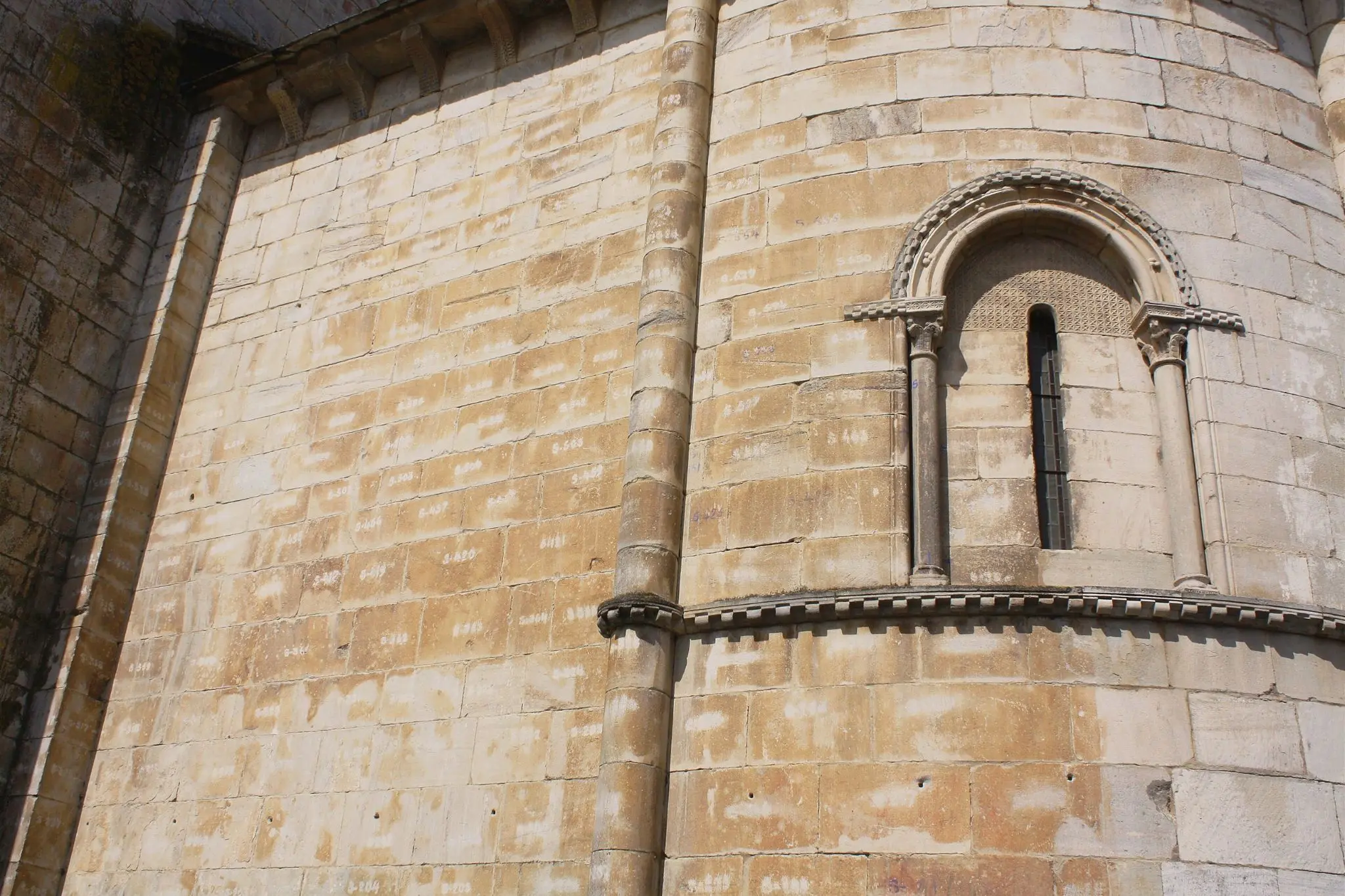
The method had a flat, bureaucratic name — desmonte y traslado, dismantling and relocation — and by the 1950s it was a rare and expensive instrument of Spanish heritage policy. Each stone was drawn, photographed and numbered; the building was taken apart into its pieces, moved uphill, and reassembled above the future waterline. The architect for the Ribeira Sacra cases was Francisco Pons-Sorolla, the state’s man for this kind of salvage across Galicia, and he worked here in quick succession — one church, then a second, then, a decade later, a whole town. Houses could be rebuilt anywhere; a twelfth-century apse could not. The people were relocated and compensated, their villages left to the reservoir; the churches were the one thing treated as beyond replacing. A region wiring itself for the modern age drowned the valley and carried the stone uphill.
San Xoán da Cova
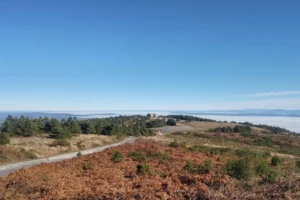
The first and smallest of the rescues was San Xoán da Cova, in the concello of Carballedo — the church where the technique was worked out. Pons-Sorolla drafted its move in 1951 and had the stones reassembled on higher ground by 1953. Its monastery reaches back to the tenth century, dual at first and then female after the papacy dissolved such mixed houses, and the church raised in the early thirteenth century carries ornament from the workshop tradition of Master Mateo, the sculptor of Compostela’s Pórtico da Gloria — echoing the south portal of Ourense cathedral and answering, across the water, the church of Santo Estevo de Atán on the far bank. Rebuilt above the reservoir with its ornate doorway to the west and a plainer one on the north flank, it now stands over the long loop the Miño throws at Cabo do Mundo, one of the most photographed bends in the territory.
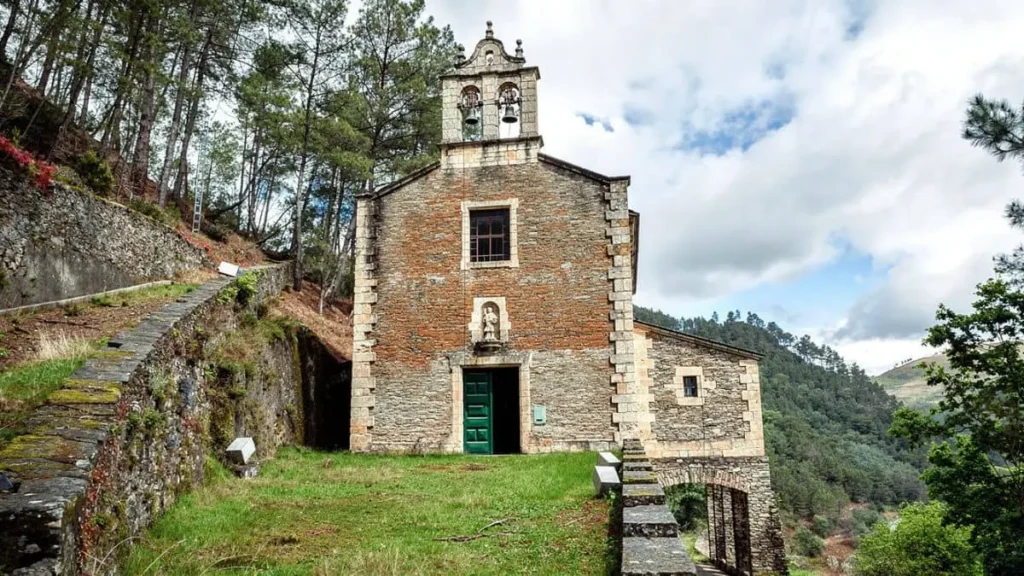
Santo Estevo de Chouzán
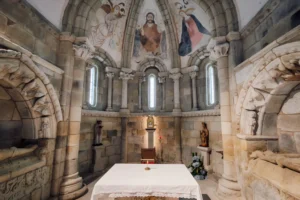
Chouzán followed immediately, in 1953, with the lessons of Cova already in hand — and came through the move more roughly. Its monastery is named in documents from the ninth and tenth centuries; by the twelfth it held a community of women under the same rule as nearby Oseira. When Os Peares threatened it, Santo Estevo de Chouzán was dismantled and carried to higher ground, where a platform had to be built to hold it on the steep new slope. What came back up was partial. The original nave was not rebuilt but replaced outright in modern slate and schist; only the semicircular granite apse, the north door and a handful of carved Romanesque elements were salvaged and set back into the new fabric — along with part of a sixteenth-century Last Judgement, crowded heaven and irreverent hell, that had lined the apse. The seams between rescued and replacement stone are still plain in the wall.
Portomarín, and the Water That Stayed
Both Carballedo churches were, in the end, a rehearsal. A decade on and upstream, Belesar was set to drown not a single church but a whole medieval town on the pilgrim road to Santiago. Working from the numbering method proven at Cova and Chouzán, Pons-Sorolla took down the fortress-church of San Nicolás — a severe, castle-like temple of the Knights of St John, its façade carrying a rose window from the Mateo circle — and rebuilt it on the hill above, at the centre of the new town raised to replace the one the water took, in 1963. It is the same operation at the scale of a settlement, and a fuller story than these pages can hold.
The valley kept the rest. Every few years a hard drought drops the reservoirs and returns, for a few weeks, what they took: the Iron-Age walls of Castro Candaz lifting out of the shallows near Chantada, the foundations of the old Portomarín standing briefly in the mud below the new one, a bridge no one has crossed in sixty years. The three churches never had to wait for a dry summer. They were carried out ahead of the water and have stayed above it — three buildings lifted from a valley that kept almost nothing else, chosen and numbered and rebuilt while the houses around them were left to the Miño.
Portomarín — the numbered stones of San Nicolás, still visible — photo by P. Lameiro.
Santo Estevo de Chouzán, rebuilt on a platform above the reservoir — photo by Lois, edited with AI.