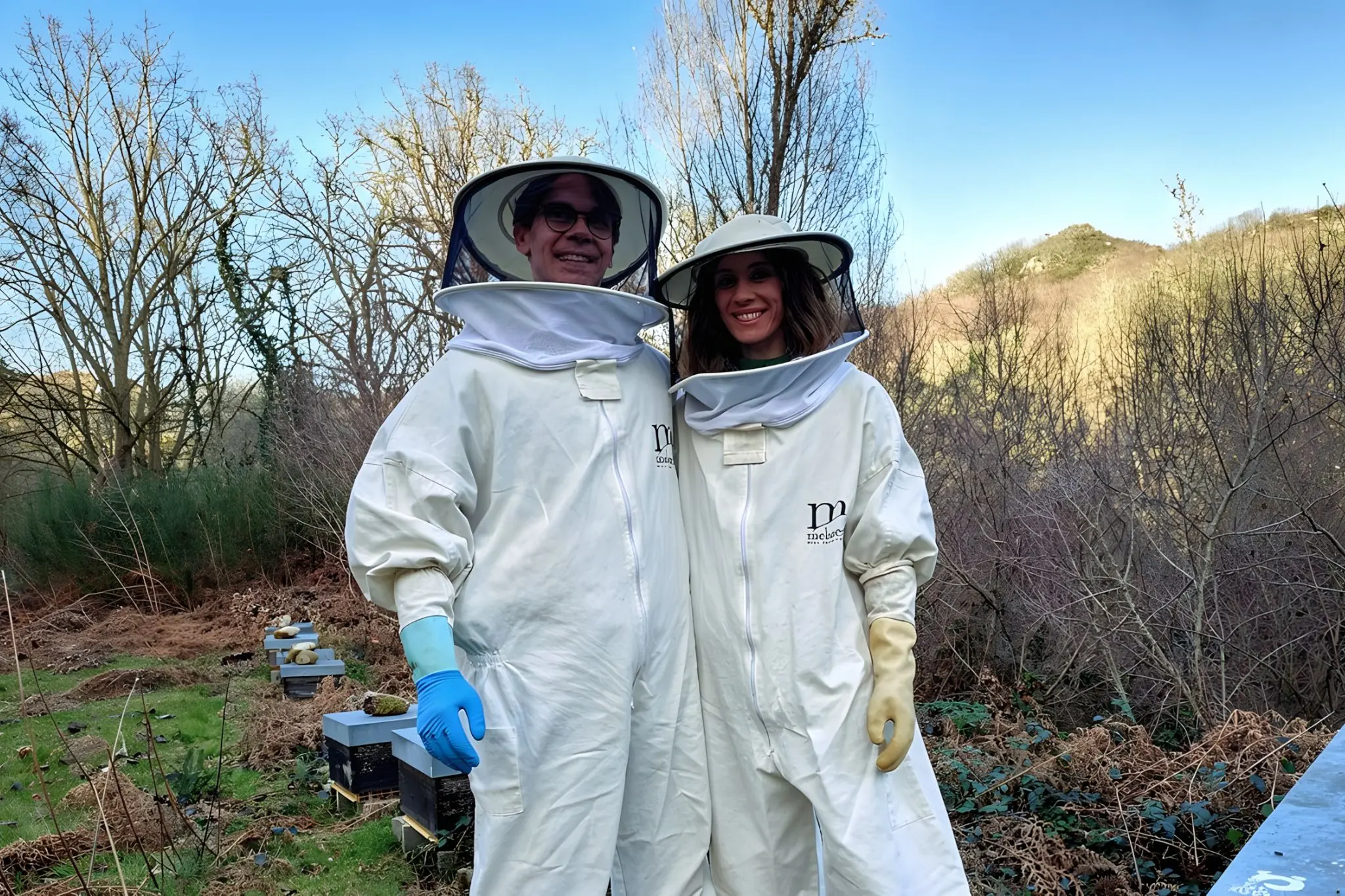
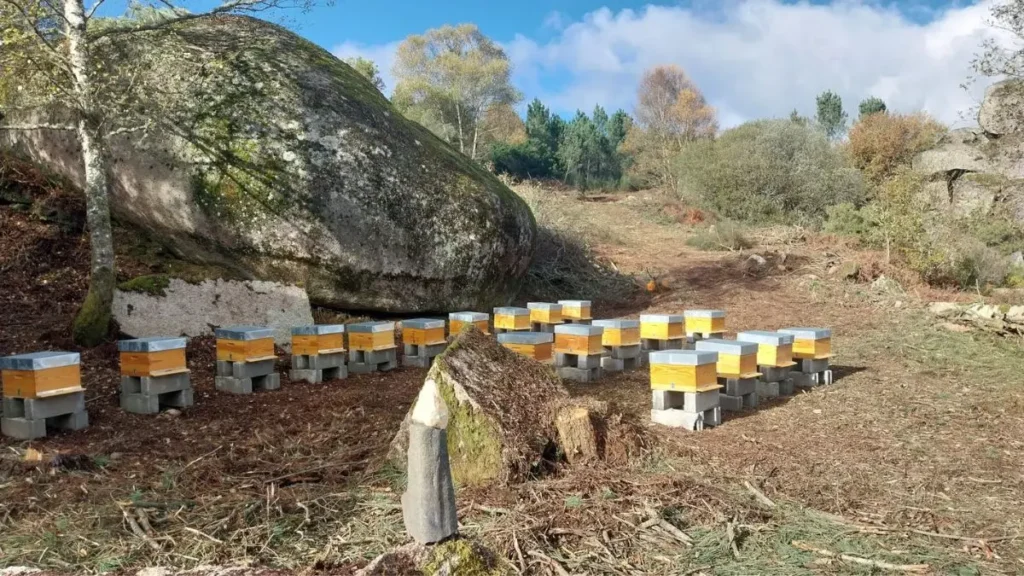
The hives sit in the old chestnut and oak woods of the Ribeira Sacra interior, the same forest a five-hundred-year-old stone enclosure — the Albariza do Vello — was built to guard from bears. Christina works them alongside her brother Carlos under the name Melsacra, a project that began less as a business plan than as a way back. Two siblings who had built separate lives in separate countries returned to the territory their grandfathers had worked, and found their common ground in a beehive. What follows is an argument disguised as a beekeeper’s account: that this is a place to be read slowly, not consumed quickly.
Q. Start with who you are — in your own words.
I’m Christina, a beekeeper by choice and by inheritance. I work with bees because in them I find a way of understanding life — cooperation, balance, respect for natural cycles. The bees teach me that you can’t understand life with your mind. You understand it with your heart.
For me beekeeping isn’t only a productive activity. It’s a way of caring for a territory, of listening to what happens in it, of taking part in something much larger than ourselves. It matters to me because it connects me to my roots, to my family, and to a more conscious way of living, closer to nature.
Q. And how did you get here?
It’s less about where I’m from than where I come from — that’s what connects me to my roots. My story with the Ribeira Sacra began long before I took up beekeeping. My grandfather was a beekeeper, and my happiest memories are tied to the summers I spent here, with my maternal grandmother and visiting my paternal grandfather.
Life took me down other roads, to other places, but some roots never disappear. In time, my brother Carlos and I — we’d built our lives in different countries, on very different paths — felt the need to reconnect with what had once united us. That return happened here, and it took the shape of a beekeeping project we share.
Q. How would you describe this place to someone who’s never been?
My relationship with the Ribeira Sacra is deeply emotional, but practical too. It’s where I work, where I learn from the bees every day, where I feel my roots are still alive.
I’d tell someone who’s never been that it’s a territory that invites you to slow down. There’s an obvious beauty in its rivers, vineyards and mountains, but what moves me most is its quiet energy. It’s a place where you can still sense the relationship between people and the land — where the landscape tells stories of effort, memory and care.
It’s a perfect place to stop and ask where you come from, where you are, and where you actually want to go. It invites you to break inherited structures and patterns, to let your real self come out. The Ribeira Sacra teaches you to see what your eyes can’t.
Q. What does this place have that you haven’t found anywhere else?
Authenticity — the hard-to-find kind. Knowledge passed down across generations still exists here, a real connection to the territory, a less hurried way of understanding time.
Q. And is anything still missing?
Maybe just that it value more fully everything it already has. From the outside, the Ribeira Sacra is sometimes seen only as a tourist destination or a spectacular landscape, when in fact it’s a living territory, full of people who work, who care, who keep alive traditions that have a great deal to teach the present. It’s memory, it’s history. Sit down with the older people in the villages and you’d be surprised by all the stories they have to tell — and you’d feel that connection, that respect for life and for the land.
Q. Tell us about the project — the idea behind it, and what you hope it becomes.
I’m developing a beekeeping project with my brother. The idea comes from wanting to honour a family tradition and, at the same time, rethink how we relate to bees.
We’re after a more loving, careful, respectful beekeeping. We believe it’s possible to find a balance between the bees’ wellbeing and production, without forgetting that they aren’t a tool or a commodity — they’re living beings, fundamental to the ecosystems.
I hope the project keeps growing sustainably, and that it helps build a greater awareness of bees, of biodiversity, and of the value of rural life.
From the outside it’s sometimes seen only as a destination, when in fact it’s a living territory — full of people who keep alive traditions that have a great deal to teach the present.
Q. What’s the hardest part of doing this here?
Nature reminds you constantly that you can’t control everything. The weather, the blooms, disease, changes in the surroundings — all of it demands continuous attention. There’s no Monday and no Sunday. You need a lot of capacity to adapt and organise, reconciling family life with work that asks you to keep watch over not just the bees but everything beekeeping carries with it: keeping the apiaries clean and cleared, cleaning frames, fitting wax, catching a swarm, and then going out to sell.
It’s also a challenge to develop rural projects in places that sometimes lack resources or visibility. But it’s precisely those difficulties that give each small advance its meaning — that make every small step turn the road into something big.
Q. What’s coming next?
We’re in a phase of growth and learning. We want to keep consolidating the apiary, expand the work around outreach, and bring more people closer to the fascinating world of bees and why they matter.
We’re especially interested in creating experiences that help people understand that importance, and that encourage a more conscious relationship with nature and the territory. Rudolf Steiner said the bee settles on every plant and draws the best from each one. In a way we want the same: to leave a seed planted in the hearts of those who come to know us, so they bring out their own best version.
Q. If you could change one thing about how the Ribeira Sacra is perceived, what would it be?
I’d want it to be seen less as a place to consume quickly and more as a territory to listen to, to feel, to understand.
The Ribeira Sacra isn’t only a beautiful landscape; it’s a network of stories, trades, knowledge and people who keep a culture deeply tied to the land alive. The more that human dimension is known, the more this place will truly be valued.
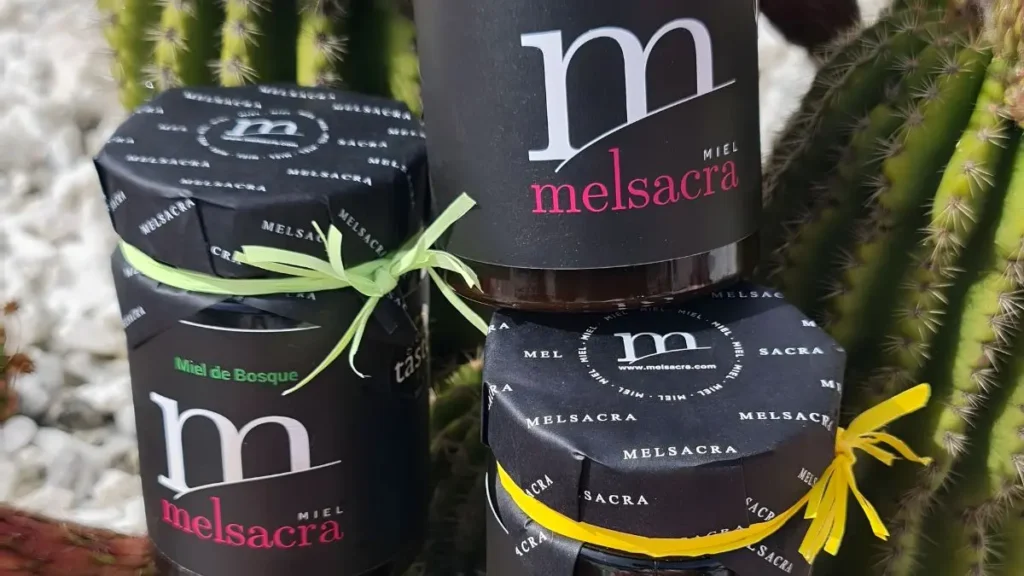
Melsacra’s chestnut and ginger honeys have each taken two stars at London’s Great Taste Awards, the ginger variety once rated best honey in the entire competition.
Fire Round
A place
The best bench in the world.
A dish and a wine
A mencía shared at sundown, looking out over the river.
A route
A kayak on the Sil in the silence of dawn.
A word
Roots.
A misconception
That it’s a place to consume, when it’s a place to listen to.
All photos courtesy of Melsacra. Not for reproduction without written permission.