~24 km drive · 5 stops · ~3 hours · Start: Santo Estevo · End: Parada de Sil
Most people know the Sil canyon from above, looking down at the river held a few hundred metres below the railing — the single frame that has made this the most photographed drop in Galicia. It is a magnificent view, and it rewards the camera. But the canyon has a second life that the long view tends to miss, and it is happening overhead. Driven slowly, with a few unhurried stops along the southern rim, this stretch turns into something closer to a morning spent watching the air.
The drive begins by descending. From Luíntra you take the OU-0508 toward Parada de Sil and turn off onto the narrow road that drops to the monastery of Santo Estevo de Ribas de Sil, now a parador, set partway down the canyon flank in deep chestnut and oak. The road is a near-empty tunnel of trees, and this is already the first habitat: forest air, close and shaded. A peregrine may cut across the gap where the canopy opens; over the slope you might catch a black kite or, in summer, the broad lazy circles of a honey buzzard riding the warm air off the rock. The monastery itself is worth the stop — three cloisters, freely open most of the year — though on this drive it serves best as a place to stand under the chestnuts and listen upward.
Then the road climbs back out and runs the rim eastward, and the air changes with it. The shaded forest gives way to the open thermal column that the gorge funnels straight up the cliff face, and the birds change too. This is where the route settles into its real rhythm: four viewpoints strung along the southern edge above Parada de Sil, each a slightly different angle on the same wall of rock and the same volume of moving air.
The Miradoiro da Ribeira Sacra comes first, the widest opening. Then come La Columna and Cabezoás, barely eight hundred metres apart and easiest taken as a single long pause. Stand at the edge in mid-morning, on a clear, still day, and give it twenty minutes. The peregrine works this stretch reliably; a goshawk may slip along the tree line behind you, a quieter bird that rewards anyone still looking. Stop, wait, and let the eye drift up rather than down.
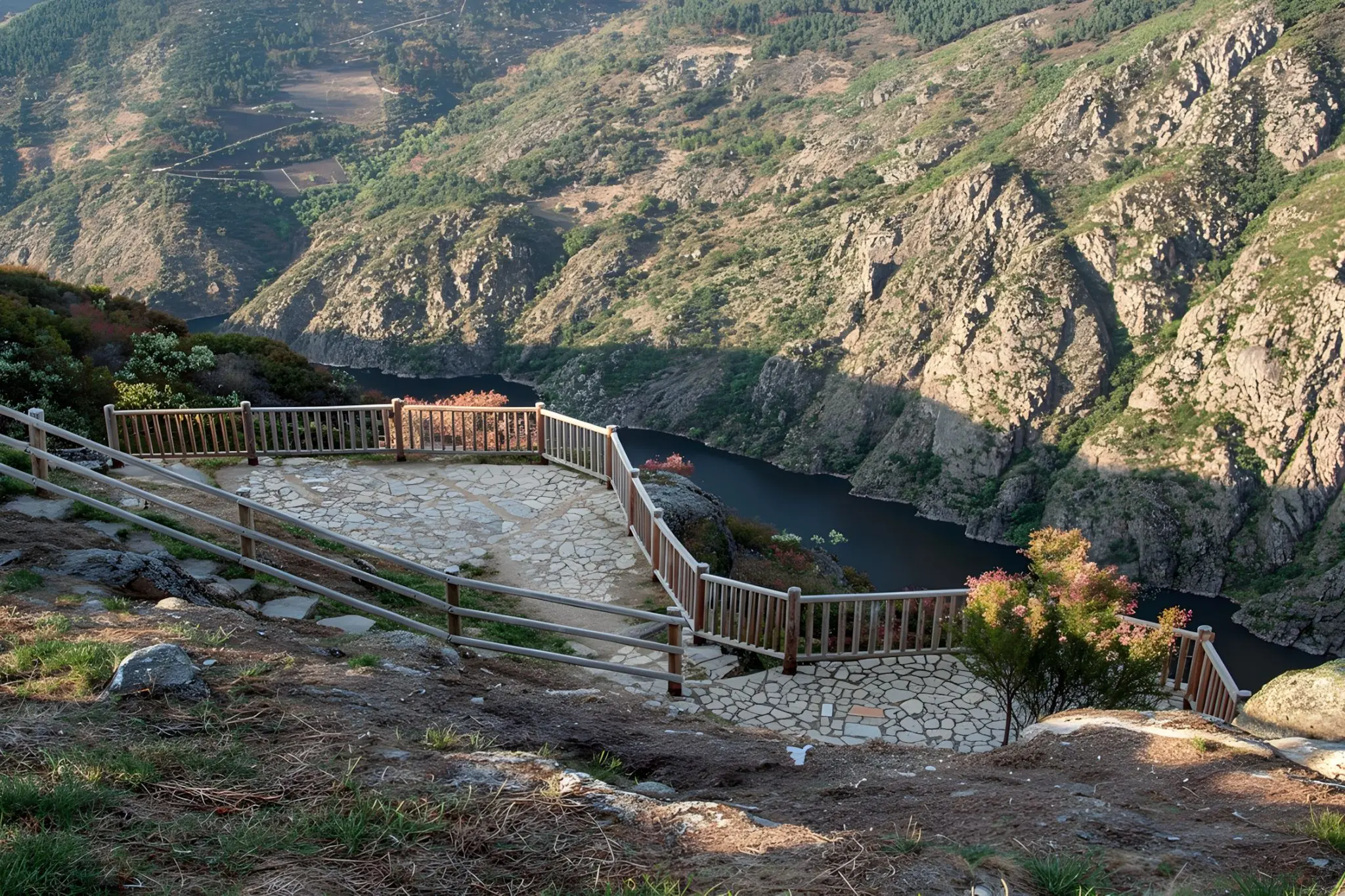
The drive ends at Los Balcones de Madrid, the last and most open of the four — a sheer drop where the canyon opens to its full vertical scale. Peregrine again, and in summer the pale underwings of a booted eagle hunting the thermals. It is also walking distance from Parada de Sil itself, where a few bars wait with the coffee the morning has earned.
The species named here follow the official birding itinerary for the Cañón do río Sil. A few practical notes to make the most of it: mornings are best, as the thermals build from mid-morning to early afternoon and that is when the raptors are up and working, and a clear, calm day keeps them high and soaring rather than low and hidden. The loop is barely twenty-four kilometres, short by design — the brevity is what leaves room to linger at each edge and let the air come to you. The monastery closes for a variable holiday period between January and February, worth confirming before a deep-winter visit. Beyond that, nothing special is needed: no hide, no permit, no target list. Just the over-known canyon, given the time to show its other half.
Mirador de Los Balcones de Madrid/Os Torgás, Sil canyon — photo by amaianos, edited with AI.